



V16 Mobile Sign Trolley – Chevrons Left, Class I
- Work zone auxiliary device V16 “Mobile sign trolleys”, to SR 1848-1:2024.
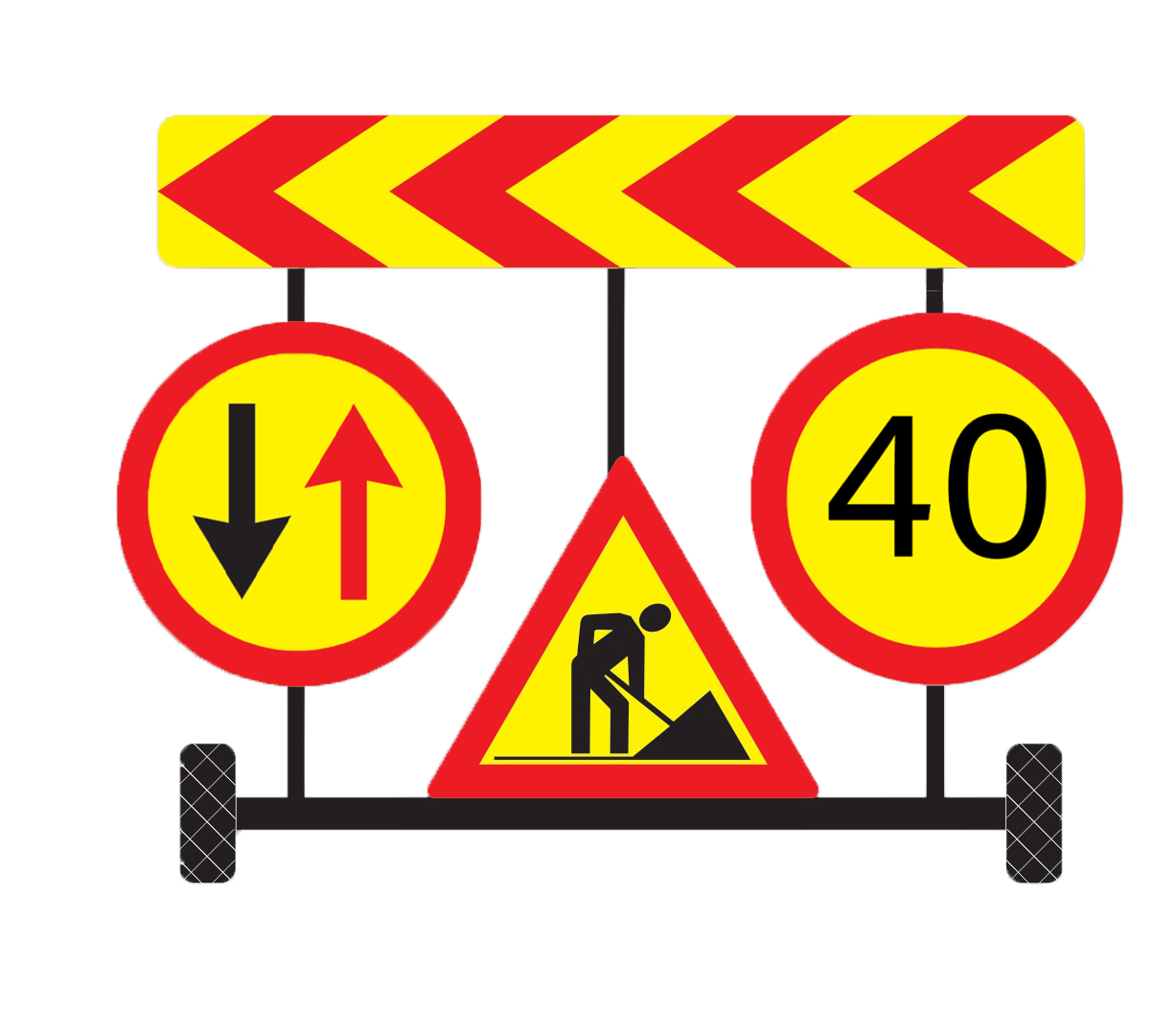
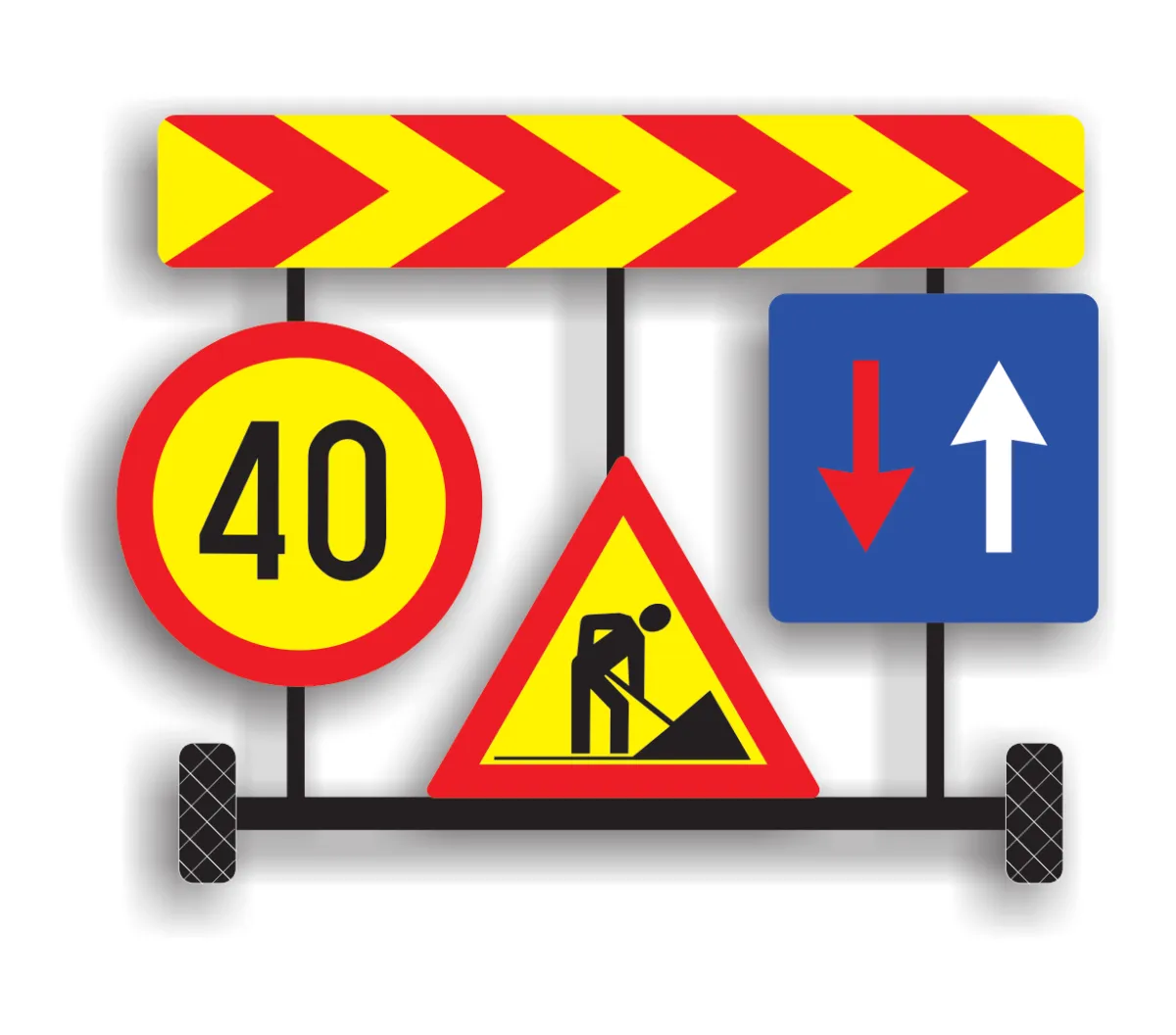
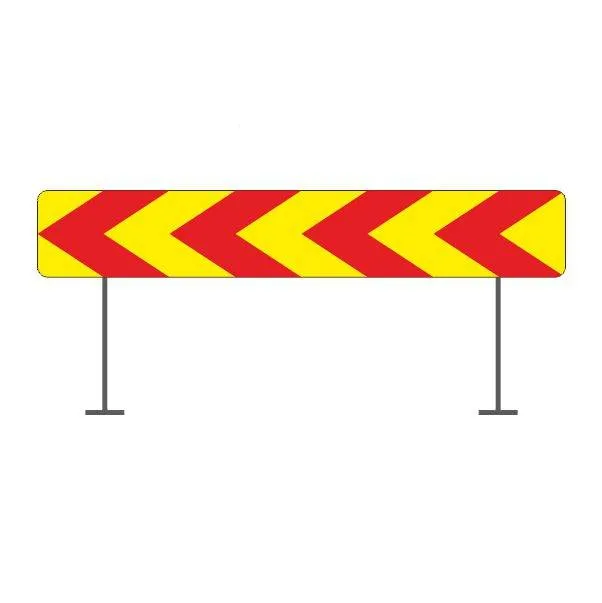
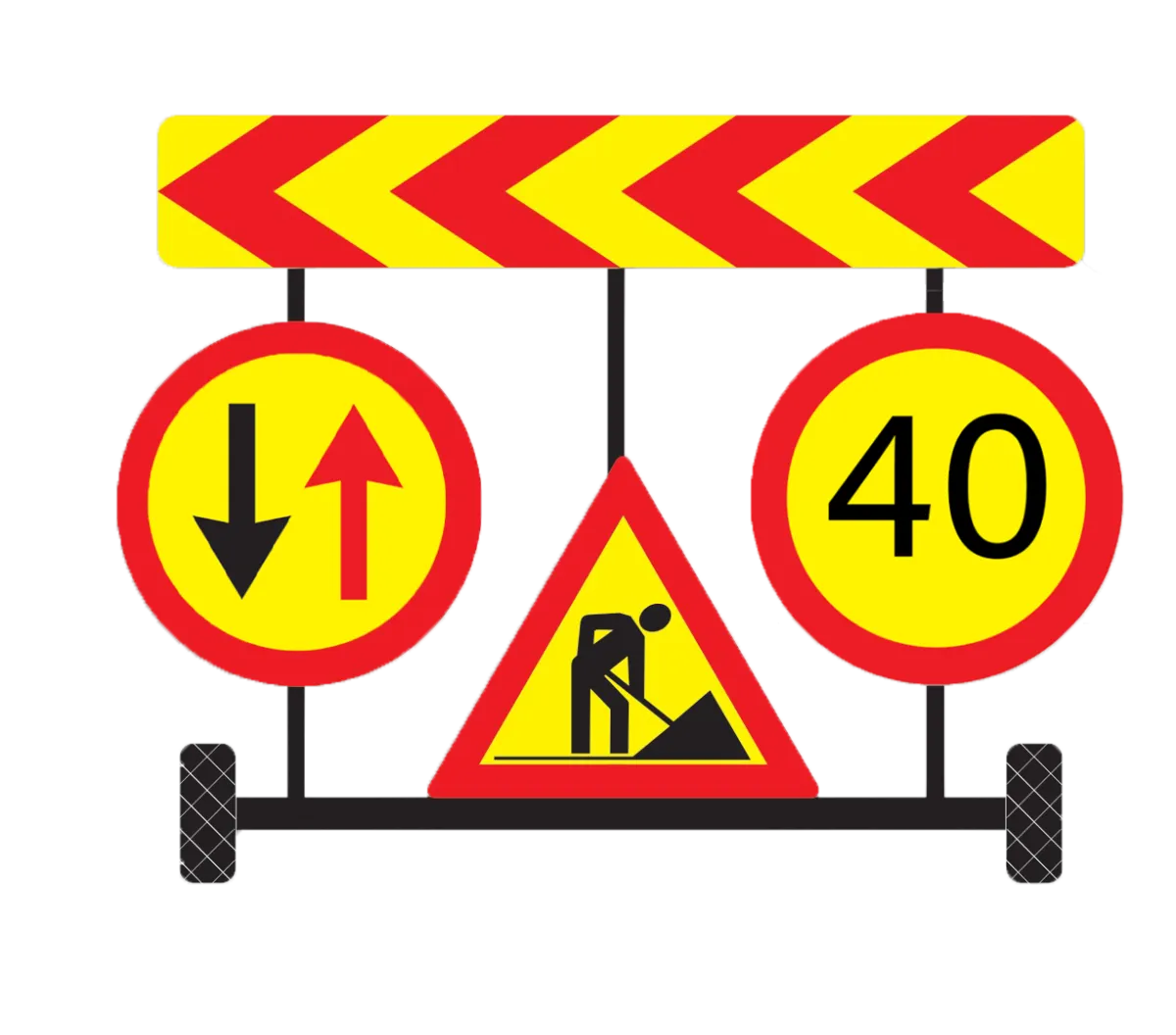
- Directional barrier board, 40 km/h speed limit, “Roadworks” and a priority sign, on a wheeled trolley.
- Class I (RA1) retroreflective sheeting.
- For work points that move during the day.
Complementary products
General features
| SR 1848-1 code | V16 |
|---|---|
| Name in the standard | Mobile sign trolleys |
| Type | Work zone auxiliary device |
| Contents | Wheeled trolley carrying a directional barrier board with chevrons to the left, a 40 km/h speed limit sign, the “Roadworks” sign and the yellow priority-for-oncoming-traffic disc |
| Material | Galvanised steel sheet, 1 mm |
| Retroreflective sheeting | Class I (RA1) |
| Retroreflection (white, 0.2°/5°) | 70 cd/(lx·m²) |
| Sheeting service life | 7 years (SR 1848-2) |
| Standards | SR EN 12899-1:2007, SR 1848-1:2024, SR 1848-2:2011, SR 1848-3:2011 |
| Weight | 31 kg |
| Length | 200 cm |
| Height | 140 cm |
Product description
V16 Mobile Sign Trolley – Chevrons Left, Class I
The counterpart of the right-chevron trolley: here the directional board points left, and the trolley carries the 40 km/h limit, the “Roadworks” sign and the yellow disc requiring drivers to give way to oncoming traffic. The sheeting is class I.
When class I is used
Class I (RA1) retroreflective sheeting is the basic class in SR 1848-2, with a 7-year service life. For roadworks, the standard requires temporary signs to have at least the class of the permanent signing on the section, so the class I version is used where the existing signs are class I too, typically on county and local roads and on streets without strong lighting.
Where it goes, under SR 1848-1:2024
SR 1848-1:2024 provides mobile sign trolleys for places where work points that move gradually during the day must be signed. The two versions, with chevrons to the right and to the left, are used at the opposite ends of the alternating-traffic section: one for the direction with priority, the other for the direction that gives way.
What the roadworks rules require (Order 1112/411/2000)
The rules treat mobile work sites, which move along the road, as a case of their own. The trolley keeps the signing next to the work point as it moves forward; its directional barrier board belongs to the signing that marks the works, and the rules require barrier boards to carry yellow-red retroreflective sheeting even where the existing signing is not retroreflective.
For alternating one-way traffic, the rules allow three systems: priority signs, traffic marshals (with paddles such as the V12-20) or traffic lights for automatic control (for example the V11-20 portable lights), supplemented with priority signs. The system is chosen by traffic volume and the length of the section; alternating traffic cannot be organised on a work section longer than 1,200 m, and control by priority signs alone requires visibility between the two ends of the works.
On public roads, works are signed under the methodological rules approved by Order MI/MT no. 1112/411/2000. The road closure or traffic restriction is approved by the road authority, with the traffic police's agreement, on the basis of a signing layout endorsed as final, a copy of which the contractor keeps at the work site. The contractor installs, completes and maintains the signing for the whole job, removes it at the end and restores the original signing; accidents caused by incomplete or missing temporary signing are entirely the contractor's responsibility.
At night, if the existing signing on the road is retroreflective, the temporary signing must be retroreflective too and can be supplemented with flashing or sequential (“cascade”) amber lamps; on main and connecting streets in towns, retroreflective temporary signs are supplemented with flashing amber lamps.
Technical data
- wheeled trolley carrying a directional barrier board with chevrons to the left, a 40 km/h speed limit sign, the “Roadworks” sign and the yellow priority-for-oncoming-traffic disc;
- signs in 1 mm galvanised steel sheet;
- class I retroreflective sheeting (RA1), with a 7-year service life;
- compliant with SR EN 12899-1:2007, SR 1848-1:2024, SR 1848-2:2011 and SR 1848-3:2011.
Use
The trolley moves with the work point, so the signing does not have to be taken down and put back at every move.
? Frequently asked questions
Where does it go?
SR 1848-1:2024 provides mobile sign trolleys for places where work points that move gradually during the day must be signed. The two versions, with chevrons to the right and to the left, are used at the opposite ends of the alternating-traffic section: one for the direction with priority, the other for the direction that gives way.
When is the trolley used?
At work points that move gradually during the day, such as maintenance works along the road: the signing moves with the crew, without being taken down and put back at every move. Like all temporary signing, it is used to the layout approved by the road authority with the traffic police's agreement.
When can class I sheeting be used for roadworks?
Where the permanent signing on the section is class I too and there are few light sources. SR 1848-2 requires temporary signs to have at least the class of the existing signing, and in areas with street lighting, shop windows or advertising it requires prismatic class 2 or 3 sheeting.
Which signs are on the trolley?
The directional barrier board with chevrons to the left, the 40 km/h speed limit sign, the “Roadworks” sign and the yellow priority-for-oncoming-traffic disc, all with class I retroreflective sheeting, mounted on a wheeled trolley.
Who is responsible for the work-zone signing?
The contractor. Under Order MI/MT no. 1112/411/2000, the contractor installs the signing to the layout approved by the road authority with the traffic police's agreement, keeps a copy of the approval and the layout at the work site, maintains and completes the signing for the whole job and removes it at the end. Accidents caused by incomplete or missing temporary signing are entirely the contractor's responsibility.
Ordering and delivery
Can I order as a private individual?
Yes. You order directly on the site, as an individual or a company, and pay by card or cash on delivery.
Do I get an invoice?
Yes. Every order comes with a tax invoice, issued to an individual or a company.
Can I buy through SEAP / SICAP?
Yes. Public institutions find us in SICAP as S.C. ATTO REGAL S.R.L. Our company details are on the Purchase through SEAP / SICAP page.
How long does delivery take?
We deliver by courier within 24-48 hours.
Can I return the product?
Yes. As a private individual you can return the product within 14 days of receiving it, as the law provides, and you get your money back within 14 days of telling us. Return shipping is paid by the customer. The full terms are on the Return policy page.
Other similar models


Get a personalised offer, transport included.
Sending this form is not an order.
 V16 Mobile Sign Trolley – Chevrons Left, Class I (V16s)
We will send you the offer, transport included, as soon as possible by email or phone.
In road safety since 1998
Atto Trafic supplies complete road signage and safety equipment — signs, traffic signs, markings, parking barriers, speed bumps, mirrors, bollards and accessories.
- Durable products, compliant with STAS and SR EN
- ISO 9001 / 14001 / 27001 / 20671 certified
- Constant stock, delivery within 24-48 hours
- Support for municipalities, contractors, private car parks