












Road marking paint calculator
Find out how much paint, how many buckets and how many glass beads your marking needs. Line sizes follow SR 1848-7; consumption is the figure from each product data sheet.
1Choose the material
Sprinkled on the fresh paint; the dose is the one in the data sheet.
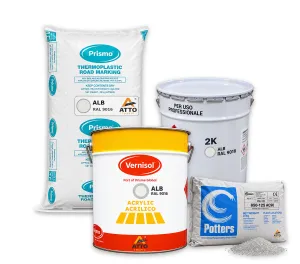
Applied first, on the same area: 250–300 g/m², 5 l cans.
For a different coat than the data sheet, e.g. from your project specification.
2What are you marking?
Where the figures come from
- Line widths, dash and gap lengths: SR 1848-7:2015 — figure 1 (longitudinal lines A–I), figure 23 (edge lines K–N), 3.3.3 (stop line 0.40 m), figure 27 (give-way line 0.40 m, 0.8 m / 0.4 m), figure 29 (pedestrian crossing: 0.40 m stripes, 0.60 m apart, 3 m or 4 m long), figure 46 (parking spaces 2.5 × 5 m).
- Consumption per m² and glass-bead dose: the technical data sheet of the chosen product (see the product page).
- Two-component (2K) paint: the data sheet gives 1.5–2 kg/m² for the roller-applied coat and a density of 1.8 kg/l. A 1 mm coat is therefore 1.8 kg/m², and 2 mm and 3 mm coats are 3.6 and 5.4 kg/m² (thickness × density).
- The result is theoretical. On porous asphalt or with manual application the real consumption is higher, so choose a reserve.
- Type I / type II (SR 1848-7): a type I marking has no requirement for retroreflection in wet or rainy weather; a type II marking has (usually a structured marking in cold plastic or thermoplastic). 1K paint makes type I markings only. Both types must be visible at night, so glass beads are used on public roads.
- The primer (ATP PRIMER) goes on concrete and on very old or polished asphalt, before the paint: 250–300 g/m² theoretical, from its data sheet (more may be needed by hand).
- Preformed thermoplastic markings are counted in pieces. Their primer is worked out on the area of each marking (the whole line or square; for the road symbols, their shape: triangle, ellipse or octagon) × 250–300 g/m². It goes on first on concrete, on smooth or old asphalt and over old paint; new asphalt needs none.