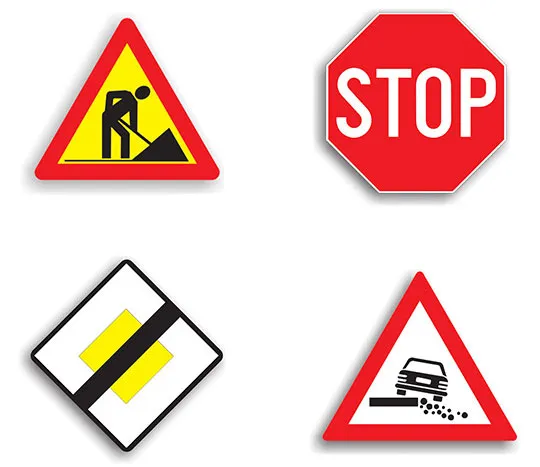
The STOP sign, B2 “Stop” in SR 1848-1:2024, is the metal sign we sell most often. It goes at junctions, at the exits of company yards and on the lanes between blocks of flats. To choose the right one you need to answer three questions: which size, which sheeting and which post. All three depend on the road the sign is going on.
What the B2 sign requires
The red octagon with STOP requires a complete stop, even if the road looks clear. It goes where drivers cannot see traffic on the priority road until they have stopped. It is the only octagonal sign, so it is recognised at once, even when the lettering is covered in snow.
Four versions: size and sheeting
- B2: 60 cm, Class I sheeting, 3 kg;
- B2_80_I: 80 cm, Class I sheeting, 5 kg;
- B2_80_II: 80 cm, Class II prismatic sheeting;
- B2_II: 100 cm, Class II prismatic sheeting.
All are made of 1 mm galvanised steel with rounded corners and pressed edges, no sharp rims, powder-coated with UV-resistant paint. They carry the CE mark and comply with SR EN 12899-1:2007, SR 1848-1:2024, SR 1848-2:2011 and SR 1848-3:2011.




Which size each road needs
SR 1848-2 ties the format to the category of road and forbids a smaller format than the road requires.
- 60 cm, small format (B2): low-traffic local roads and short-term police signing. It also suits private premises, car parks and yards. At 60 cm the white border is 7 mm and the STOP letters are 225 mm.
- 80 cm, normal format (B2_80_I, B2_80_II): county and commune roads, streets and private roads open to public traffic. At 80 cm the border is 9 mm and the letters are 300 mm.
- 100 cm, large format (B2_II): national roads. Motorways require the 120 cm format.
Class I or Class II
Class I sheeting (RA1) returns 70 cd/(lx·m²) for white to the driver and has a 7-year service life. It is enough on roads where headlights are the only light: commune, local and private roads or quiet streets.
Class II prismatic sheeting (RA2) returns roughly three to four times more light, so the sign is seen from further away at night and stays legible when viewed at an angle. Its guaranteed service life is 10 years. In areas with street lighting, shop windows, advertising and in built-up areas, SR 1848-2 requires Class 2 or 3 prismatic sheeting, because a Class I sign gets lost against the lit background. More on the difference in our article on Class I and Class II.
Where it goes under SR 1848-1:2024
- On the public road or cycle track without priority, at junctions without guaranteed visibility, or where a cycle track or cycle road meets the carriageway.
- As close as possible to the edge of the priority road, but so that stopped vehicles do not block pedestrians crossing.
- At crossings with a railway without barriers, other than an industrial line, where it goes with the A47 or A48 cross.
- The face of the sign must not be visible from the priority road.
- At acute-angle junctions the sign is set back from the edge of the priority road; if the setback exceeds 10 m, the additional panel P4 with the distance goes under it.
B2 can be announced in advance by an identical sign with the P4 panel, which shows the distance in metres to the edge of the road being joined.
Which post and at what height
The post fixings come with every version: 2 clamps for a Ø48 mm post and 4 bolts with nuts. Clamps for a Ø60 mm post are available on request. The post is ordered separately, depending on where the sign goes:
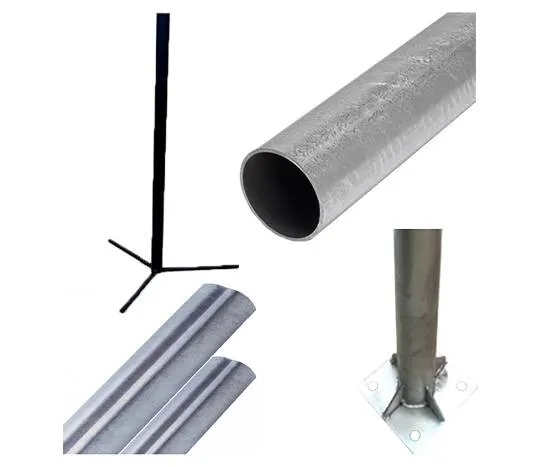
- fixed, with a concrete foundation: ATT 48x2_3, galvanised post Ø48 mm, 300 cm;
- temporary, no foundation: ATZ M12048, tripod post Ø48 mm, 120 cm;
- on concrete or paving where you cannot dig: ATZ M300, flanged post Ø60 mm, 300 cm, bolted down; ask for the Ø60 mm clamps when you order.
The bottom edge of the sign goes 1.50–2.50 m above the road or the kerb, and the edge nearest the road 0.50–2.0 m from the road platform. When several signs share a post, priority signs go above mandatory signs.
What to buy, in short
- Yard, car park or private premises: B2, 60 cm, Class I.
- Street or commune road without strong lighting: B2_80_I, 80 cm, Class I.
- Street with street lighting, shop windows or advertising, busy county road: B2_80_II, 80 cm, Class II.
- National road: B2_II, 100 cm, Class II.
What to order for a whole junction
Besides the sign you need a post, and sometimes other signs. For each road without priority entering the junction, count as follows:
- one B2 sign on each arm without priority, in the size the type of road requires;
- one post for each sign, chosen by where it goes: galvanised for a concrete foundation, tripod for temporary works, flanged on concrete or paving;
- if you choose the Ø60 mm flanged post, ask for the Ø60 mm clamps instead of the Ø48 mm ones when you order;
- at a level crossing with a railway without barriers, the A47 cross for a single line or the A48 for a double line, alongside the B2;
- if the B2 is announced in advance or set back by more than 10 m, the additional panel P4 with the distance.
Common mistakes
- 60 cm on a public street. The small format is for private premises, yards and low-traffic local roads. Streets and county and commune roads require the normal format, 80 cm.
- Class I in town, under street lighting. In an area with street lighting, shop windows and advertising, SR 1848-2 requires Class 2 or 3 prismatic sheeting. A Class I STOP sign gets lost there against the lit background.
- Forgetting the post. The pack has the clamps and bolts, not the post. Add it to the same order so you can fit the sign as soon as it arrives.
- The wrong clamps. The standard clamps are for Ø48 mm. On a Ø60 mm post, such as the flanged one, you need the Ø60 mm clamps, which you ask for when ordering.
- The face visible from the priority road. The sign faces the road without priority, so drivers on the priority road do not see it and do not think it applies to them.
Frequently asked questions
How big is a STOP sign?
The size is the height of the octagon: 60 cm (small format), 80 cm (normal format) or 100 cm (large format). Motorways require 120 cm.
Which STOP sign do I put at the exit from our company yard?
For private premises or a yard, the B2, 60 cm, is enough. If the exit opens onto a street with street lighting and advertising, where the sign must stand out at night, Class II sheeting is worth it.
Is the post included?
No. The fixings are included, 2 clamps for a Ø48 mm post and 4 bolts with nuts; the post is ordered separately.
How long does the sheeting last?
Class I sheeting has a 7-year service life, and Class II prismatic sheeting a guaranteed 10-year service life.
How high is it mounted?
The bottom edge 1.50–2.50 m above the road or the kerb, and the edge nearest the road 0.50–2.0 m from the road platform.
How much does it weigh?
The B2, 60 cm, weighs 3 kg, and the B2_80_I, 80 cm, weighs 5 kg.
How we can help
All versions are under priority signs, and delivery takes 24-48 hours. If you are signing a whole junction, tell us what kind of road it is and how the roads meet, and we will put together the list of signs, posts and fixings. For the other signs, see our guide to metal road signs.