

A car parked in front of the gate, a yard that lorries use for just one week, a space kept free for a house move or a pothole on the car park lane that will only be fixed tomorrow. Each time you need a sign today, for a few days, and after that you put it away. That is what threaded plastic signs are for: you screw them onto a cone or a mobile post, move them with one hand and take them off without tools. This guide explains which signs there are, where they are used, what they fit on and how to put them together to sign a car park or a short job.
What threaded plastic signs are
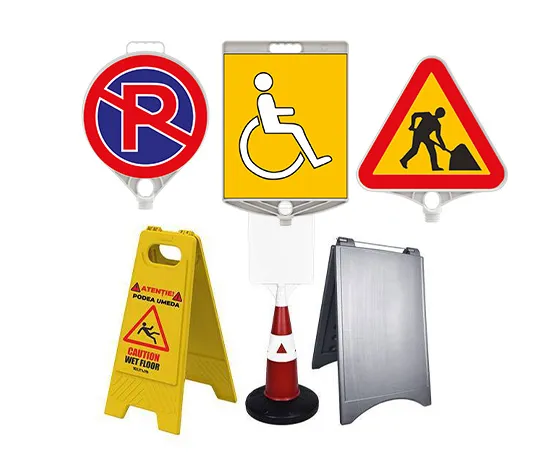
They are small signs with the symbols every driver knows: STOP, no parking, the letter P, the road works triangle. The round discs are Ø28 cm, the triangles are 39 cm tall and the parking panels are 34 x 40 cm. They are made of PPC plastic (the 30 km/h sign is polypropylene), have honeycomb reflective sheeting, a handle at the top and a spigot with a 35 mm thread at the base. They weigh between 0.35 and 0.75 kg and do not rust.
For private areas and temporary signing
They belong in private car parks, company yards, campuses, on housing estate lanes, in warehouses, at events and around short jobs. They are for signing that changes: a work zone that moves from one day to the next, a lane closed for cleaning, a space reserved for a delivery. Even in a private yard, for a space reserved long term, the plastic panel stands in until a fixed sign goes up.
On public roads, permanent signing is done with metal signs, not with these. When the works are on a public road, the traffic plan says which temporary signs go up and in what order; the details are in our guide to signing road works with U signs.
Which signs there are and what each one is for
No parking, in two sizes
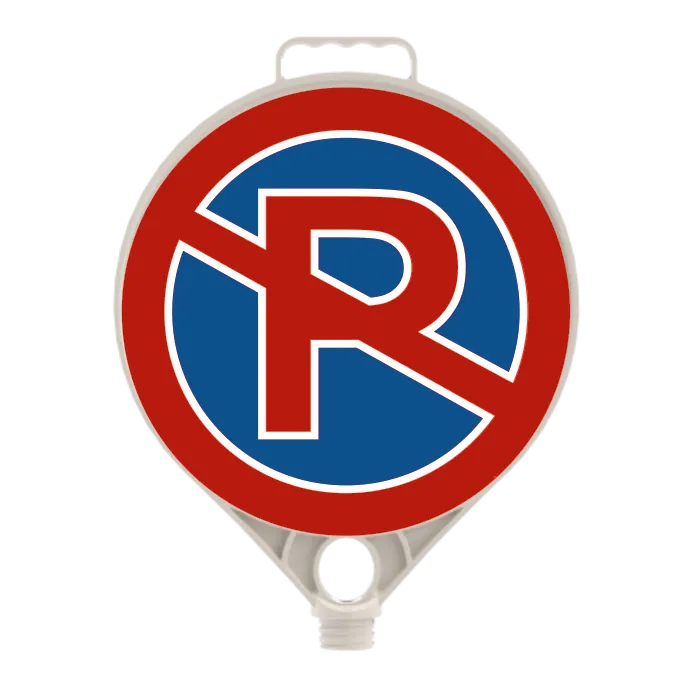
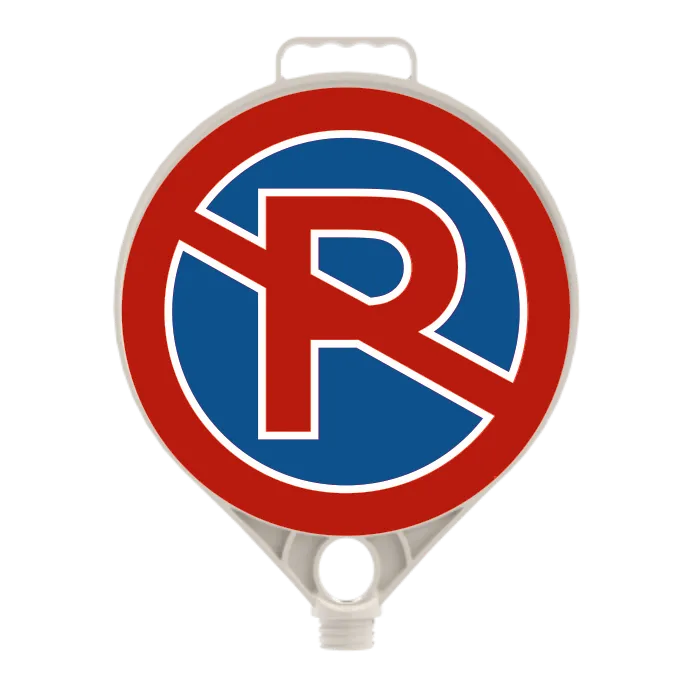
This is the most searched-for sign in the range, because it solves the most common problem: a car parked exactly where it should not be. The disc has a blue background, a red border and a red diagonal bar.
- ATZ 545: Ø28 cm, 0.35 kg; for garage gates, service entrances, ramps, hydrants and spaces kept free for a move or a delivery;
- ATZ 645: Ø38 cm, 0.75 kg; for the entrances of large car parks, private streets, industrial gates, warehouses and office buildings, where vehicles come faster and the sign has to be noticed in good time.
The small disc reads well from close up. The large one reads from the driver’s seat, especially on a 120 cm mobile post, which lifts it to the driver’s eye level.
Parking and disabled parking spaces
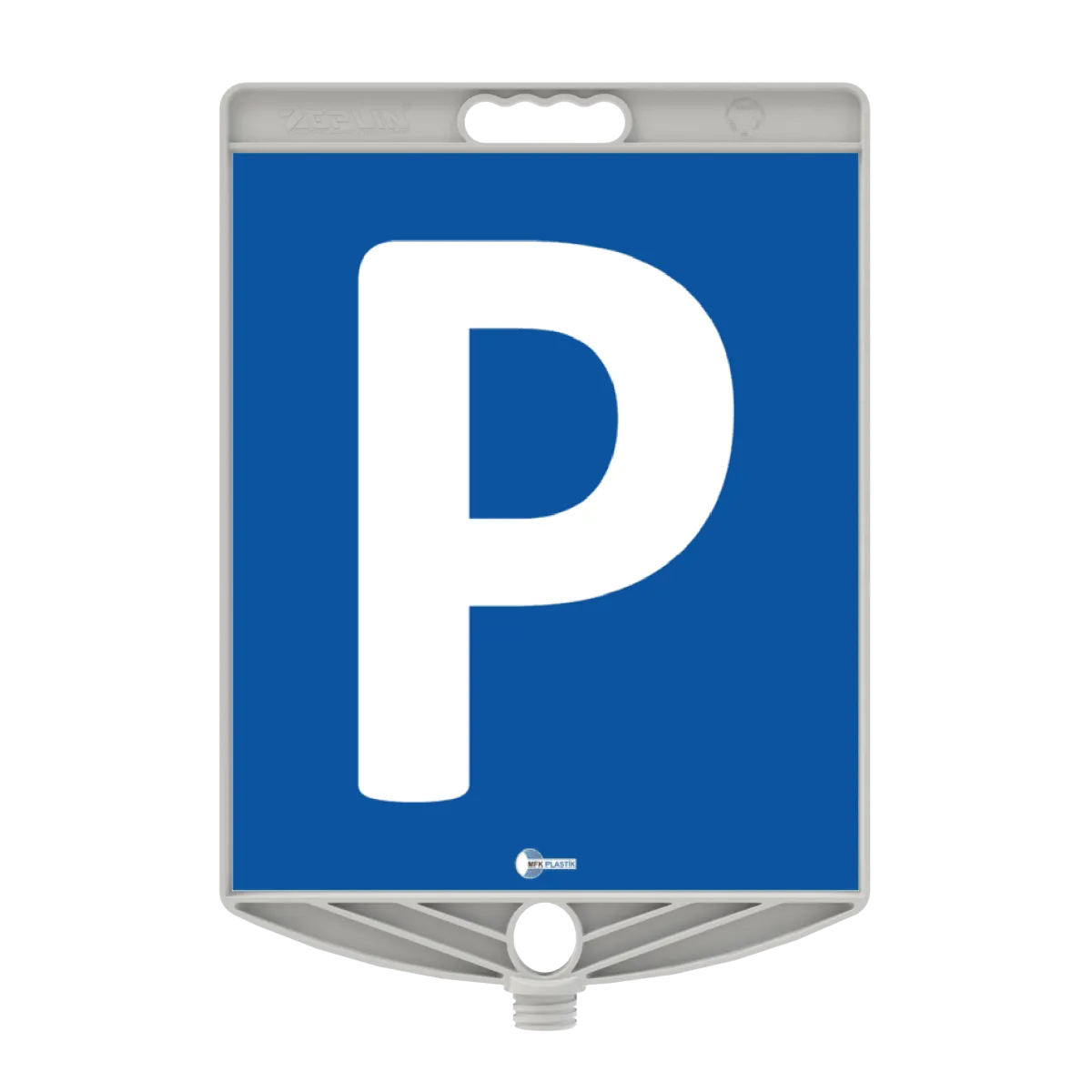
The 34 x 40 cm rectangular panels mark a car park with no fixed signs: a field used for an event, the car park next to a building site, a yard where customers come or the visitor spaces.
- ATZ 359: a white letter P on a blue background, 0.6 kg; placed next to it, the double-sided ATZ 538 also shows which way the car park is;
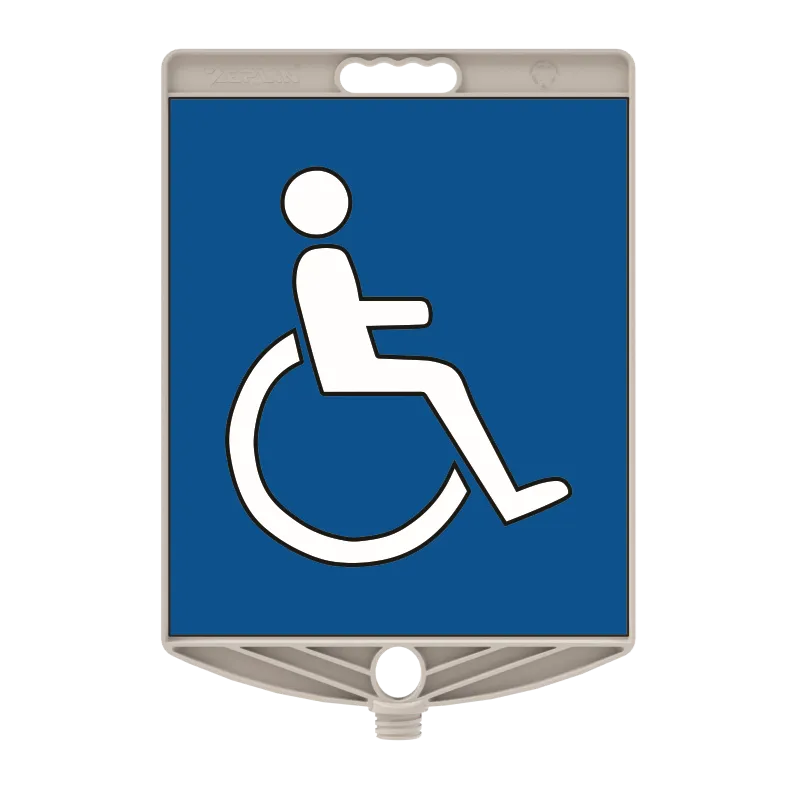
- ATZ 358: the white wheelchair symbol on a blue background, the form every driver knows for reserved spaces, 0.6 kg;
- ATZ 357: the same symbol and size on a yellow background, which stands out against grey asphalt even when the ground marking is worn or covered in snow;
- ATZ 957: the square version, 30 x 30 cm, also on yellow, for slim posts and narrow gaps between two parking spaces.
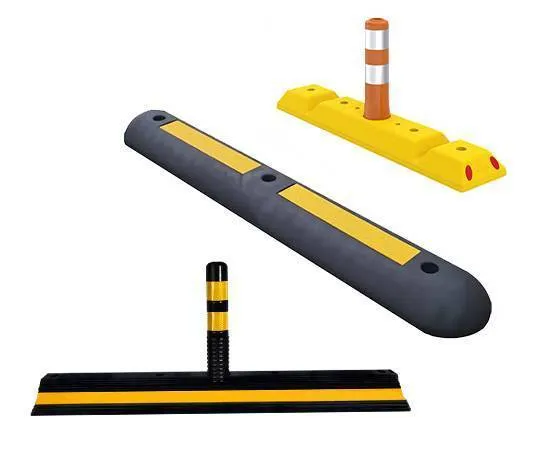
For a private or visitor car park, three signs are usually enough: ATZ 359 at the entrance, the disabled parking panels at the head of the reserved spaces and ATZ 545 in front of the gates. The sign only announces that the space is reserved; to keep it free physically, read our guide to parking blockers.
STOP, no entry and 30 km/h
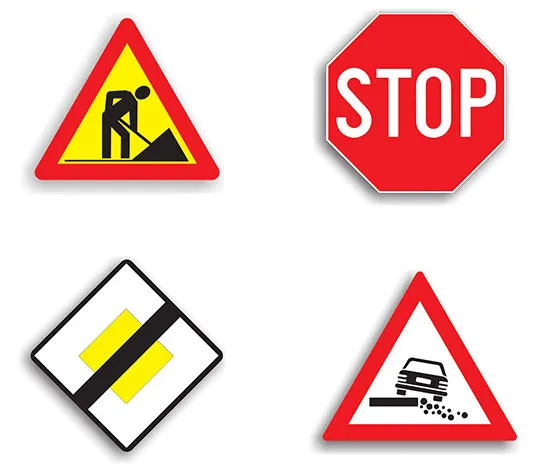
- ATZ 543: the red STOP octagon on a Ø28 cm disc, 0.35 kg; for car park exits, lane junctions in warehouses and the point where lorries leave a building site;
- ATZ 542: the red disc with a white horizontal bar, Ø28 cm, 0.35 kg; for a lane turned one-way at an event or a car park exit that must not be used as an entrance;
- ATZ 548: the 30 km/h limit, black figures on white, a Ø28 cm disc, 39 cm tall including the handle, 0.5 kg; for large car parks, estate lanes and the roads around a work zone.
Direction and keep left or right
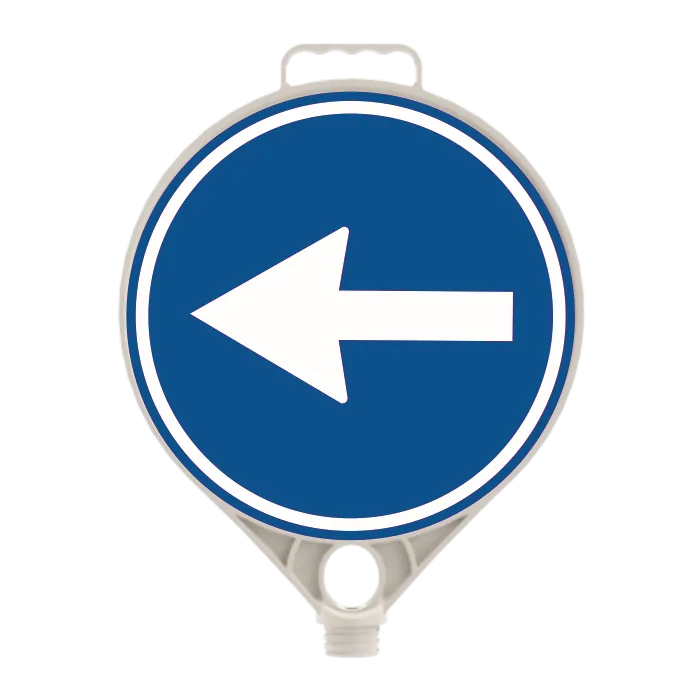
All three have a white arrow on a blue Ø28 cm disc and weigh 0.35 kg:
- ATZ 540, keep right: the arrow points down to the right; it is most often screwed onto the first cone in front of the obstacle, whether that is a pothole, a parked machine or a fenced-off area;
- ATZ 539, keep left: its pair, for an obstacle on the right-hand side of the lane, such as a service vehicle stopped by the kerb; put it where the narrowing starts, not level with the obstacle, so drivers have time to change course;
- ATZ 538, turn left / turn right: the arrow is printed on both faces; you turn it round and change the direction in seconds, so for a route with several turns a few copies of the same sign are enough.
Warning: the 39 cm triangles
The red-bordered triangles tell drivers in good time what is coming. All are 39 cm tall and weigh 0.48 kg:
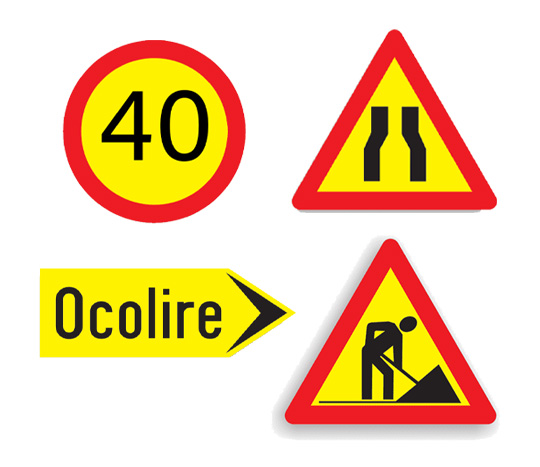
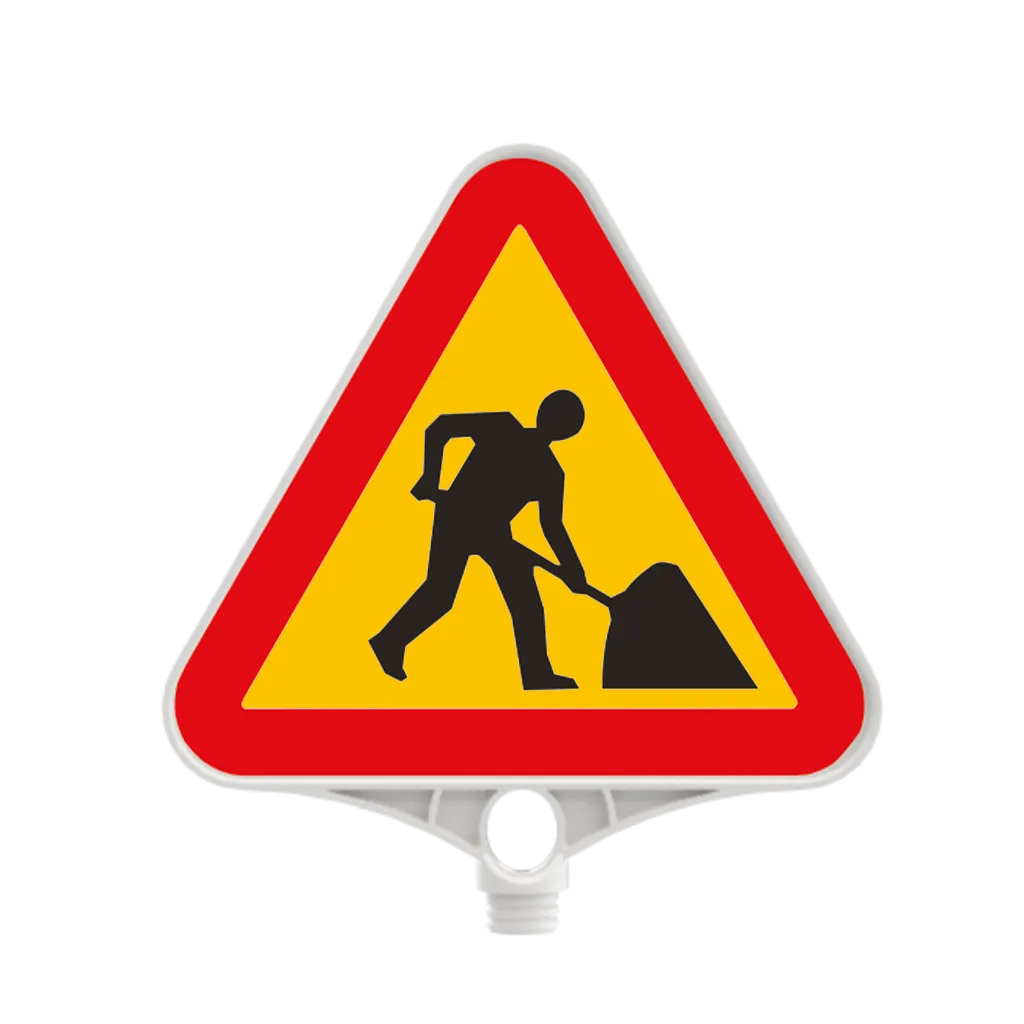
- ATZ 782, road works: the worker with a shovel on a yellow background, the first sign seen by anyone approaching an open manhole, a pavement repair or a ditch being cleared;
- ATZ 779, uneven road: it goes a few dozen metres before a new speed bump, a stretch of milled asphalt or a pothole; for the bumps themselves, see our guide to speed bumps;
- ATZ 776, other danger: the exclamation mark, for hazards without a symbol of their own, such as a cable across the roadway, an oil spill or a machine pulling out;
- ATZ 774, ATZ 775 and ATZ 777: road narrows on the right, on the left or on both sides.
Paddles for traffic controllers
When traffic runs alternately on a single lane, someone has to show who goes and who waits. The V12-20 has a Ø20 cm disc, a green face with GO and a red face with STOP, honeycomb sheeting and a weight of only 0.3 kg, so it can be held for hours. Two controllers, one at each end of the zone, hold their paddles with opposite faces showing.
The wet floor sign
It is the only one in the range made for indoors. The ATZ 5002 is a yellow A-frame PPC panel, 40 x 67 cm and 0.82 kg, with the warning in Romanian and English on both faces. You open it in the middle of the washed area and, once the floor is dry, fold it flat and carry it by the handle. It does not screw onto anything: it stands on the floor by itself.


What they fit on: the 35 mm thread
The spigot at the base of the sign has a 35 mm thread. Every threaded product in our shop has the same thread, so any plastic sign fits any threaded holder we sell:
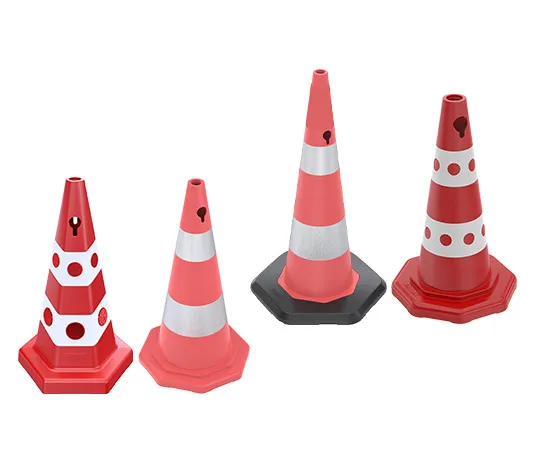
- the cones sold in sets, which have a built-in thread at the top; the sign screws straight in, with no adaptor; there is more about cones in our guide to traffic cones;
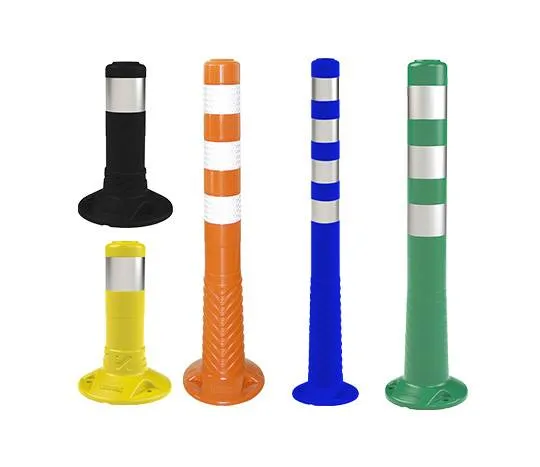
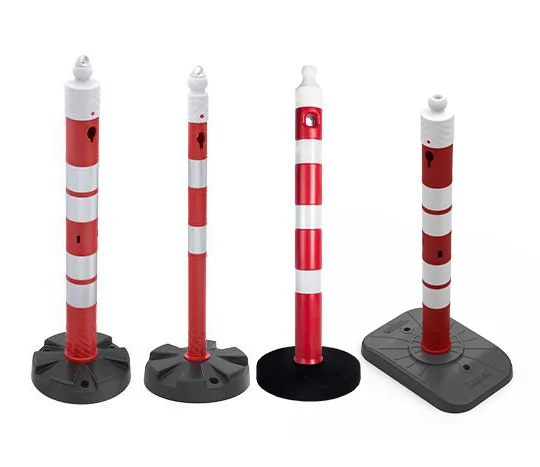
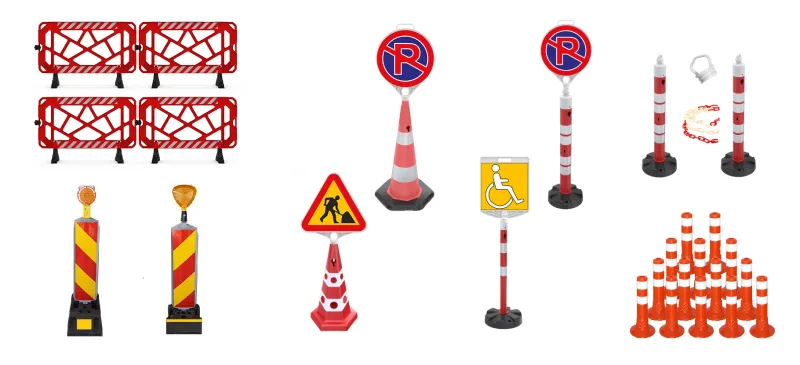
- mobile delimiter posts, in the threaded socket at the top; the 120 cm posts lift the sign above parked cars, and those with a heavy base stand steady at the head of a parking space;
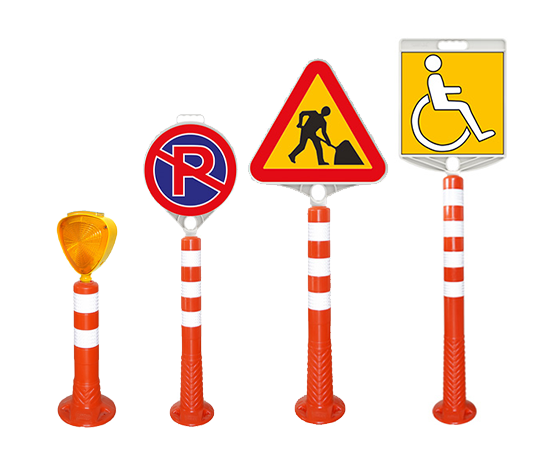
- flexible beacons, which have a threaded socket on top; their types are explained in our guide to road beacons.
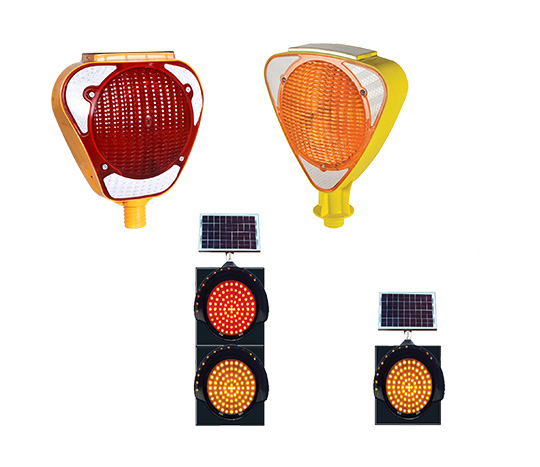
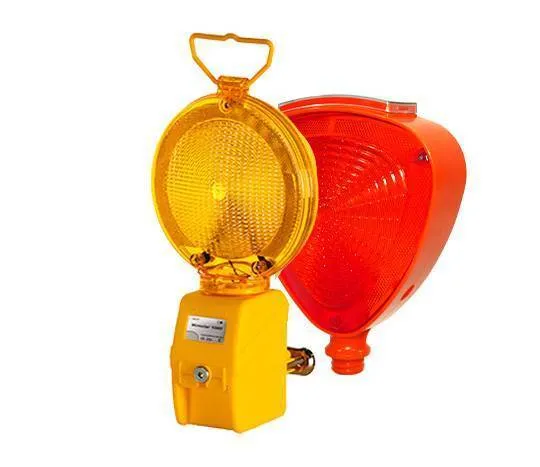
You need no tools: you screw the sign on by hand and take it off just as easily. The same socket can hold a warning lamp instead of the sign. Some signs also come ready fitted, in sets with a mobile post or a cone, for example no parking, road works and the 30 x 30 cm disabled parking panel.
If the problem is not just to announce something but to separate a lane or a row of parking spaces, see our guide to flexible delineator posts.
How to choose: three questions
What does the driver have to do?
If they only need to know what is coming, use a warning triangle. If they must stop, not enter or not park, use a round sign: STOP, no entry or no parking. If they must change direction, use a blue keep left, keep right or direction sign.
How far away must it be read?
A pedestrian or a driver manoeuvring slowly reads a Ø28 cm disc without trouble. When the sign has to be seen from the driver’s seat or across a yard, choose the ATZ 645, Ø38 cm, and for disabled parking spaces the 34 x 40 cm panels rather than the 30 x 30 cm one.
On a cone or on a post?
For a day, or for the length of an event, a sign on a cone is the quickest: you put it out in the morning and take it in at night, but it sits low. A 120 cm post lifts it above the bonnets, so it is the better choice until a fixed sign goes up.
Two signing examples
A small job on the right-hand edge of a lane
- First the ATZ 782, road works, so drivers know what is coming.
- Then the ATZ 774, road narrows on the right, and, if you want them to slow down, the ATZ 548, 30 km/h.
- At the obstacle, the ATZ 539, keep left.
- Mark off the zone with cones or warning tape.
If the job is on the left, put the ATZ 775 on the right-hand side before the narrowing, line the cones up at an angle so they lead vehicles to the right, and add the ATZ 540. If both edges are being worked on, use the ATZ 777 and mark the remaining lane with cones on both sides.
An event car park
At the entrance, put the ATZ 359 and, next to it, the ATZ 538 turned towards the car park. Mark the reserved spaces with the ATZ 358 or the ATZ 357. At the exit that must not be used as an entrance, put the ATZ 542 with a few cones in front of it, and where cars leave onto a busy lane, the ATZ 543.
Frequently asked questions
Can I use plastic signs on a public road?
Not as permanent signing: on public roads that is done with metal signs. Plastic ones are for private areas and temporary signing.
Do I need an adaptor to put the sign on a cone?
No. The 35 mm thread at the base screws straight into the thread at the top of the cones sold in sets, with no extra part.
Do they fit all the posts and cones in the shop?
All the threaded ones, yes. The cones sold in sets, the mobile posts and the flexible beacons have the same thread, so any plastic sign fits any of them.
What is the difference between STOP and no entry?
The ATZ 543, STOP, requires a full stop before entering the road or the junction. The ATZ 542, no entry, means no one goes in that way at all.
Blue or yellow background for disabled parking spaces?
At the same 34 x 40 cm size, only the background differs. Blue, the ATZ 358, is the form every driver knows; yellow, the ATZ 357, stands out better against asphalt and parked cars. Yellow also comes in the compact ATZ 957.
Can they be seen at night?
Yes. The threaded signs have honeycomb reflective sheeting that shows up in the headlights. If you want more attention, the same socket can hold a warning lamp instead of the sign.
How we can help
All the signs, the paddle and the wet floor sign are under plastic signs. Tell us where they will go, what drivers need to do there and how long the signing will stay, and we will put the list together for you, including the cones or posts they screw onto.