




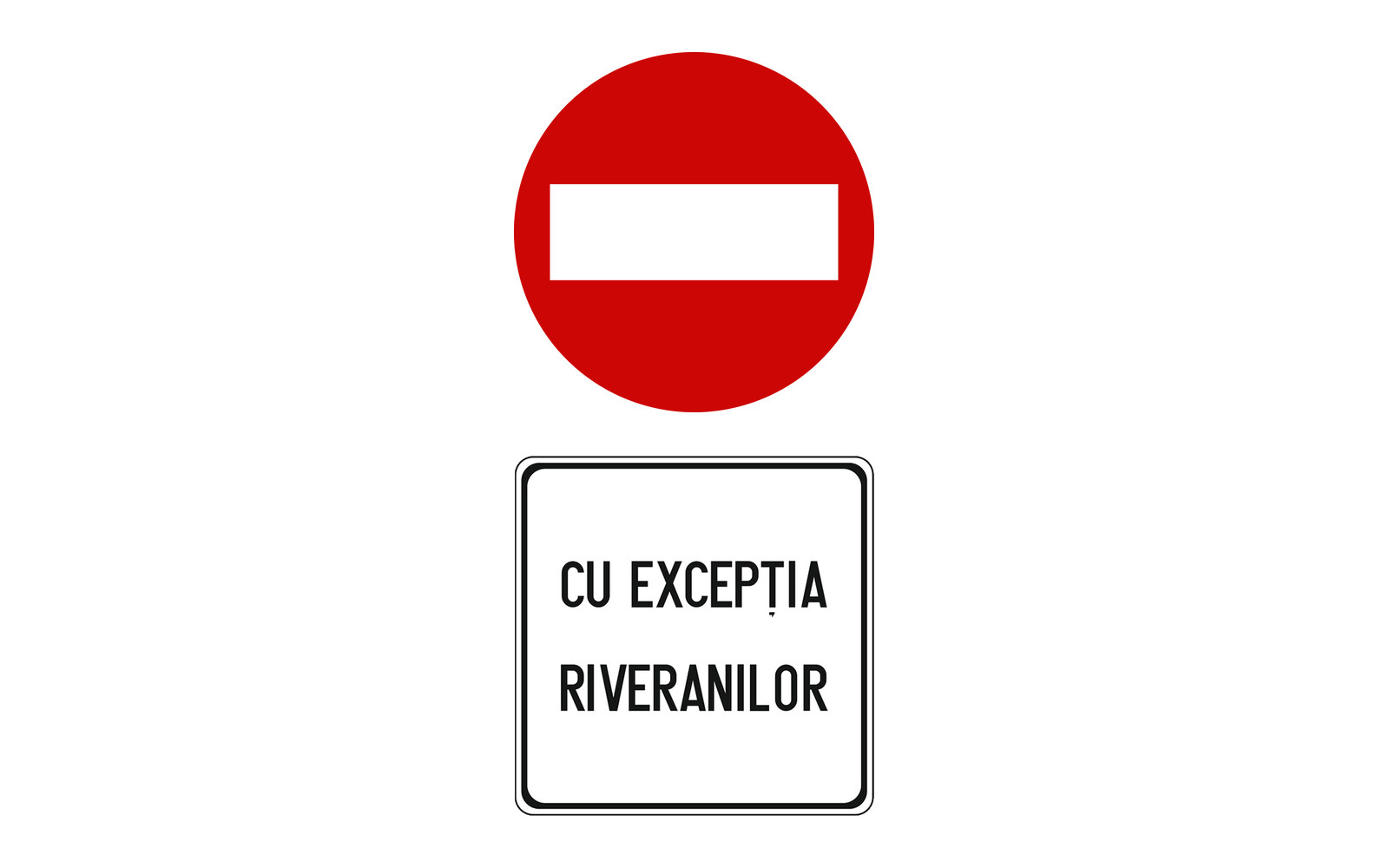
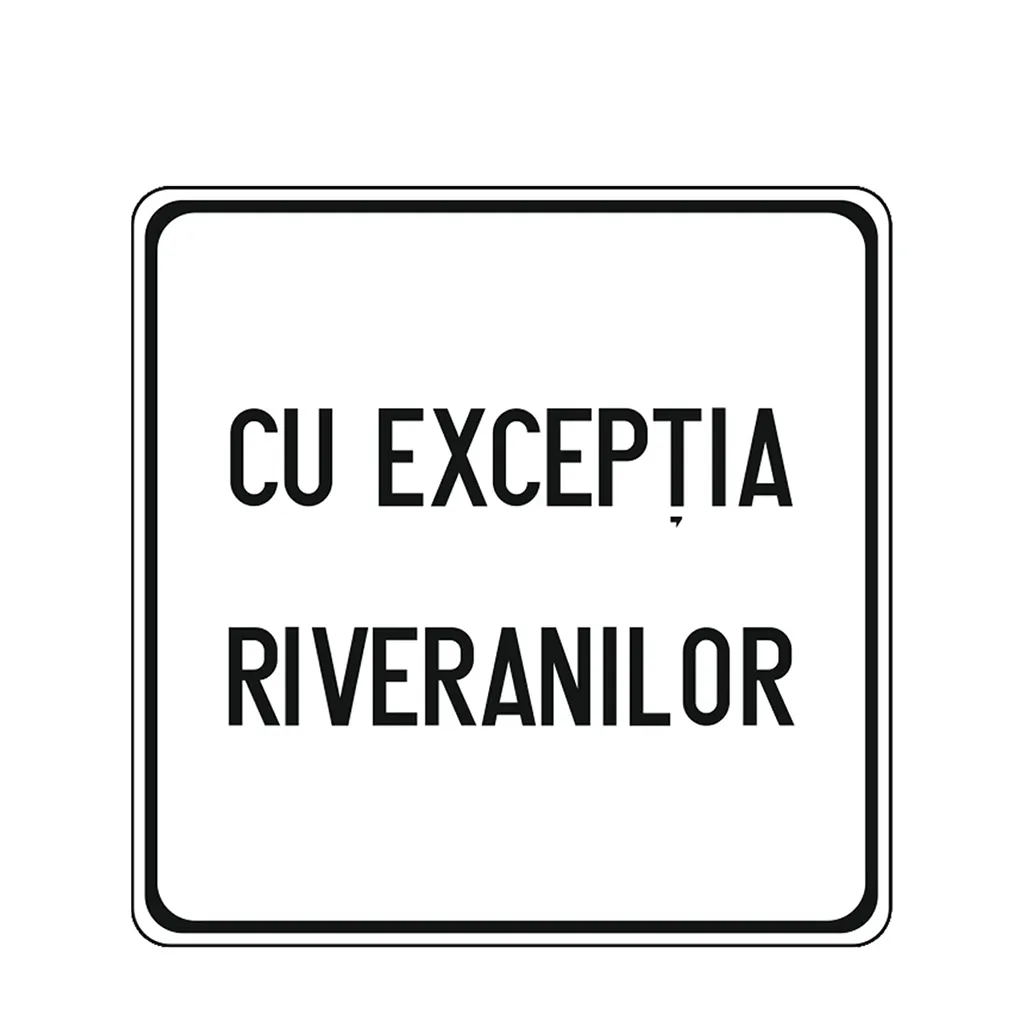
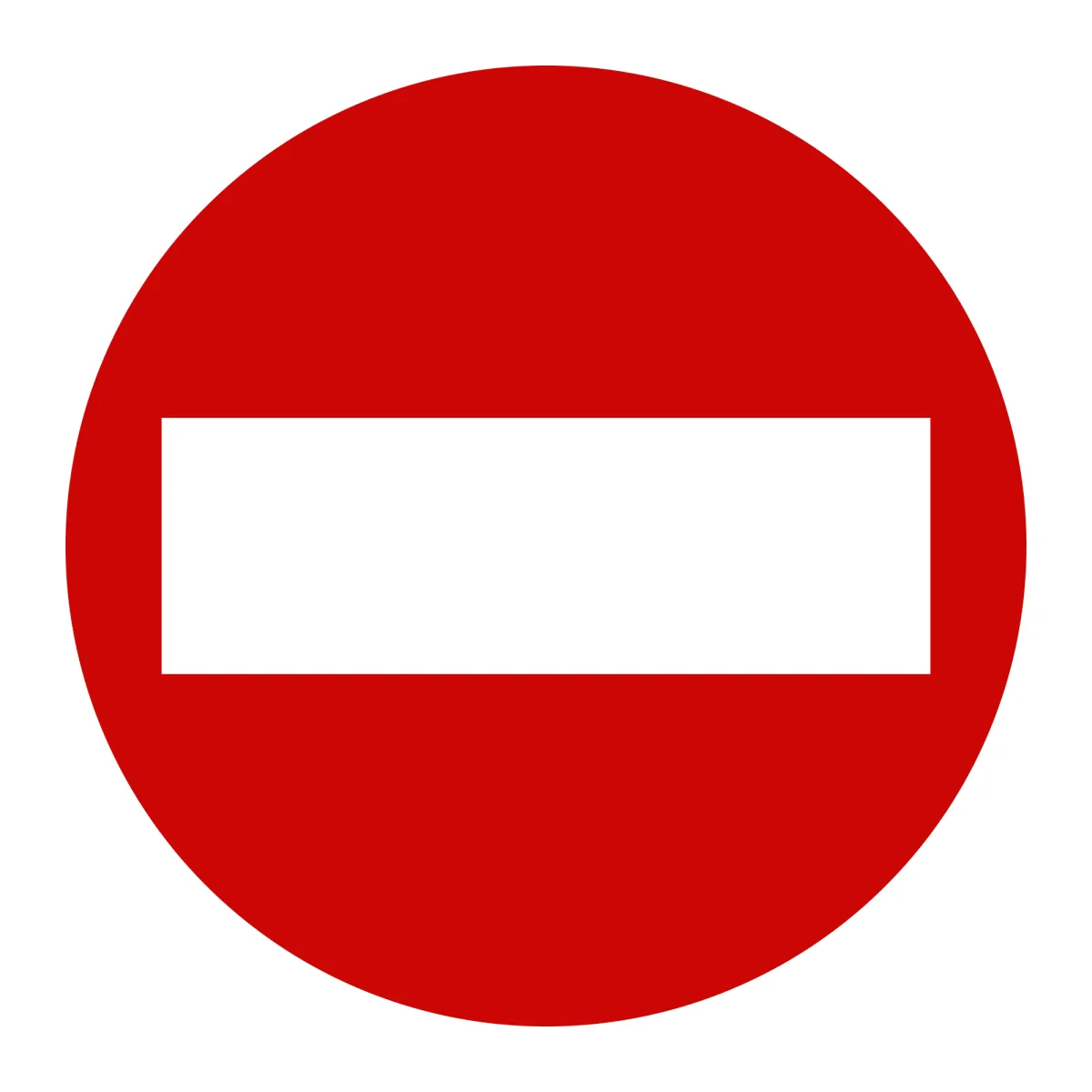
On a no-entry sign in Romania you may see a white panel underneath reading CU EXCEPȚIA RIVERANILOR, which means “except local access”. Behind the wheel, the question is simple: may I drive in or not? If you manage a street, the question is different: how do you let the people who are based there through and keep other traffic out? For both, the place to start is SR 1848-1:2024, which says exactly who counts as a riveran.
What “cu excepția riveranilor” means
The ban on the sign above still applies to everyone except the riverani. SR 1848-1:2024 defines a riveran as a natural or legal person with their home (residence) or registered office (workplace) on a given stretch of road. In short:
- Your home or residence is on that stretch: you are a riveran.
- Your company has its registered office or a workplace on that stretch: the company is a riveran.
- You live on the next street: the definition speaks of a given stretch of road, not the whole neighbourhood.
- You are passing through to save time: you are not a riveran, so the ban applies to you too.
What the standard does not say
The definition is short and leaves some cases open. It does not mention someone who only owns land on the street, with no home or office there; elsewhere, at point 5.2.2.7, the standard speaks of “those adjoining the road” without further detail. It says nothing about visitors or couriers, nor which document you show at a check. The Romanian Highway Code does not settle the term either: in Emergency Ordinance 195/2002 the word appears only once, in the definition of a motorway, and it does not appear in the implementing regulation at all.
For a specific case, ask the road administrator or the traffic police. Together they decide which signs go up and where, so they can say what they had in mind for your street.
Which signs the P34 panel goes under
The P34 panel is not used on its own. It completes a prohibition or restriction sign and goes under it. The standard names it directly for the following:
- C1, no entry, at the start of a section where no vehicle has right of way, although traffic runs in the opposite direction;
- C2, no vehicles in either direction, where the road is closed to all vehicles;
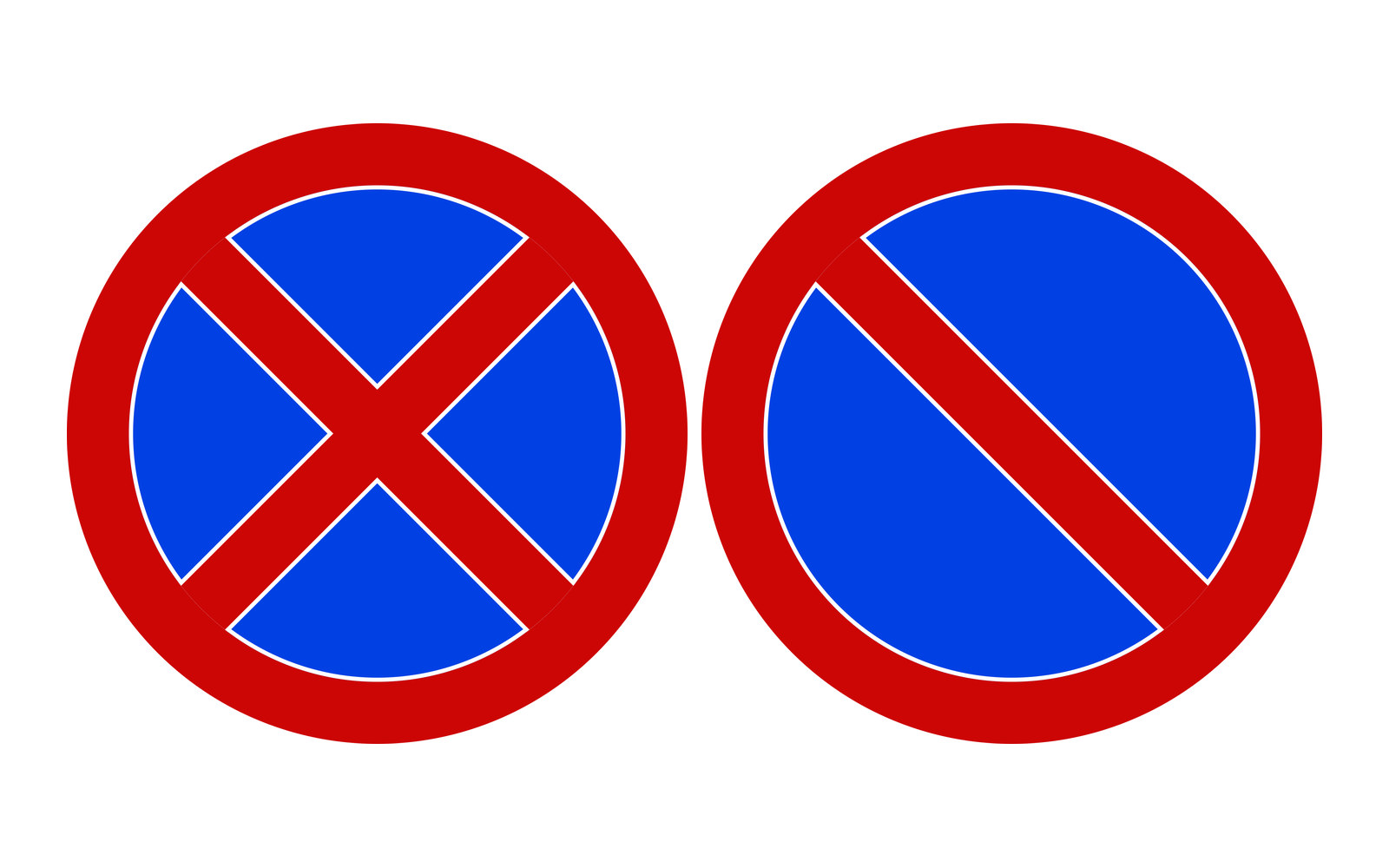
- C36, no parking and C37, no stopping, covered in more detail in the article on stopping and parking;
- C38 and C39, alternate-side parking.
Point 5.2.2.7 of the standard widens the list. When traffic is banned for certain vehicle categories, or there are mass or size limits, and you want to exempt those adjoining the road, a P18 adapted to the exempt category and/or a P34 goes under the sign. For example:
- C7, no goods vehicles, and C13, for agricultural and forestry tractors;
- C15, for motor vehicles and animal-drawn vehicles;
- C18-1.5, the total mass limit, and C19-6.5, the limit on a single driven axle;
- size limits: C16-2.3 for width, C17-1.9 for height, C20-10 for length.
How to read a few combinations
- C1 + P34: nobody enters in that direction except riverani. This is the combination people search for most.
- C2 + P34: the street is closed to vehicles in both directions, but riverani may drive on it.
- C7 + P34: lorries stay out, except those of riverani, such as a company with a workplace on the street.
- C36 or C37 + P34: the parking or stopping ban does not concern riverani. Everyone else follows it as usual.



P34, P35, P33 or P18: which panel to choose
Four panels of the same 60 x 60 cm size, easily confused because all have black text on white. The difference is who gets through:
- P34, except local access: exempts the people and companies on that stretch. The standard allows the wording to be written for any type of vehicle the exemption applies to.
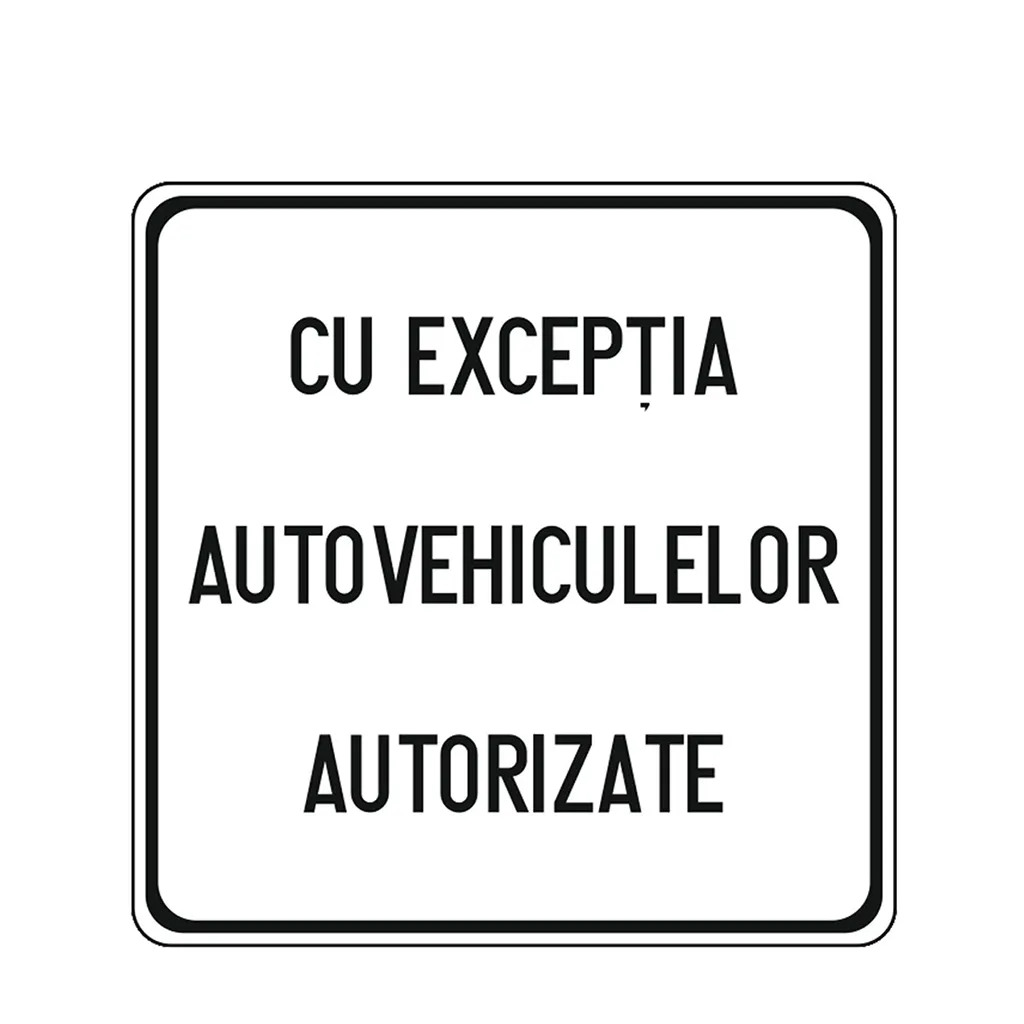
- P35, except authorised vehicles: exempts vehicles holding an authorisation, wherever their owner is based. The standard gives it as an option under the C1.
- P18, exempt vehicle categories: exempts a type of vehicle, not a person. The model we list reads CU EXCEPȚIA TRAMVAIELOR (except trams).
- P33, road closed to public traffic: does not specifically exempt anyone. It announces that the road ahead is not open to public traffic and is used, for example, under the C1.
One more panel says almost the opposite: the P14 shows which vehicle categories must obey the sign, so the ban concerns only them.
Who decides and who installs
If you want a P34 on a public street, you do not put it up yourself. SR 1848-1:2024 says buying, installing and maintaining signs falls to the road administrator, and that the type of sign and its location are set by the administrator together with the traffic police. A residents’ association or a company on the street therefore starts with a request to the administrator; the town hall or road administrator then orders what has been decided.
On an alley or premises closed to public traffic, things are different: the standard is not mandatory, although it can be applied. If a private road is open to public traffic, the usual rules apply. There is more in the guide to metal signs.
Where it goes on site
- Right after the junction before the section. The standard wants drivers to find a way round without having to turn back.
- Again after every junction on the section. The sign is repeated for those joining from side roads. Fit the panel under the repeated signs as well, or a driver coming from the side sees a ban with no exemption.
- On the right-hand side of the direction of travel, as a general rule.
- Visible from a distance: at least 50 m in built-up areas and 100 m outside them. The edge nearest the road sits 0.50–2.0 m from the road platform.
Post, height and fixings
The panel goes on the same post, right under the sign, and the bottom edge of the assembly sits 1.50–2.50 m above the road or kerb. This is where a little arithmetic pays off before you order: a Ø60 cm disc and a 60 x 60 cm panel together take up at least 120 cm. With the bottom edge at 1.50 m, the top reaches 2.70 m. With a Ø80 cm disc it reaches 2.90 m.
That is why a sign plus a panel calls for a longer post:
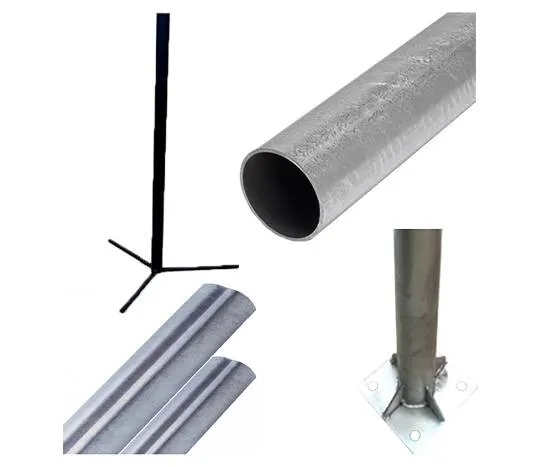
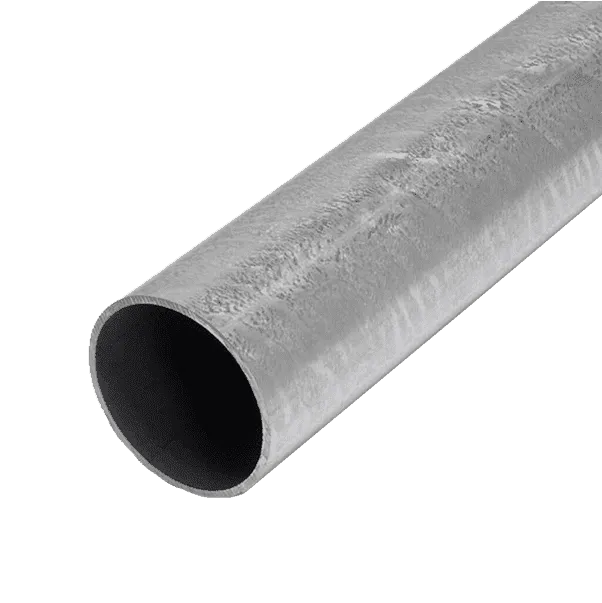
- ATT 60x2_3.5: Ø60 mm galvanised post, 350 cm, 10 kg, in a concrete foundation. The 50 cm extra compared with the standard post is meant for exactly this kind of stacked pair;
- ATZ M300: Ø60 mm flanged post, 300 cm, 10 kg, bolted to concrete or paving where you cannot dig;
- ATT 48x2_3: Ø48 mm galvanised post, 300 cm, 8.5 kg. It suits a single sign; with a disc and a panel, little is left for the foundation;
- ATZ M12048: Ø48 mm tripod post, 120 cm, for temporary use without a foundation.
The Ø60 cm disc weighs 3 kg and the P34 weighs 3.2 kg. Each comes with 2 clamps for Ø48 mm posts and 4 bolts with nuts. For Ø60 mm posts, ask for the matching clamps when you order or buy the ATT 60c separately; a Ø48 mm clamp will not close around a Ø60 mm tube. The remaining details are in the guide to sign posts.
Which size and which sheeting
The P34 panel has one size in SR 1848-2: 60 x 60 cm, with a 5 mm border. The disc depends on the road: Ø60 cm on county and local roads, streets and private roads open to public traffic, Ø80 cm on national roads. For the C1 we also list the C1_II, Ø80 cm, class II.
The P34 we list has class I (RA1) sheeting, with 70 cd/(lx·m²) for white and a 7-year service life. It suits local, minor and private roads and streets without strong lighting. Where there is street lighting, shop windows or advertising, SR 1848-2 requires prismatic class 2 or 3 sheeting, so write to us before you order. The differences are explained in the article on class I and class II.
Frequently asked questions
Who is a riveran?
Under SR 1848-1:2024, a natural or legal person with their home (residence) or registered office (workplace) on a given stretch of road.
Can I drive into a no-entry street marked “cu excepția riveranilor” if I do not live there?
If your home, residence, office or workplace is not on that stretch, you do not fit the definition of a riveran, so the ban applies. The standard does not deal separately with visitors and couriers.
Can the P34 stand alone on a post?
No. Additional panels go under the sign they complete, on the same post. The only exceptions are the P13 and P17, which can stand next to reserved parking spaces.
What is the difference between the P34 and the P35?
The P34 exempts those with a home or office on the stretch. The P35 exempts vehicles holding an authorisation, wherever their owner is based.
Which post do I need for a sign and a panel?
Together they take up at least 120 cm, so choose the Ø60 mm, 350 cm post in a concrete foundation, or the 300 cm flanged post if you cannot dig. For both, ask for the Ø60 mm clamps.
Can I put up a P34 on my street myself?
Not on a public road. The type of sign and its location are set by the road administrator and the traffic police, so your request goes to the administrator.
How we can help
The P34 and the other exemption panels are in the additional panels category, the discs in prohibition and restriction signs, and the posts and clamps in sign posts. Tell us what the road administrator has decided and what kind of road the assembly is for, and we will tell you which disc, panel and post to order. Delivery takes 24-48 hours.