
A metal sign stays on its post for years and has to say the same thing by day and by night. When you buy one, the choice does not stop at the symbol: the group, the size required on that road, the sheeting class, the post and the fixings all matter. This guide takes them one at a time, in the order customers ask us on the phone.
The road sign groups
Road signs in Romania are set by SR 1848-1:2024, which divides them into groups. Each group has a letter, and each sign a code made of the letter and a number, for example A1 or B2. The codes and names on our site are those of SR 1848-1:2024.
Warning signs (A)
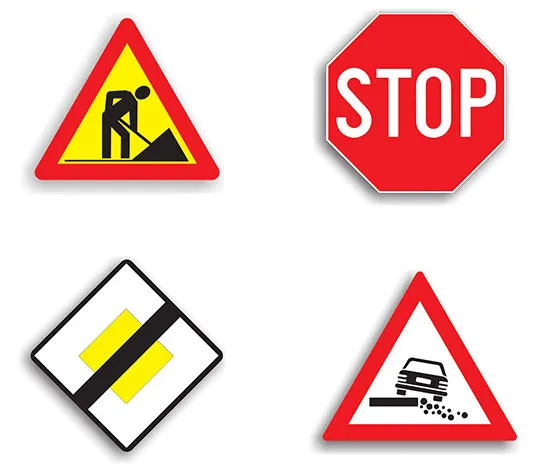
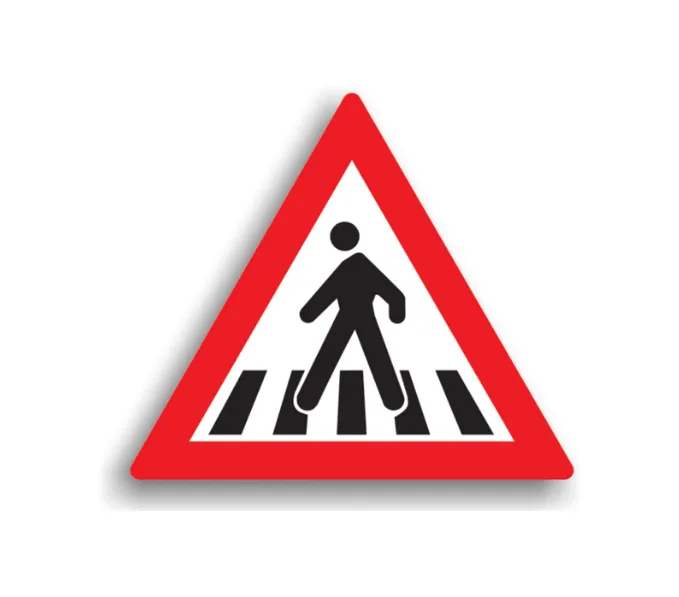
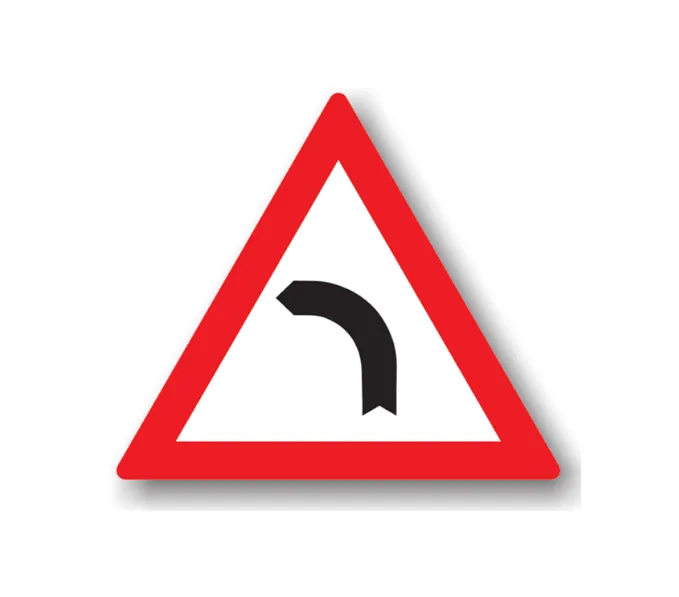
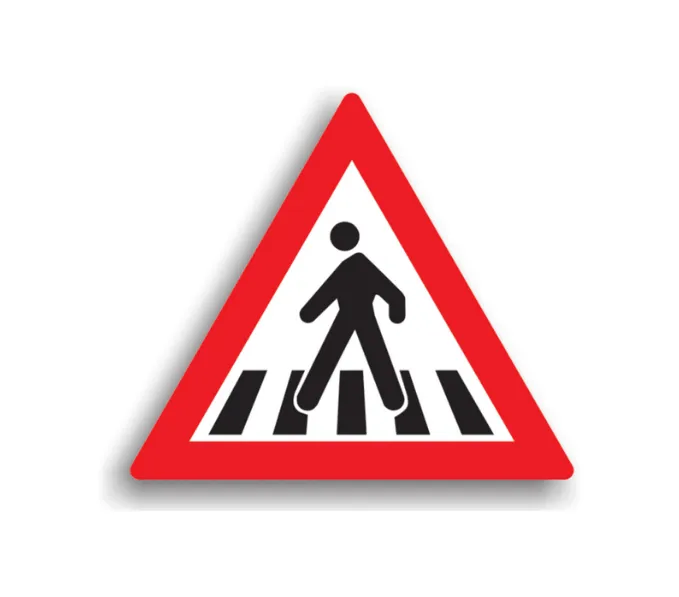
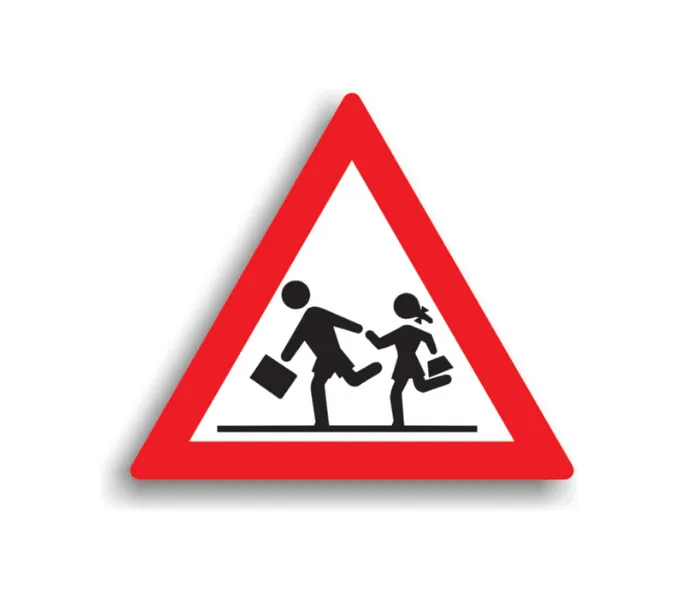
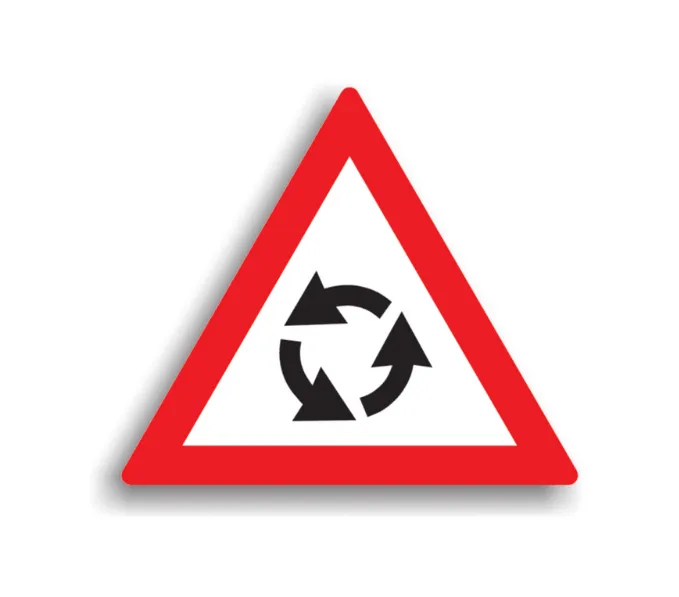
They announce a hazard ahead and what kind it is: a tight bend, a narrowing, a level crossing with a railway, animals on the road. The group runs from A1 – Left bend to A52 – Advance warning of a vehicle turning point. Most are triangles with a red border, white background and black symbol, such as the A1, the A22 (pedestrian crossing ahead), the A38 (roundabout ahead) or the A23 (children). A few have their own shapes: the A5 panel for particularly dangerous bends, the A6 successive bend panels, the striped railway panels, the markers placed on obstacles and the crosses at level crossings. All are under warning signs (A).
The A18 announces a hump placed on purpose to slow vehicles down, in other words a row of speed bumps, and everything about those is in our guide to speed bumps.
Priority signs (B)
They decide who goes first: at junctions, when leaving a minor road and on narrowed sections. The group has six signs, with shapes no other sign has, so they can be recognised by their outline even when partly covered:
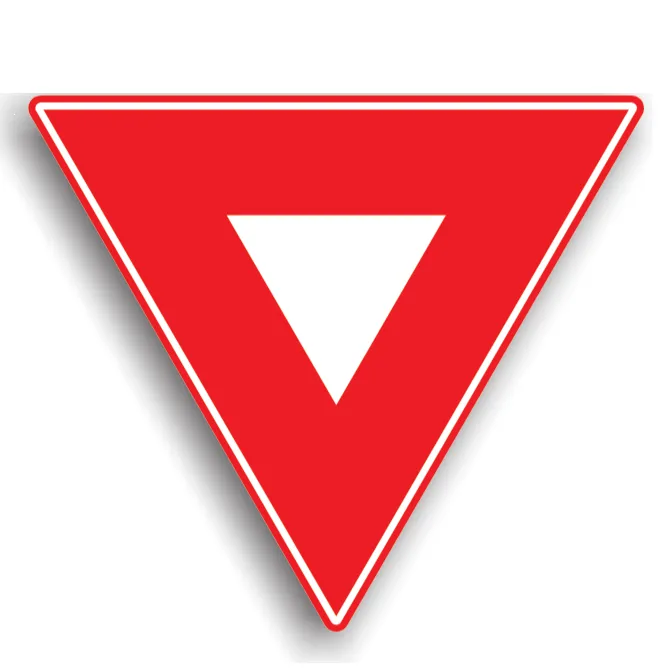
- B1 – Give way, the triangle pointing down: on the road without priority, at junctions with good visibility; the driver slows down and lets the vehicles on the road being joined pass;
- B2 – Stop, the red octagon: where visibility is lacking and stopping is necessary, and at level crossings without barriers;
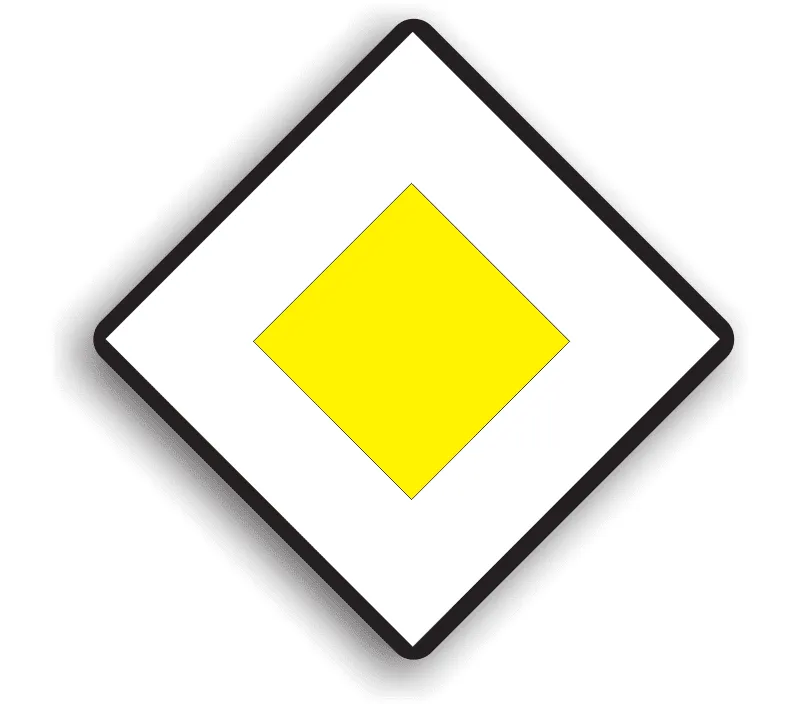
- B3 – Priority road, the white diamond with a yellow centre, and B4 – End of priority road, placed 50–250 m before the junction where priority ends;
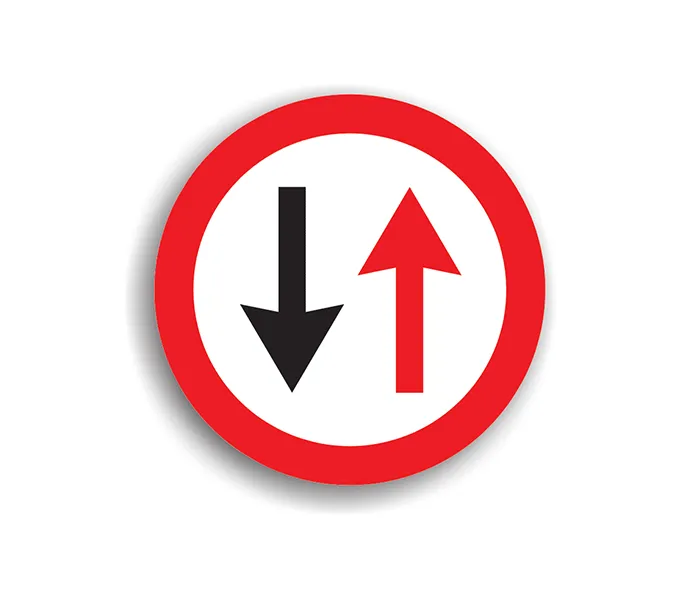
- B5 and B6, which work as a pair, one at each end of a section narrower than 5.50 m: B5 stands on the direction that gives way, B6 on the direction that goes first.
When the priority road turns at a junction, an additional panel showing the direction of the priority road goes under the sign: the “priority road with an additional sign” that many people search for. All six are under priority signs (B).
Prohibition or restriction signs (C) and mandatory signs (D)
Prohibition or restriction signs tell you what you may not do: no entry, no overtaking, no stopping or no waiting, speed limits, no access for vehicles above a certain weight or height. They are under prohibition or restriction signs (C). Mandatory signs tell you what you must do: the compulsory direction, passing an obstacle, the minimum speed. They are under mandatory signs (D).
Orientation (F), information (G) and kilometre signs (K)
Orientation signs help drivers choose their road and lane, information signs point out what is useful along the route, from pedestrian crossings to bus stops, and kilometre and hectometre signs mark the position on the road. You will find them under orientation signs (F), information signs (G) and kilometre and hectometre signs (K).
Additional panels (P)
They are mounted under a sign and complete its meaning: the distance to the hazard, the length of the section, the vehicle category concerned or exceptions such as “except for residents”. One example is the P4 panel, with the distance in metres, placed under a warning sign mounted further from the hazard than usual. The panels are under additional panels (P).
Signing road works: U and V
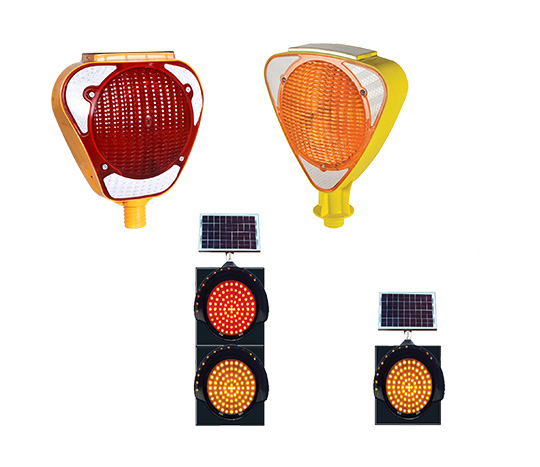
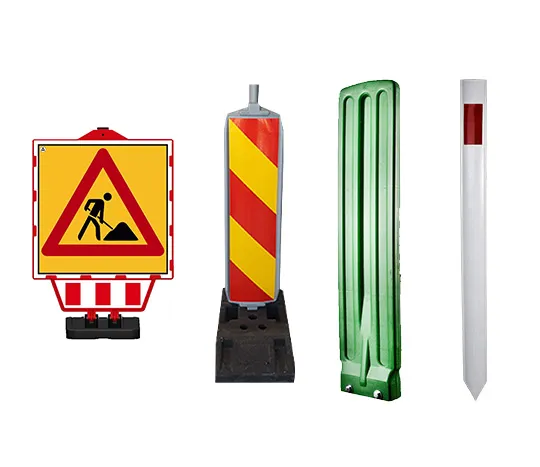
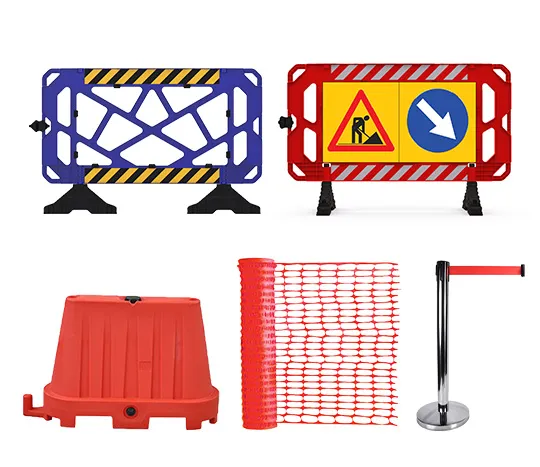
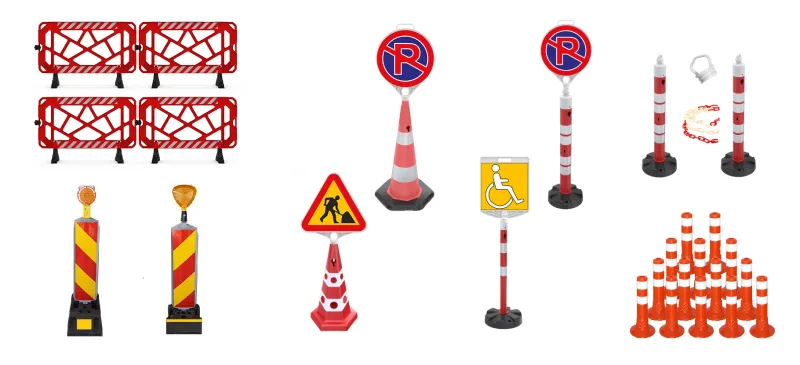
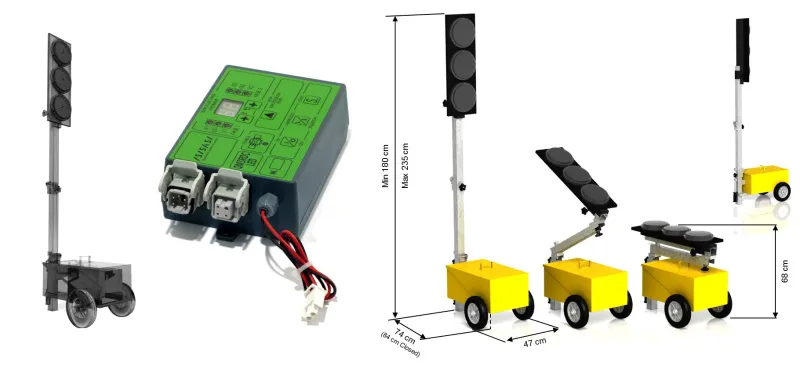
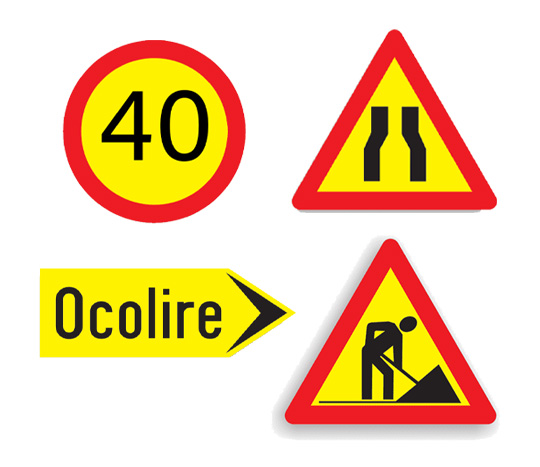
For work sites there is the group of temporary U signs and the auxiliary V devices: barriers, signal trolleys, mobile traffic lights. What a work site needs and in what order is explained in our guide to signing road works with U signs. You will find them under temporary traffic signs (U) and auxiliary work signal devices (V). There are also signing of special situations (L) and solar road signs, with LEDs powered by a solar panel.
How a metal sign is made
Our metal signs are made of 1 mm galvanised steel sheet, with rounded corners and pressed edges, so there are no sharp edges to cut yourself on during mounting. The sheet is electrostatically painted, and the face carries retroreflective sheeting, which sends the headlight beam back to the driver. The signs comply with SR EN 12899-1:2007, SR 1848-1:2024, SR 1848-2:2011 and SR 1848-3:2011.
If you read the standards: SR 1848-1:2024 sets out the signs, with codes, names and placement conditions, while SR 1848-2:2011 gives the technical conditions, including the formats. SR 1848-2 still uses the codes from before 2024, so a code in its tables may differ from the one on our site. Look a sign up by its name, not by its code.
Class I or Class II sheeting
The warning and priority signs in our standard range have Class I (RA1) sheeting, with a retroreflection of 70 cd/(lx·m²) for white (0.2°/5°) and a service life of 7 years. Under SR 1848-2, over that time the retroreflection stays at no less than 80% of the initial minimum value, and the sheeting stays bonded over at least 95% of the surface.
Class II sheeting returns more light and has a service life of 10 years. It is worth it on national roads, where the large formats are also required, and on streets with a lot of ambient light, where a Class I sign gets lost among the surrounding lights. The Class II versions are under metal road signs (Class II), and the difference between the two classes is explained in detail in our guide to Class I and Class II sheeting.

Which size for which road
SR 1848-2 ties the size of the sign to the category of the road: the faster vehicles travel, the larger the sign. A format smaller than the one set for that road is not allowed:
- warning triangles come in four formats: small (60 cm), normal (70 cm), large (90 cm) and very large (120 cm); county and communal roads, streets and private roads open to public traffic need the normal 70 cm format, national roads the large one and motorways the very large one;
- Give way is 70 cm in the small format, the B1, and 90 cm in the normal one, the B1_90_I; national roads need 120 cm and motorways 150 cm;
- Stop is 60 cm in the small format, the B2, and 80 cm in the normal one, the B2_80_I; national roads need 100 cm and motorways 120 cm;
- round signs are Ø60 cm in the normal format; for the B5, national roads need 80 cm;
- the B3 and B4 come in one size only, 60 cm a side, and the B6 is 65 cm a side.
The small Give way and Stop format is meant for low-traffic vicinal roads and short-term signing by the Police. For a Stop sign where a street meets a county road, take the 80 cm one, not the 60 cm. Our 70 cm triangles suit most local roads; for national roads, some signs have 90 cm versions with Class II sheeting.
Where and at what height signs are mounted
The bottom edge of the sign sits 1.50–2.50 m above the road or the kerb, and the edge nearest the road 0.50–2.0 m from the roadway, on the right-hand side. The sign must be visible from at least 50 m in built-up areas and from 100 m outside them. No more than three signs go on one post, and a priority sign goes above a mandatory one. The exception: the railway panels A42-III, A42-II, A42-I and the markers A44, A45, A46 go lower, with the bottom edge 0.75 m above the carriageway edge.
Warning signs go before the hazard: no more than 50 m before it in built-up areas, 100–250 m outside them, 500–1,000 m on motorways and expressways, with the P4 panel showing the distance. The A23, however, goes right next to the school or playground, and the A5 right in the bend, in the driver’s line of sight. Each product page gives the placement conditions for that sign.
Some signs work together. On a narrow bridge, the A9, A10 or A11 announces the narrowing, then the B5 and B6, mounted 10–20 m before the narrow section, one at each end, decide who goes first.
Posts, clamps and weights
Fixings are included with every sign unless the product name says otherwise: priority signs and 70 cm triangles come with 2 clamps and 4 bolts with nuts. The clamps are for Ø48 mm posts; for Ø60 mm we supply them on request, so tell us the diameter when you order.
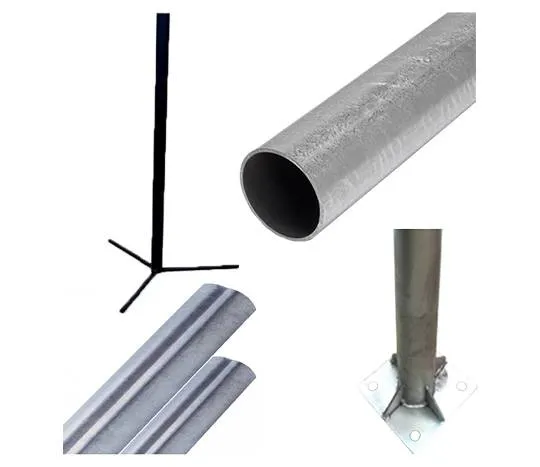
The usual post is a Ø48.3 mm galvanised tube, 300 cm long. For large signs, windy spots or two signs on the same post, the Ø60 mm tube, 350 cm long, is used. Round posts are set in a concrete foundation; on concrete or paving, where you cannot dig, flanged posts bolted down are used. The details are in our guide to sign posts, and the posts are under road sign posts.
Weights: the 70 cm triangle is 2 kg, the 90 cm one 5 kg; the Ø60 cm disc 3 kg; the 60 x 60 cm square or diamond 3.2 kg, the 65 x 65 cm square 3.5 kg; the Stop octagon 3 kg at 60 cm and 5 kg at 80 cm.
Private roads, car parks and yards
Private roads open to public traffic need the same formats as streets: 70 cm triangles, a 90 cm Give way, an 80 cm Stop. In car parks, yards and private lanes closed to public traffic, the standard can be applied but is not mandatory, so the small format is enough there: the 70 cm B1 or the 60 cm B2. For signs on private premises, such as private parking or video surveillance, see the Non-STAS signs; if the signing changes often, plastic signs are easier to move.
On public roads, buying, mounting and maintaining the signs is generally the job of the road administrator. Exceptions include information signs for public service businesses and signs for access to commercial and economic sites, which fall to the beneficiaries and are mounted to plans approved by the road administrator and the traffic police.
How to choose and order
- Find the name of the sign and its SR 1848-1:2024 code, for example from the signing plan.
- Establish the road category: vicinal, communal, county, street, national, motorway or private premises. The format depends on it.
- Choose the sheeting: Class I for local roads, Class II for national roads and places with a lot of ambient light.
- Count the posts and check their diameter, Ø48 or Ø60 mm, so you get the right clamps.
- If you are a public institution, you can also buy through SEAP / SICAP.
Frequently asked questions
What do the letters A, B, C, D in a sign code mean?
They are the SR 1848-1:2024 groups: A warning, B priority, C prohibition or restriction, D mandatory. There are also F for orientation, G for information, K for kilometre signs, P for additional panels and U for temporary signs.
What size should a Stop sign be?
On county and communal roads and on streets, 80 cm: the B2_80_I. The 60 cm format, the B2, is for low-traffic vicinal roads and for private premises closed to public traffic.
How long does the reflective sheeting last?
Class I sheeting has a service life of 7 years, and Class II 10 years.
Which signs go at a level crossing with a railway?
At a crossing with barriers, the A39 goes 150 m before the barrier outside built-up areas, above the A42-III panel, and 50 m before it in built-up areas, above the A42-I. At crossings without barriers, the A47 or A48 cross goes 6–10 m before the rail, together with the Stop sign. Under SR 1848-1:2024, the crosses are the responsibility of the railway administrator.
What if my post is Ø60 mm?
Tell us when you order: the standard clamps are for Ø48 mm, and we send Ø60 mm clamps on request.
Do I need standard signs in a private car park?
If it is closed to public traffic, the standard is not mandatory, though it can be applied. A private road open to public traffic needs the normal formats, as on streets.
How we can help
All the signs are under metal road signs. If you have a signing plan or just a list of sign names, send it to us with the road type and the post diameter, and we will put the full list together: format, sheeting, posts and clamps.