


On a car park lane, in a residential courtyard or on a factory road, a speed limit sign is not always obeyed. A row of speed bumps cannot be ignored: drivers feel it and lift off the accelerator. A bump does not stop the car, it makes it pass more slowly, and how slowly depends on how wide and how tall it is. This guide explains the types of speed bumps, the speed each model is made for, how to work out a row and how to fit it. We mean the bumps fixed to the road surface, not the electronic speed limiter in a car.
What a speed bump is
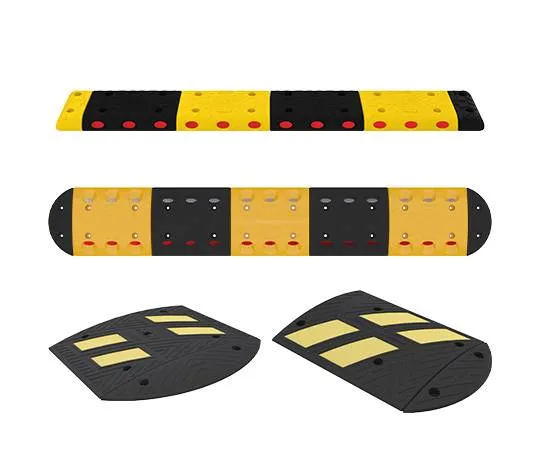
A speed bump, also called a speed hump, a traffic calming bump or simply a “bumper”, is a low piece with a ramp on both sides, fitted across the road. Ours are prefabricated: 50 cm long pieces (33 cm for the small plastic model) that join into a row from one kerb to the other and are fixed into asphalt or concrete with dowels and screws. They are not poured from asphalt; the only work on the road is drilling the dowel holes.
The basic rule is simple: the wider the bump in the direction of travel, the longer the wheel stays on it and the lower the speed at which the crossing stays bearable. That is why every model has the speed it is made for in its specification sheet, and the choice starts with the question “how fast do I want vehicles to pass here?”.
The types of speed bumps and where each one is used
Rubber speed bumps, V19 series
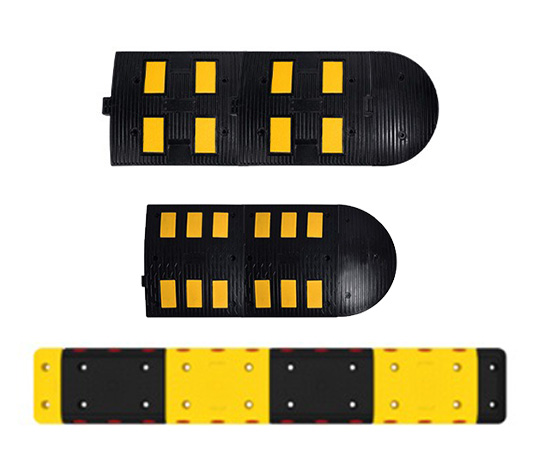
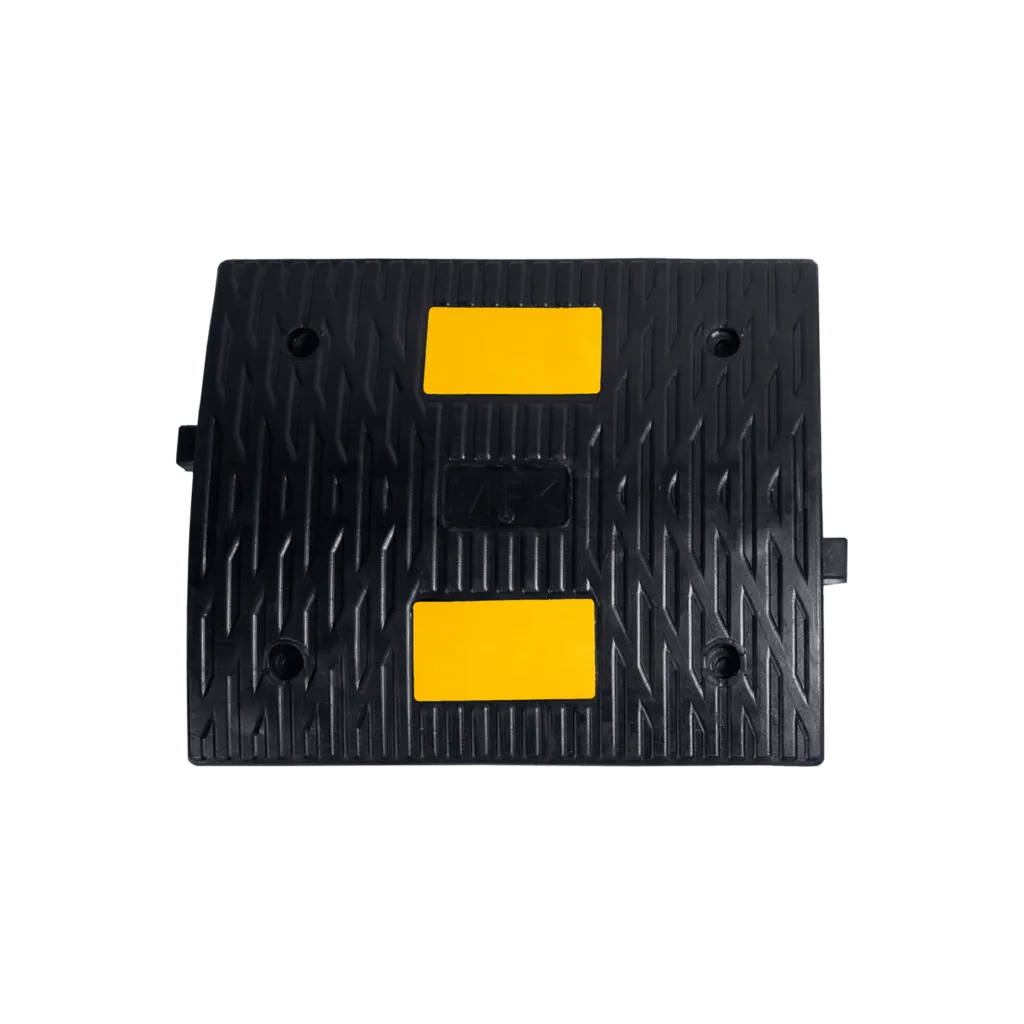
These are the bumps you see in supermarket car parks and residential courtyards: black, with a ribbed surface and yellow reflective strips that show up in the headlights. All are 50 cm long, so 2 fit per metre, and each joins the next one through the keys on its sides. They differ in width in the direction of travel:
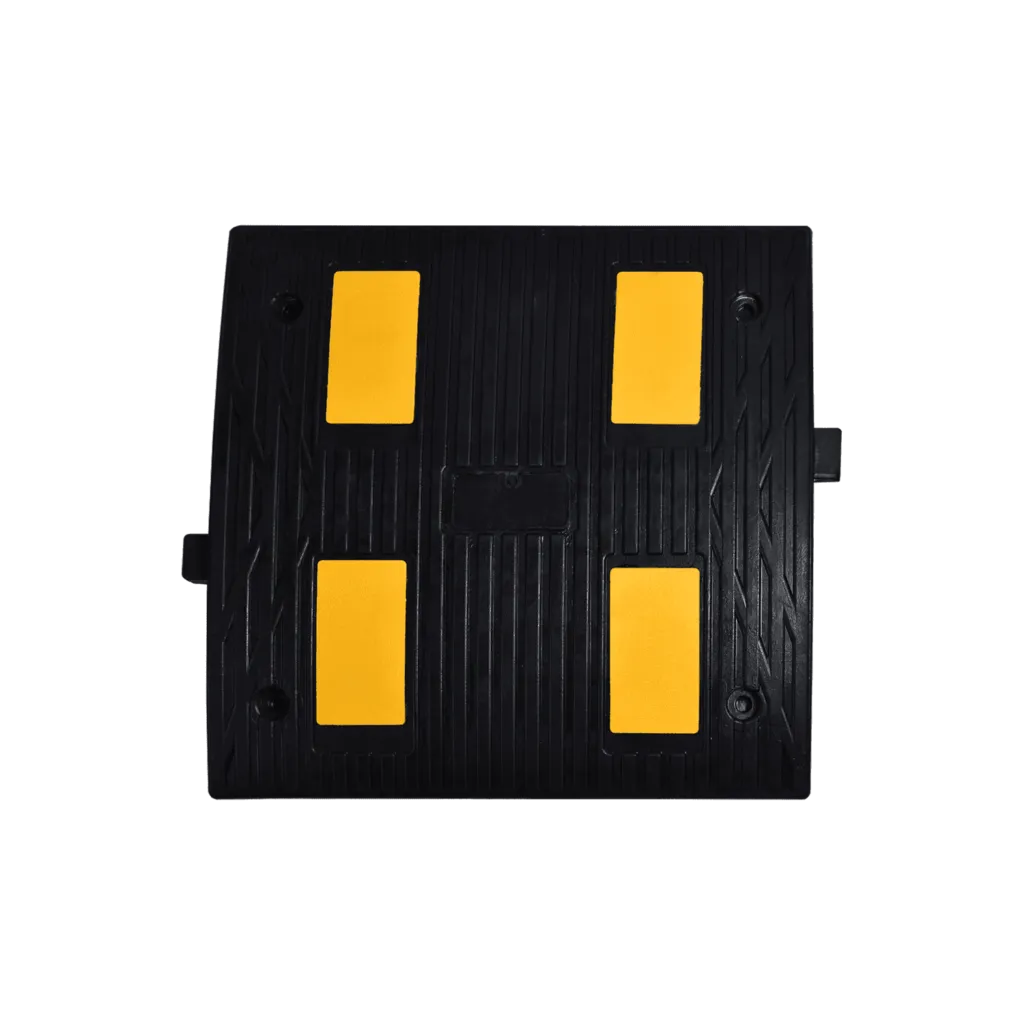
- V19-400: 40 cm wide, 4 cm tall, 7 kg, 2 reflective strips, for 30 km/h;
- V19-500: 50 cm wide, 4 cm tall, 8 kg, 4 strips, also for 30 km/h, but with a longer ramp and a smoother crossing;
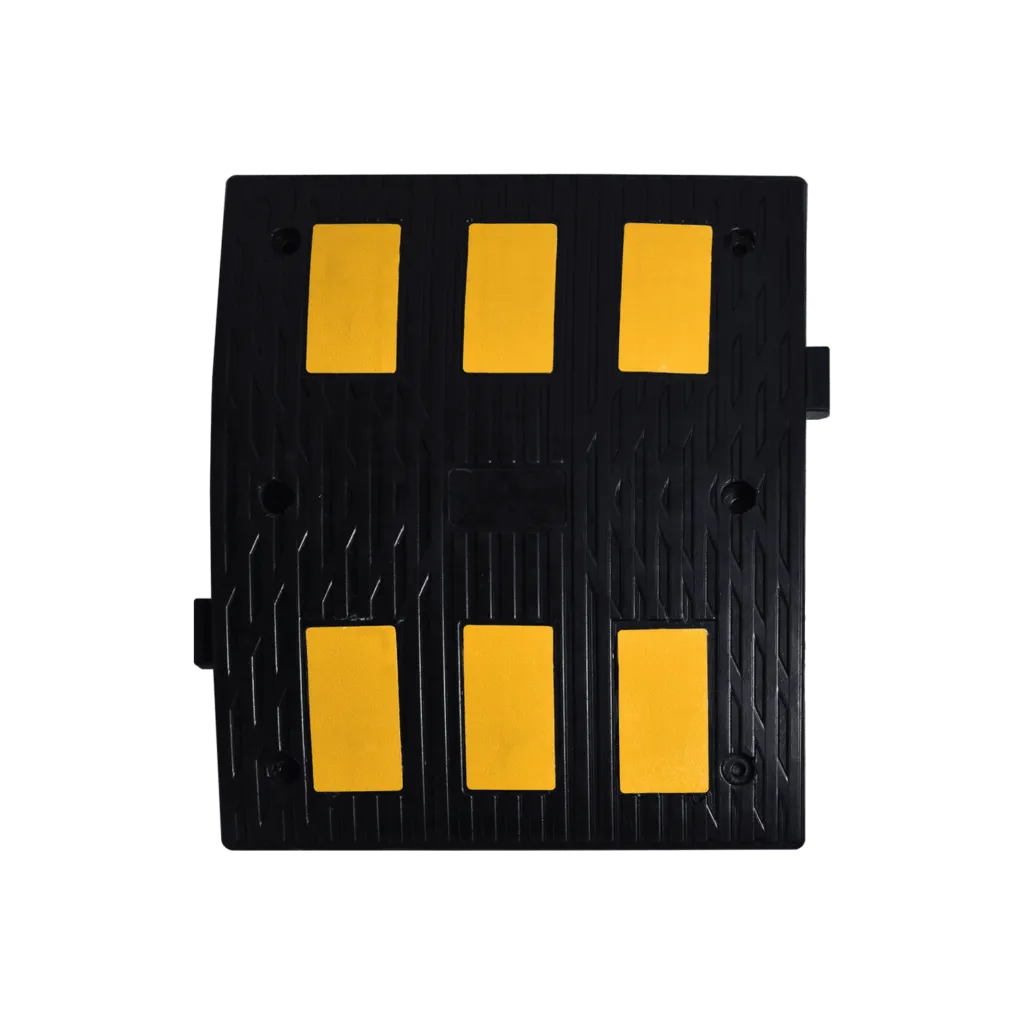
- V19-600: 60 cm wide, 4.5 cm tall, 8.5 kg, 6 strips, for 20 km/h; for underground car parks, streets where children play and warehouses that pedestrians also walk through;
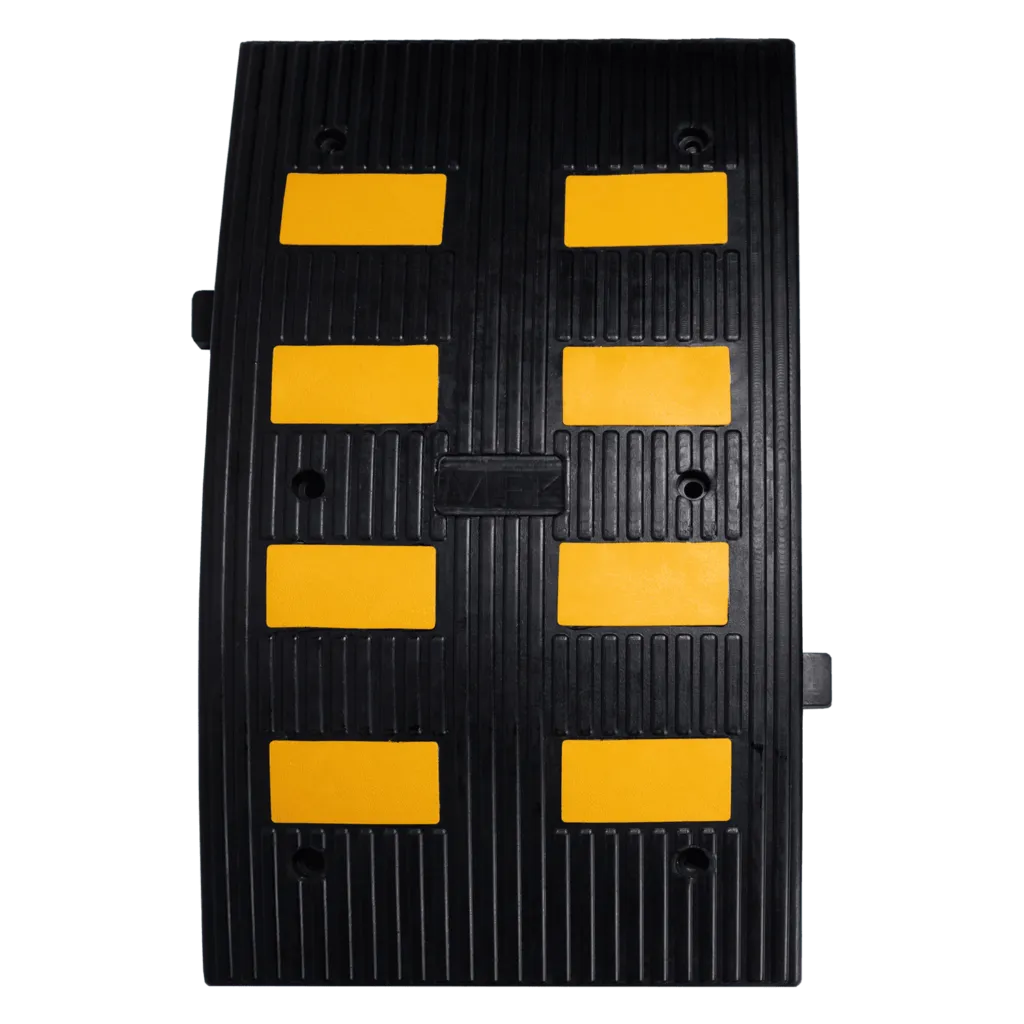
- V19-900: 90 cm wide, 4.5 cm tall, 17 kg, 8 strips in two columns, for 10 km/h; the widest, for entrances to pedestrian zones and school yards.
Each has its own end cap for the ends of the row: V19-401, V19-501, V19-601 and V19-901. You will find them all under rubber and compound speed bumps.
Compound speed bumps
The compound models are also black and also have reflective strips, but their surface has a chevron texture:
- ATZ 40400: 40 cm in the direction of travel and 4 cm tall, for 30 km/h, like the V19-400, but it weighs 5.9 kg instead of 7 kg and has 4 reflective strips instead of 2; its end cap, the ATZ 40401, is only 10 cm long;
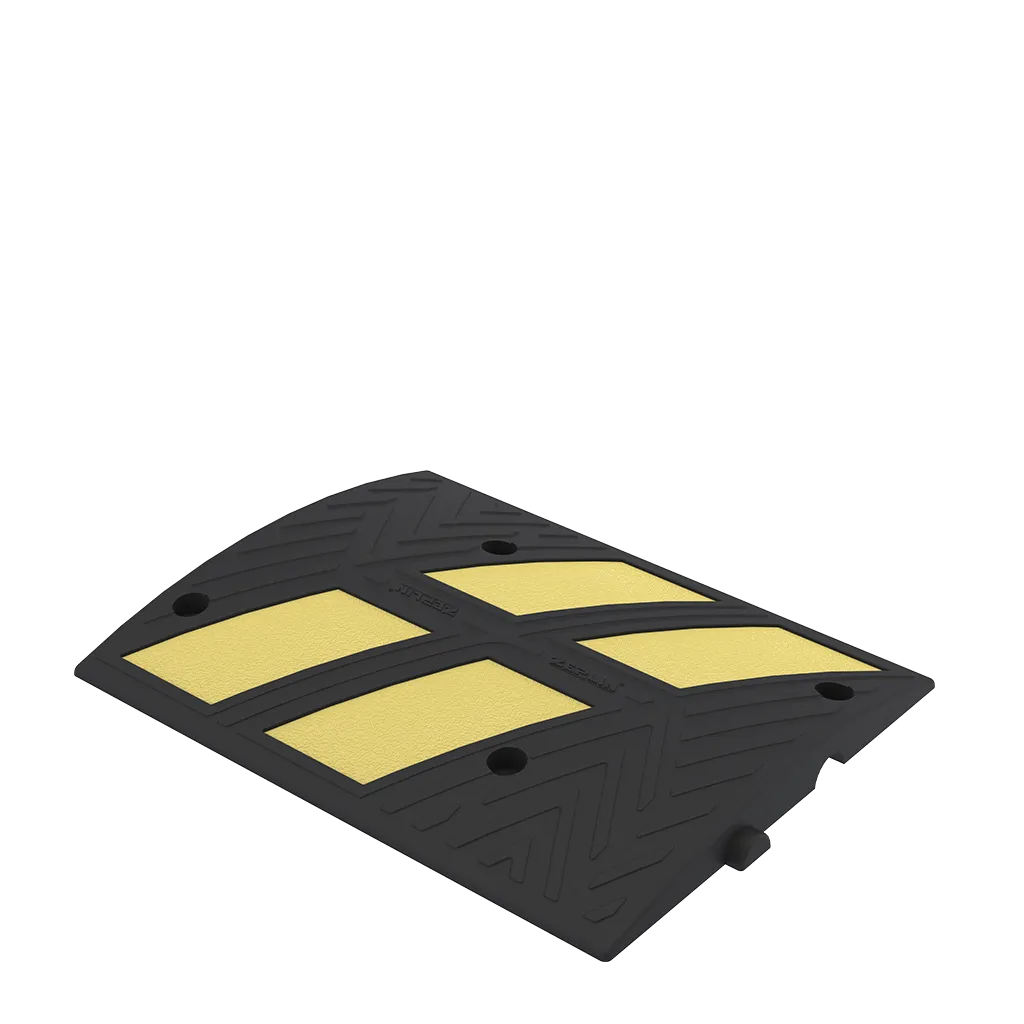
- ATZ 45600: the wide version, 60 cm in the direction of travel, 4.5 cm tall and 9 kg, with 4 reflective strips in two pairs; its end cap, the ATZ 45601, is 15 cm long.
The ATZ 45600 goes where you want a longer crossing than over the 40 cm bumps, such as industrial park roads and large car park entrances. Compared with the V19-600, of the same width, it has 4 strips instead of 6 and 5 fixing points instead of 4.
Plastic (PPC) speed bumps
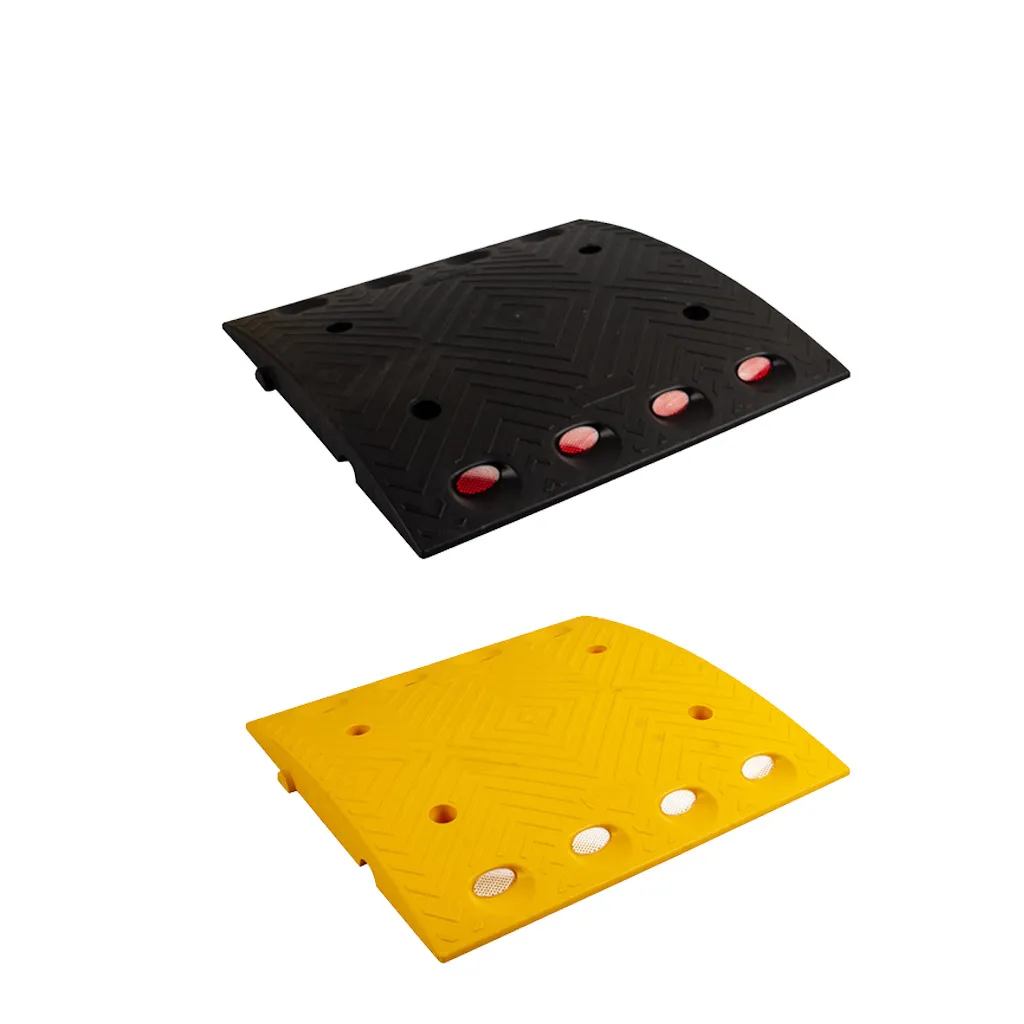
These are the light option. A 50 cm PPC piece weighs 3.5 kg, against 8 kg for a rubber one of the same size, so a whole row is easy to carry and quick to fit. Instead of reflective strips they have red cat’s eye reflectors on the long sides, and they are sold by the piece, in black or yellow, to be laid alternately:
- ATZ 50500: 50 x 50 x 4.5 cm, 3.5 kg, 8 reflectors, for 20 km/h, 2 pieces per metre; end cap: ATZ 50501, 20 cm long;
- ATZ 50250: 33 x 25 x 5 cm, 1.5 kg, 6 reflectors, for 10 km/h, 3 pieces per metre; end cap: ATZ 50251, 10 cm long.
The ATZ 50250 seems to break the width rule: it is only 25 cm in the direction of travel, yet it is made for 10 km/h. The height makes the difference: 5 cm on such a short ramp is felt clearly, so vehicles pass almost at walking pace. It is the bump for underground car parks, shared garages, petrol stations and company yards. The plastic models are under plastic speed bumps.
The one-way spike bump
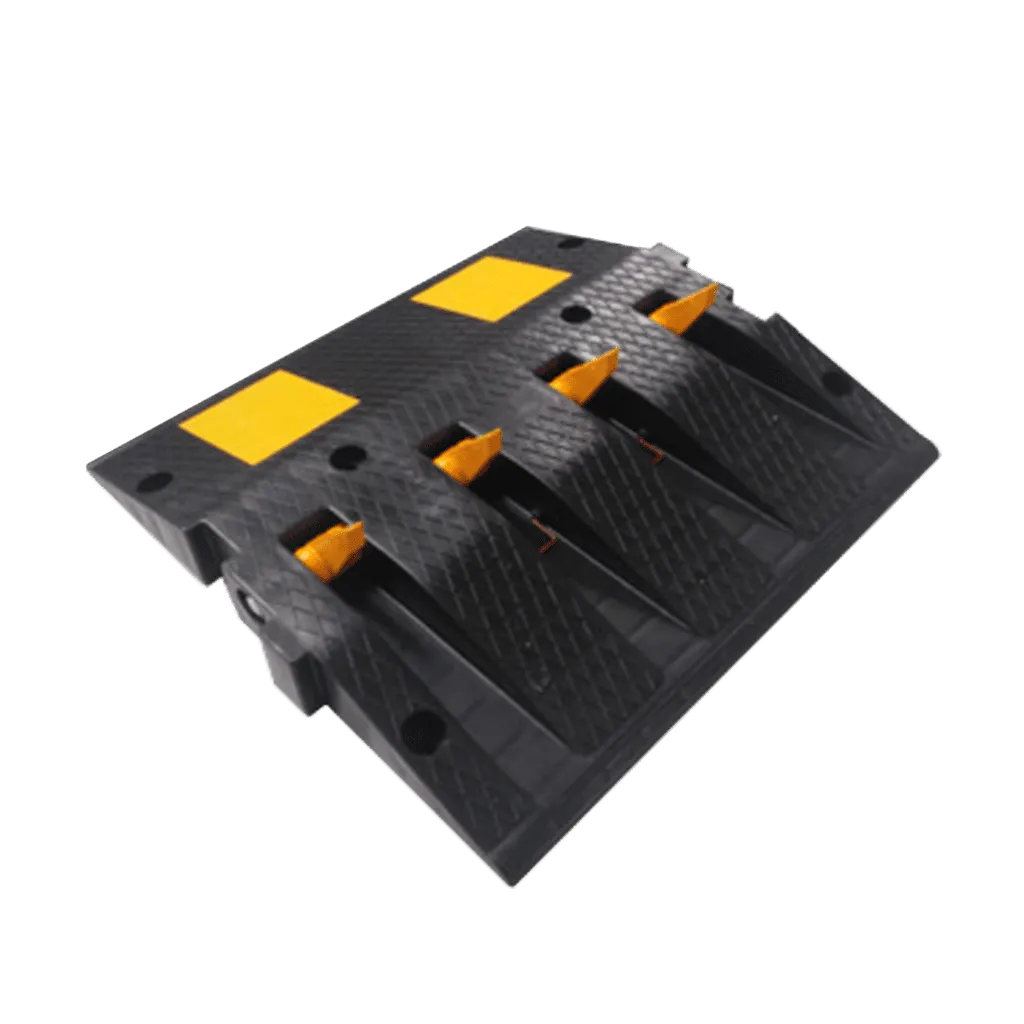
The ATE 12290 is not an ordinary speed bump. Four yellow metal spikes come out of its black PPC body, angled in the permitted direction of travel. From that direction, vehicles drive over it like any speed bump; against the flow, the spikes can puncture the tyres. It goes at the exit of a car park with separate entry and exit, at the gate of a company yard or on an access ramp. It measures 50 x 50 x 6 cm, weighs 7.3 kg, has 2 yellow reflective strips and is fixed at 6 points, on concrete or asphalt. Two pieces fit per metre, and the ends of the row take the ATE 12291 end cap, 9 cm long.
Because it can damage wheels, the spike bump is only fitted together with clear signs: one-way on the permitted side and no entry on the opposite side, placed before it, so drivers know in good time which direction is the right one.
Cable protectors
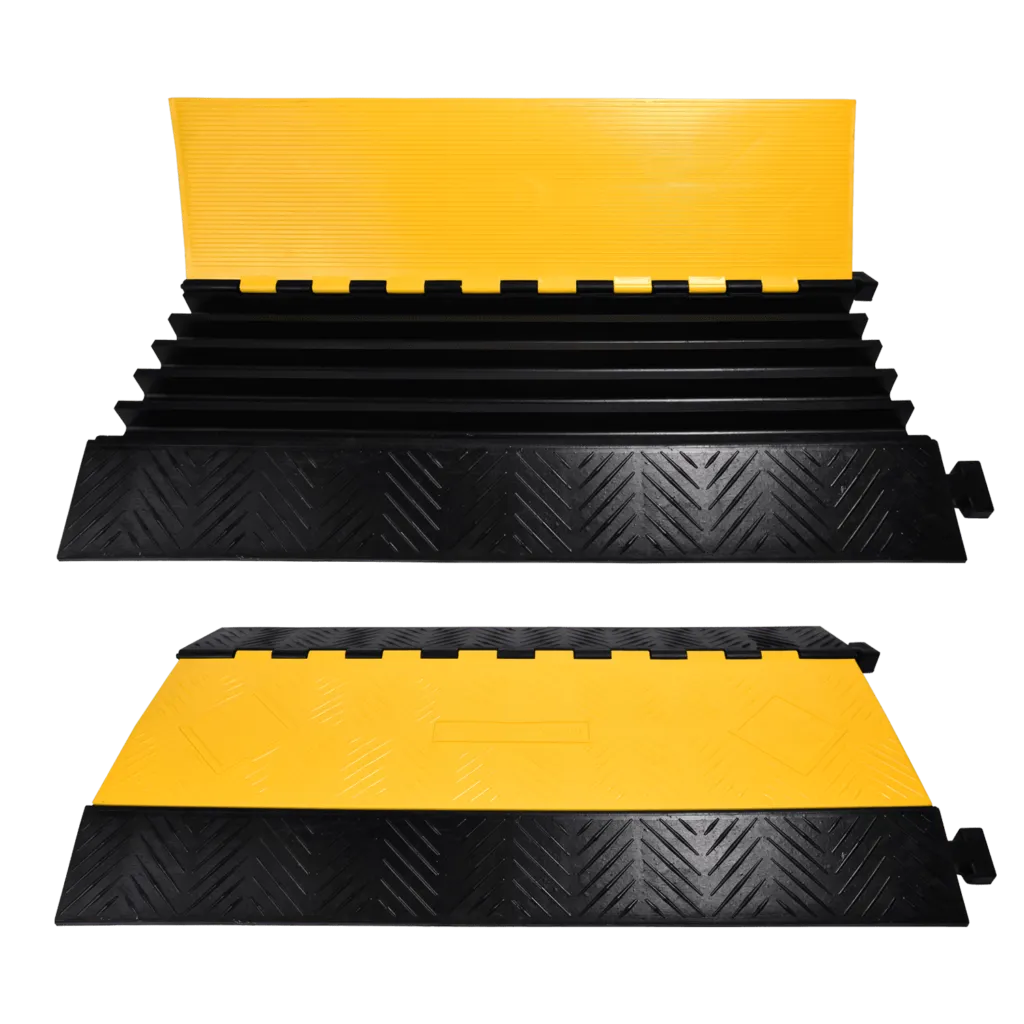
They are not made to slow vehicles down, but they also lie across the road. When a power cable or a hose has to cross a lane, a site road, the entrance of a hall or the grounds of a concert or fair, you put it in a protector: the cables sit in channels under a yellow hinged lid, and pedestrians, trolleys and vehicles pass over them. The body is black vulcanised rubber with side ramps, and the pieces join end to end, with no gaps, for as many metres as you need:
- ATZ R102: 2 channels of 3 x 3 cm, 100 x 25 x 4.5 cm, 8.5 kg;
- ATO 5855: 5 channels of 3 x 3 cm, 90 x 50 x 5.5 cm, 17.5 kg.
Both are rated for crossing at 10 km/h. You choose by the number of cables: for one or two, the ATZ R102 is enough, narrower and easier to move; from three cables up, or when a hose runs along the same route, take the ATO 5855. You will find them under cable protectors and under special speed bumps, next to the spike bump. If you are also closing a lane on the same site, the right beacons are explained in our guide to road beacons.
How to choose: three questions
How fast do you want vehicles to pass?
According to the product sheets:
- 30 km/h: V19-400, V19-500 and ATZ 40400;
- 20 km/h: V19-600 and ATZ 50500;
- 10 km/h: V19-900 and ATZ 50250.
30 km/h suits shop car park lanes, residential courtyards and petrol station entrances. Where there are pedestrians, children playing or loading areas, go down to 20 or 10 km/h, with a 60 or 90 cm bump.
How smooth should the crossing be?
At the same speed, the wider bump is gentler: the V19-500 is also made for 30 km/h, but its 50 cm ramp gives a smoother crossing than the V19-400. In a busy car park, the difference is noticeable.
Rubber, compound or plastic?
Rubber and compound are heavy, with yellow reflective strips, and are the usual choice for internal streets, yards and open-air car parks. Plastic weighs less than half at the same size, is quicker to fit and stands out through alternating black and yellow by day and red reflectors at night.
How to work out a row
A complete row means the bumps in the middle plus one end cap at each end. The cap slopes down in a curve to the asphalt, so that the wheel of a bicycle or of a car cutting the corner does not hit a step. Each cap has the same width and height as its own bump and fits only that model: the V19-601 and the ATZ 45601, for example, are both for 60 cm bumps, but they are not interchangeable. End caps range from 9 to 30 cm in length, and on a narrow lane that decides whether the row fits.
- Measure the width of the road between the kerbs.
- Subtract the length of the two end caps.
- Divide the rest by the length of one piece: 50 cm for almost all models, so 2 per metre, and 33 cm for the ATZ 50250, so 3 per metre.
- Round down, so that the row fits between the kerbs.
The end cap lengths, from the sheets: the V19-401 and V19-501 are 25 cm, the V19-601 is 30 cm, the ATZ 50501 is 20 cm, the ATZ 45601 is 15 cm, the ATZ 40401 and ATZ 50251 are 10 cm, and the ATE 12291 is 9 cm. A few examples:
- 5 m street: 9 pieces of V19-500 (4.5 m) and 2 V19-501 end caps; the row is exactly 5 m;
- 4 m street: 7 pieces of ATZ 45600 (3.5 m) and 2 ATZ 45601 end caps (30 cm), with 20 cm left at the edge;
- an entrance of exactly 3 m with the spike bump: 5 pieces of ATE 12290 and 2 ATE 12291 end caps, 2.68 m in total.
With the plastic models there is one more step: count how many pieces of each colour you need, end caps included. The end caps also come in black and in yellow; for each end, choose the colour opposite to the last bump, so the alternation carries on to the kerb.
How to fit them
All bumps and end caps come with the dowels and screws in the pack and are fixed into asphalt or concrete. The number of fixing points grows with size: 4 points on most bumps, 5 on the ATZ 45600 and 6 on the V19-900 and the ATE 12290. End caps are fixed at 2 points, except the V19-601, fixed at 3, and the V19-901, fixed at 4.
- Clean the spot and mark the line of the row on the asphalt, from one kerb to the other.
- Lay the whole row on the ground, with the bumps joined through the side keys and the end caps at both ends.
- Only once the row is straight, mark and drill the holes.
- Insert the dowels and tighten the screws on every piece.
With the spike bump, check the direction once more before drilling: the spikes must be angled in the permitted direction of travel. Cable protectors go in differently: lift the yellow lid, lay the cables in the channels, close the lid and join the next piece end to end.
Frequently asked questions
What effect does a speed bump have?
It makes drivers slow down, without stopping the car. How much depends on its width and height: our models are made for 30, 20 or 10 km/h.
What are speed bumps made of?
Rubber (the V19 series), compound (the ATZ 40400 and ATZ 45600) or PPC plastic (the ATZ 50250 and ATZ 50500). The ATE 12290 spike bump has a PPC body and metal spikes.
How many speed bumps fit per metre?
Two, for all models that are 50 cm long. The ATZ 50250, which is 33 cm long, fits three per metre. At the ends of the row you add one end cap each.
Can the row be seen at night?
Yes. Rubber and compound bumps have between 2 and 8 yellow reflective strips, and the plastic ones have 6 or 8 red reflectors, which appear in the headlights as a line of red dots.
Can I put the spike bump on a two-way street?
No. The ATE 12290 lets vehicles pass only in the direction the spikes are angled; in the other direction the spikes can puncture the tyres. It goes only where traffic runs in a single direction, with one-way and no-entry signs.
Which cables fit in the cable protectors?
Both models have 3 x 3 cm channels: the ATZ R102 has 2 channels and the ATO 5855 has 5. Check the thickness of the cables or the hose before ordering.
How we can help
All speed bumps, end caps and cable protectors are under speed bumps. If you are not sure how many pieces you need, send us the width of the road between the kerbs, the speed you want and the kind of traffic that passes there, and we will put the list together for you, end caps included. If you also want the signs that announce the row, we will add them to the same list.