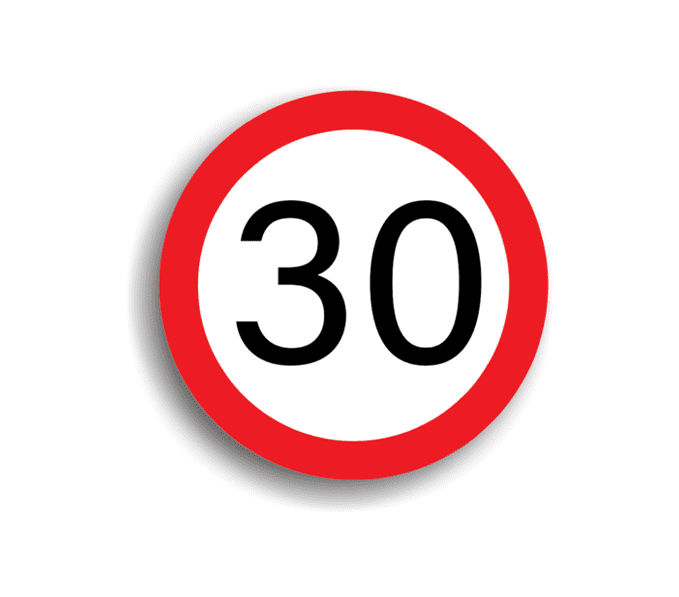
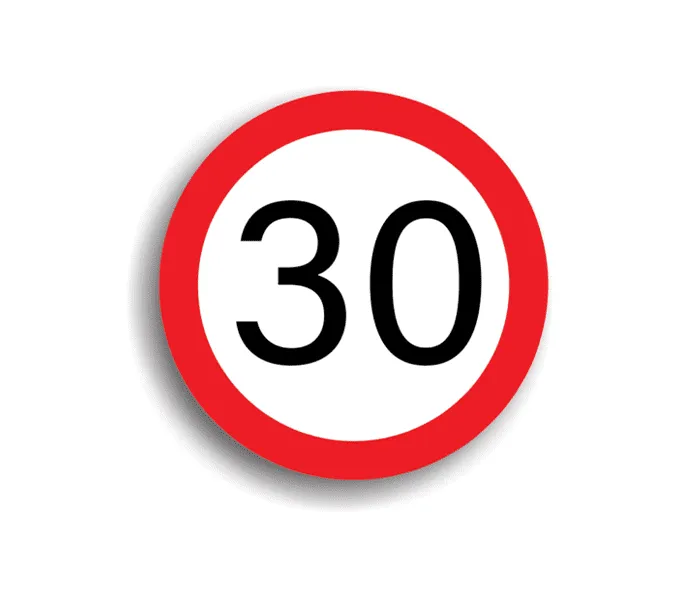
C27 - Speed limit 30 km/h (Ø60 cm - CLASS I)
- Material:: 1mm Oțel galvanizat
- Sistem de Prindere:: Cleme x2, Şurub si Piuliţa x4
- Reflectorizant:: Folie tip EG Cl.1
- Greutate: 3 kg
Complementary products
General features
| Material: | 1mm Galvanized steel |
|---|---|
| Reflective: | EG type film Cl.1 |
| Mounting System: | Clamps x2, Screw and Nut x4 |
| Weight | 3 kg |
| Height | 60 cm |
Product description
Speed Limit 30 km/h – Road Safety in Risk Areas
Every day, on roads around the world, road safety is an absolute priority. A key factor in preventing accidents is controlling vehicle speed. The speed limit sign at 30 km/h is an essential measure that helps reduce accident risks, protecting the lives of all road users, whether they are drivers, pedestrians, or cyclists.Why is the sign “Speed Limit 30 km/h (60 cm, CLASS I)” important?
- Reducing accident risks Speed limits are established to protect road users and prevent accidents. In areas with heavy traffic, near schools, parks, or residential areas, a speed of 30 km/h is considered optimal to avoid collisions. The limit sign helps drivers adjust their speed according to traffic conditions and the safety of the area.
- Safety of pedestrians and cyclists In many locations, pedestrians and cyclists are more vulnerable than vehicles, and the speed limit sign significantly contributes to their protection. It ensures a quick response from drivers in the face of potential obstacles, such as children playing or people crossing the street.
- Reducing noise pollution and emissions Speed limits help not only in reducing accidents but also in lowering traffic noise, which is particularly important in residential areas. Additionally, a lower speed contributes to reducing harmful gas emissions, having a positive impact on the environment.
- Improving traffic flow Although it may seem that speed limits would slow down traffic, in reality, they can contribute to smoother circulation, reducing the risks of congestion and collisions. At lower speeds, drivers have more time to react and adjust the vehicle's trajectory.
- Increasing driving comfort The speed limit sign at 30 km/h can contribute to a more relaxed and safer driving environment. Drivers can travel more calmly, knowing that limits are being respected and that accident risks are lower.
Where can the sign “Speed Limit 30 km/h (60 cm, CLASS I)” be used?
- Near schools and playgrounds: to protect children and families in these areas.
- In residential areas: to prevent accidents in busy neighborhoods or areas with many pedestrians.
- Near hospitals or other sensitive institutions: where peace and safety are a priority.
- In areas with heavy traffic: to reduce accident risks and improve traffic flow.
- Near parks or shopping areas: where pedestrians and cyclists are frequently on the move.
Advantages of using the sign “Speed Limit 30 km/h (60 cm, CLASS I)”
- Increased safety for pedestrians and cyclists: protects vulnerable road users.
- Reducing accidents: the sign helps reduce collision risks, especially in crowded areas.
- Increased driving comfort: drivers can drive more relaxed, knowing that speed is regulated.
- Reducing pollution: contributes to lowering noise and exhaust gas emissions.
- Improving traffic: the sign helps reduce congestion and increase traffic efficiency.
? Frequently asked questions
Ordering and delivery
Can I order as a private individual?
Yes. You order directly on the site, as an individual or a company, and pay by card or cash on delivery.
Do I get an invoice?
Yes. Every order comes with a tax invoice, issued to an individual or a company.
Can I buy through SEAP / SICAP?
Yes. Public institutions find us in SICAP as S.C. ATTO REGAL S.R.L. Our company details are on the Purchase through SEAP / SICAP page.
How long does delivery take?
We deliver by courier within 24-48 hours.
Can I return the product?
Yes. As a private individual you can return the product within 14 days of receiving it, as the law provides, and you get your money back within 14 days of telling us. Return shipping is paid by the customer. The full terms are on the Return policy page.
Other similar models
Get a personalised offer, transport included.
Sending this form is not an order.
 C27 - Speed limit 30 km/h (Ø60 cm - CLASS I) (C27-30)
We will send you the offer, transport included, as soon as possible by email or phone.
In road safety since 1998
Atto Trafic supplies complete road signage and safety equipment — signs, traffic signs, markings, parking barriers, speed bumps, mirrors, bollards and accessories.
- Durable products, compliant with STAS and SR EN
- ISO 9001 / 14001 / 27001 / 20671 certified
- Constant stock, delivery within 24-48 hours
- Support for municipalities, contractors, private car parks