

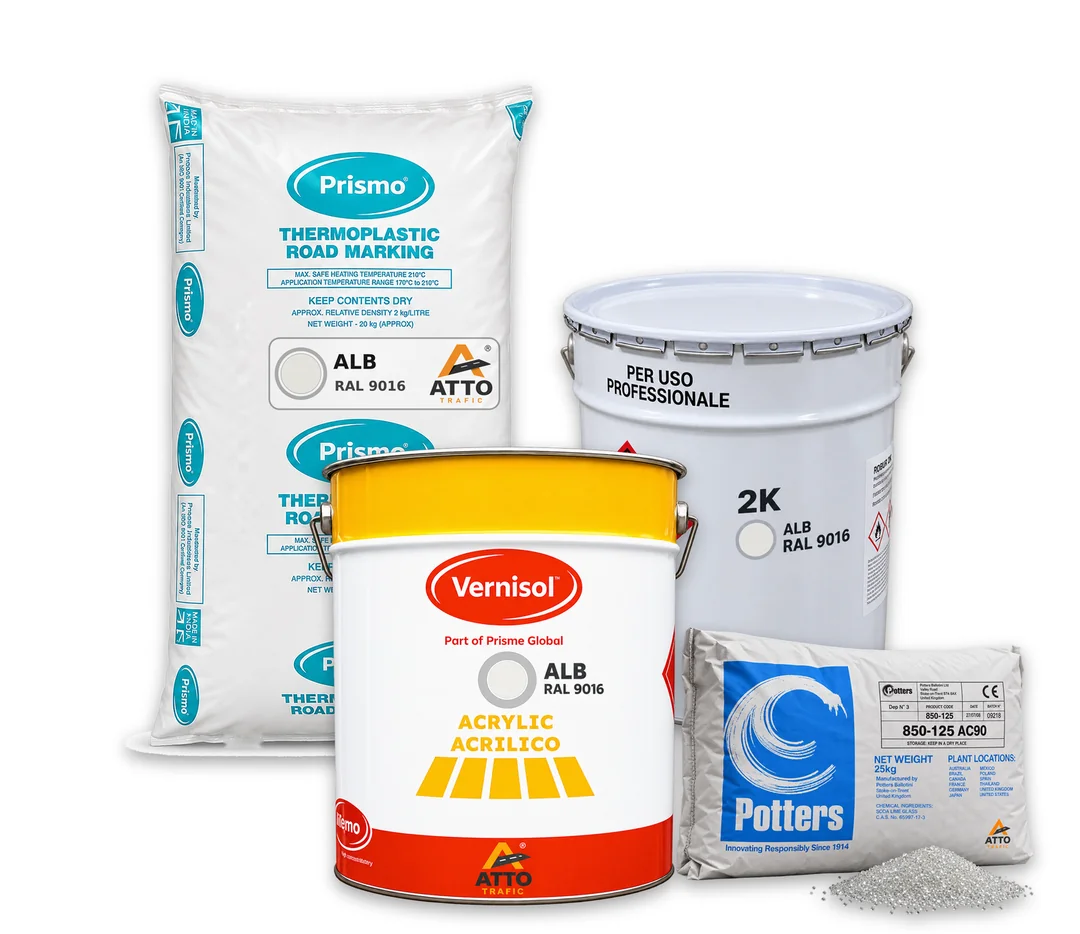
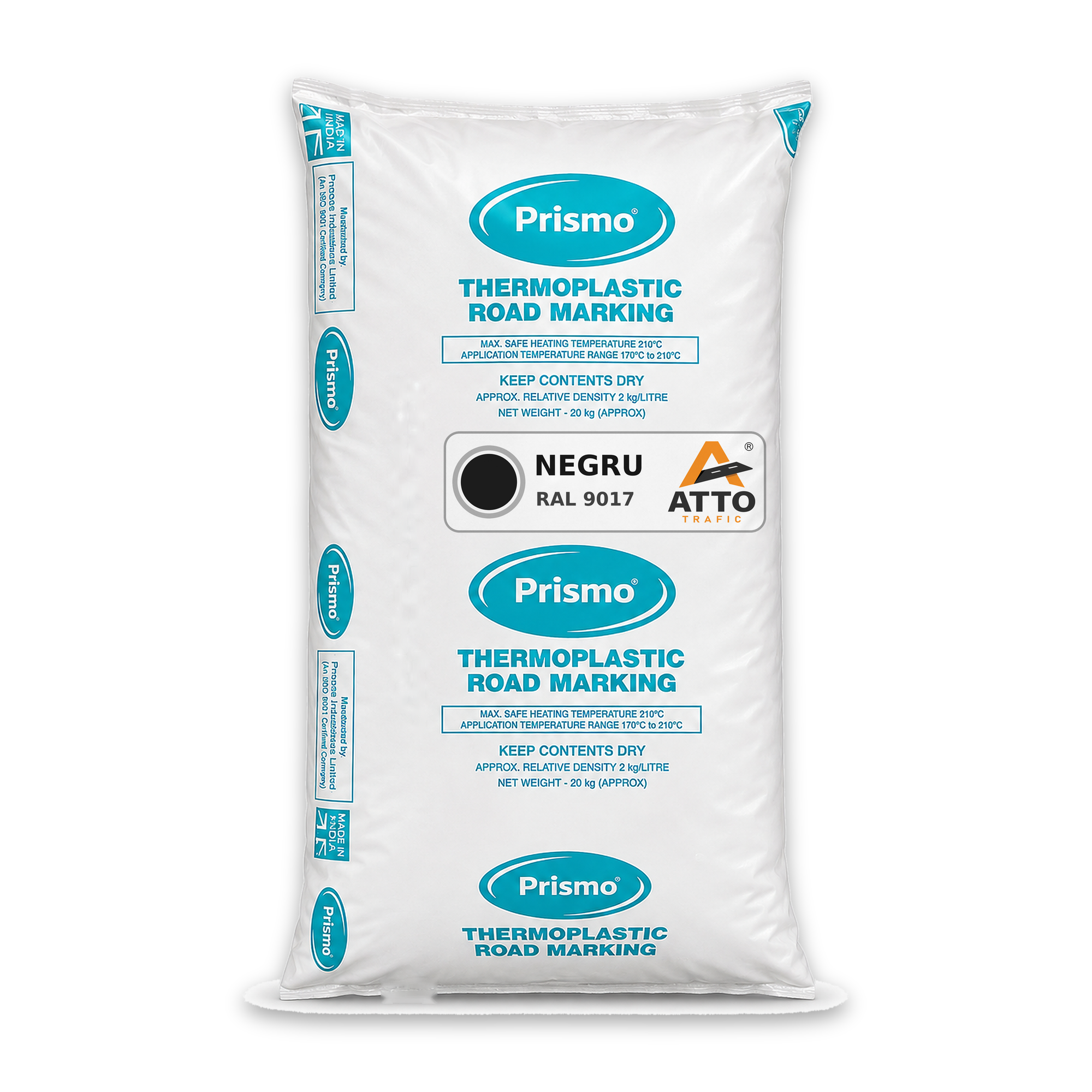
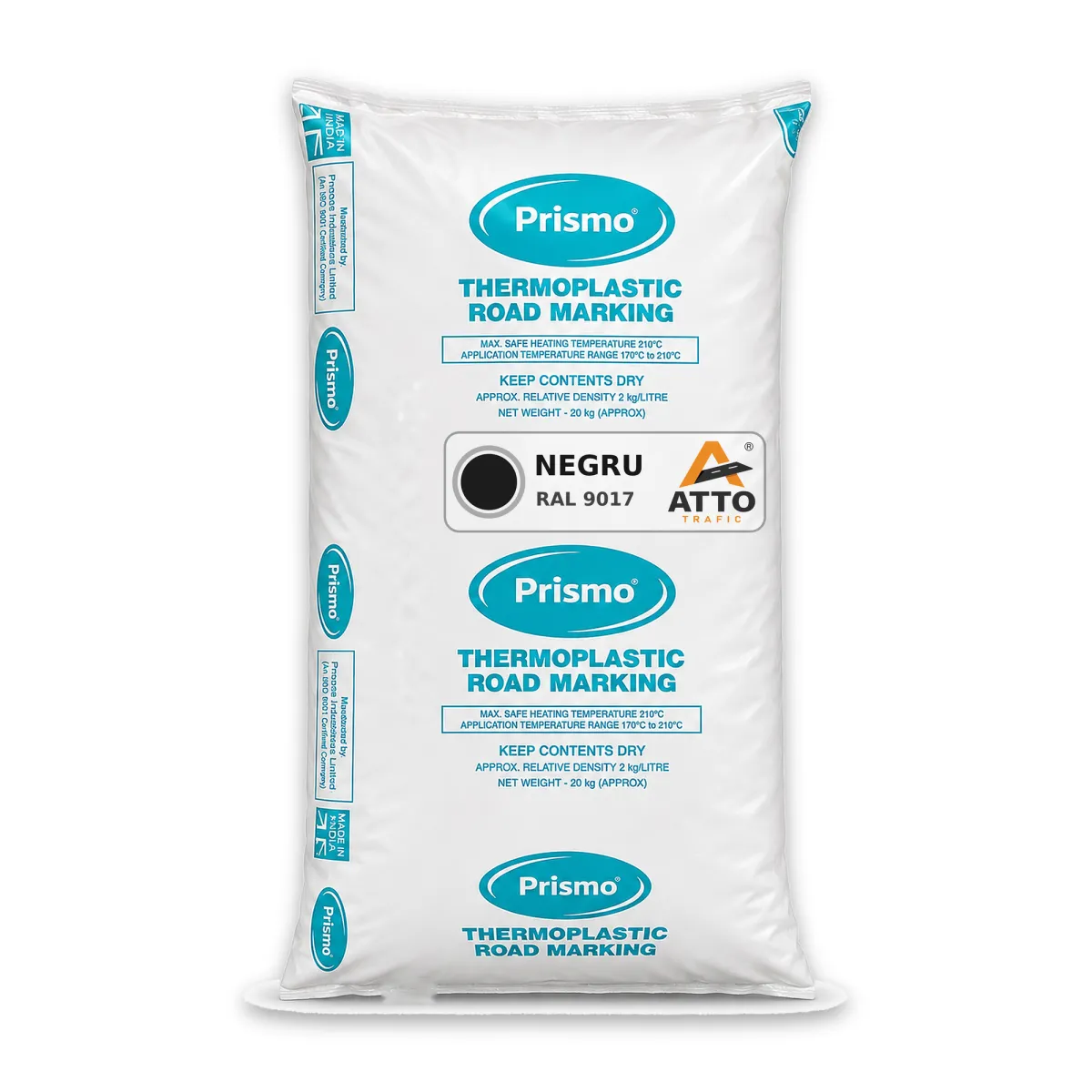
Hot-Applied Thermoplastic Road Marking Material, Black (RAL 9017), 20 kg
- Black hot-applied thermoplastic (RAL 9017).
- 20 kg meltable bag; 6 kg/m² at 3 mm.
- Type II: retroreflective also in wet or rainy weather.
- Softening point ≥ 110 °C (SP4).
Complementary products
General features
| Type | Hot-applied thermoplastic road marking material |
|---|---|
| Marking type | Type II flat marking: retroreflective also in wet or rainy weather |
| Colour | Black (RAL 9017) |
| Weight | 20 kg |
| Packaging | 20 kg meltable bag, material in powder form |
| Density | 1.9-2.1 g/cm³ |
| Softening point | SP4, ≥ 110 °C (EN 1871) |
| Application temperature | 170-190 °C |
| Maximum heating temperature | 220 °C |
| Typical thickness | 3 mm |
| Consumption | 6 kg/m² at 3 mm thickness (about 4 kg/m² at 2 mm); drop-on glass beads: 400 g/m² |
| Application | By hand with screed tools, or with an extrusion machine |
| Road performance (EN 1436) | Initial: Qd Q5, RL dry R5, wet RW3, rain RR1, SRT S2; after 2 million wheel passes (P6): Q4, R2, RW2, RR1, S1 (measured on the white version) |
| Durability | P6, 2,000,000 wheel passes (EN 13197) |
| Compliance | EN 1871, EN 13197, EN 1436 |
| Storage | Dry, covered place, away from direct sunlight |
| Shelf life | 24 months from manufacture |
Product description
Black thermoplastic for road markings, RAL 9017, 20 kg
On high-traffic roads, markings have to last longer than a coat of paint. The ATA 4520 is a black hot-applied thermoplastic: it is applied molten, at 170-190 °C, in a typical 3 mm layer, several times thicker than acrylic paint, so it stands up to traffic for much longer.
Type II marking
It is certified as a type II flat marking: it stays visible at night not only when the road is dry, but also when it is wet or raining. Under EN 1436 it starts at retroreflectivity R5 dry, RW3 wet and RR1 in rain, daytime visibility Q5 and skid resistance S2; after 2 million wheel passes (class P6, EN 13197) it keeps R2, RW2, RR1, Q4 and S1 (values measured on the white version).
Consumption
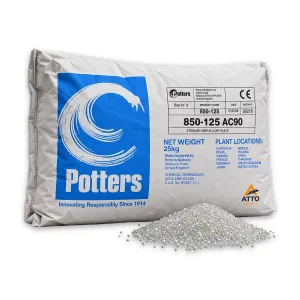
6 kg/m² at the typical 3 mm thickness, so a 20 kg bag covers about 3.3 m²; at 2 mm, about 4 kg/m² (5 m² per bag). ATP AC90 glass beads are dropped on straight after, 400 g/m².
Application
By hand with screed tools or with an extrusion machine, at 170-190 °C; do not heat it above 220 °C. The material comes as powder in a 20 kg bag that melts together with it.
Technical data
- density 1.9-2.1 g/cm³;
- softening point SP4, at least 110 °C;
- compliant with EN 1871, EN 13197 and EN 1436;
- shelf life 24 months from manufacture, stored dry, covered and out of direct sunlight.
Other colours
? Frequently asked questions
What is the ATA 4520 black thermoplastic used for?
On concrete or light-coloured asphalt, a white line is hard to see, especially in sunshine. A black border beside it increases the contrast; the ATA 4520 is used for such borders and for other markings that need black.
How is it applied?
It is melted and applied at 170-190 °C, by hand with screed tools or with an extrusion machine, in a typical 3 mm layer; do not heat it above 220 °C.
How long does the lane stay closed?
Not long: the material sets by cooling, not by a solvent evaporating, so the lane reopens once the marking has cooled; how long that takes depends on the road and air temperature.
How far does 20 kg go?
Consumption is 4 kg/m² at 2 mm and 6 kg/m² at 3 mm. A contrast border is narrow, so 20 kg goes a long way along a line.
Does the black marking need glass beads too?
Only if the marking also has to be retroreflective; the machine then also uses its glass bead gun, at about 400 g/m².
What does a type II marking mean?
That it stays visible at night not only on a dry road but also in wet or rainy weather: it starts at retroreflectivity R5 dry, RW3 wet and RR1 in rain (EN 1436), and after 2 million wheel passes it keeps R2, RW2 and RR1. The values are those measured on the white version.
Ordering and delivery
Can I order as a private individual?
Yes. You order directly on the site, as an individual or a company, and pay by card or cash on delivery.
Do I get an invoice?
Yes. Every order comes with a tax invoice, issued to an individual or a company.
Can I buy through SEAP / SICAP?
Yes. Public institutions find us in SICAP as S.C. ATTO REGAL S.R.L. Our company details are on the Purchase through SEAP / SICAP page.
How long does delivery take?
We deliver by courier within 24-48 hours.
Can I return the product?
Yes. As a private individual you can return the product within 14 days of receiving it, as the law provides, and you get your money back within 14 days of telling us. Return shipping is paid by the customer. The full terms are on the Return policy page.
Other similar models
Get a personalised offer, transport included.
Sending this form is not an order.
 Hot-Applied Thermoplastic Road Marking Material, Black (RAL 9017), 20 kg (ATA 4520)
We will send you the offer, transport included, as soon as possible by email or phone.
In road safety since 1998
Atto Trafic supplies complete road signage and safety equipment — signs, traffic signs, markings, parking barriers, speed bumps, mirrors, bollards and accessories.
- Durable products, compliant with STAS and SR EN
- ISO 9001 / 14001 / 45001 / 27001 / 20671 certified
- Constant stock, delivery within 24-48 hours
- Support for municipalities, contractors, private car parks