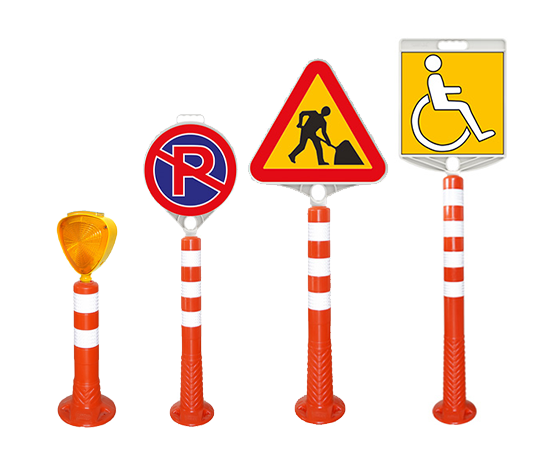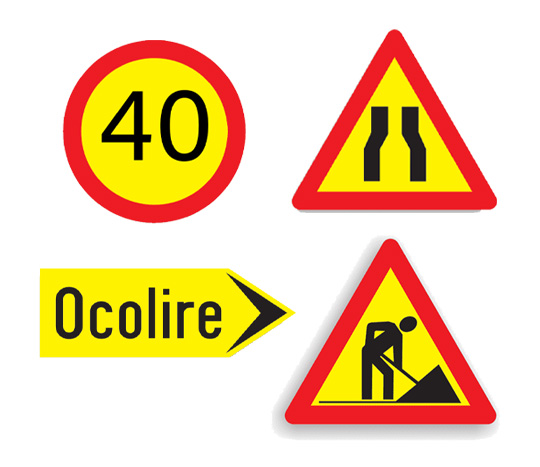
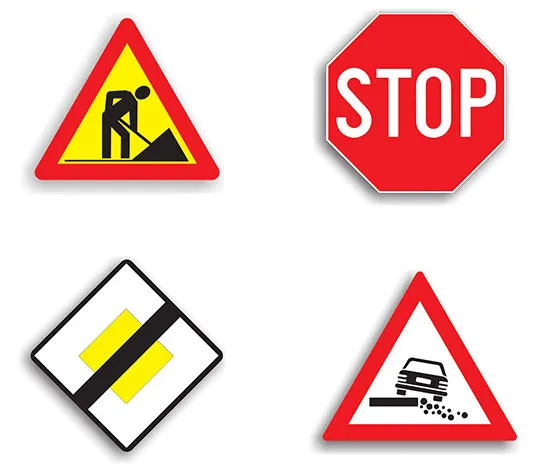
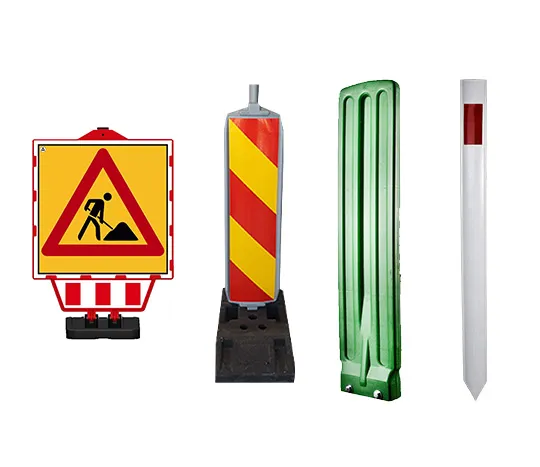
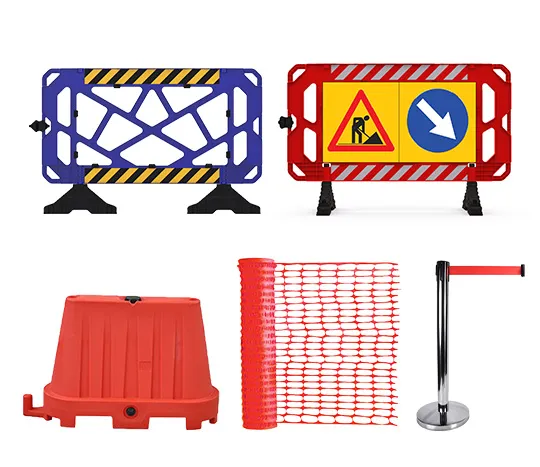
A fence blown over onto the pavement or a hole marked with a shovel stuck in the ground stops no one. Temporary barriers have one job: to say clearly “this far and no further”. On a building site they keep people away from the hole, on the road they keep vehicles away from the workers, and in a warehouse they close off a danger zone. This guide goes through the types of barriers we stock and helps you choose by how long the area stays closed, who has to be stopped and what the place looks like. All of them are mobile barriers that you bring, set up and pack away when the job is done; we are not talking here about the barriers at level crossings or automatic car park barriers.
The types of barriers and where each one is used
Modular fences, 150 x 100 cm
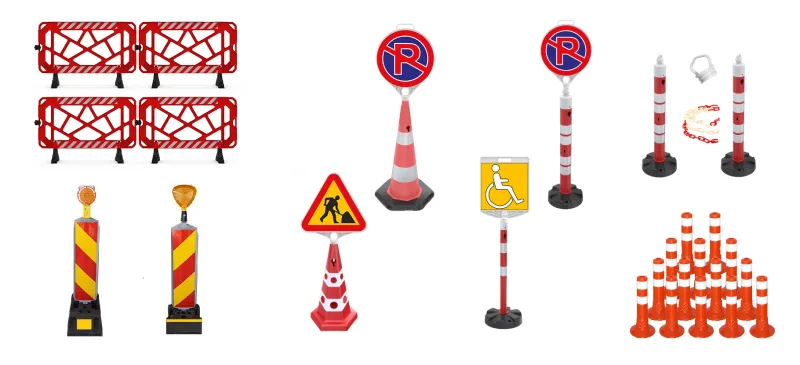
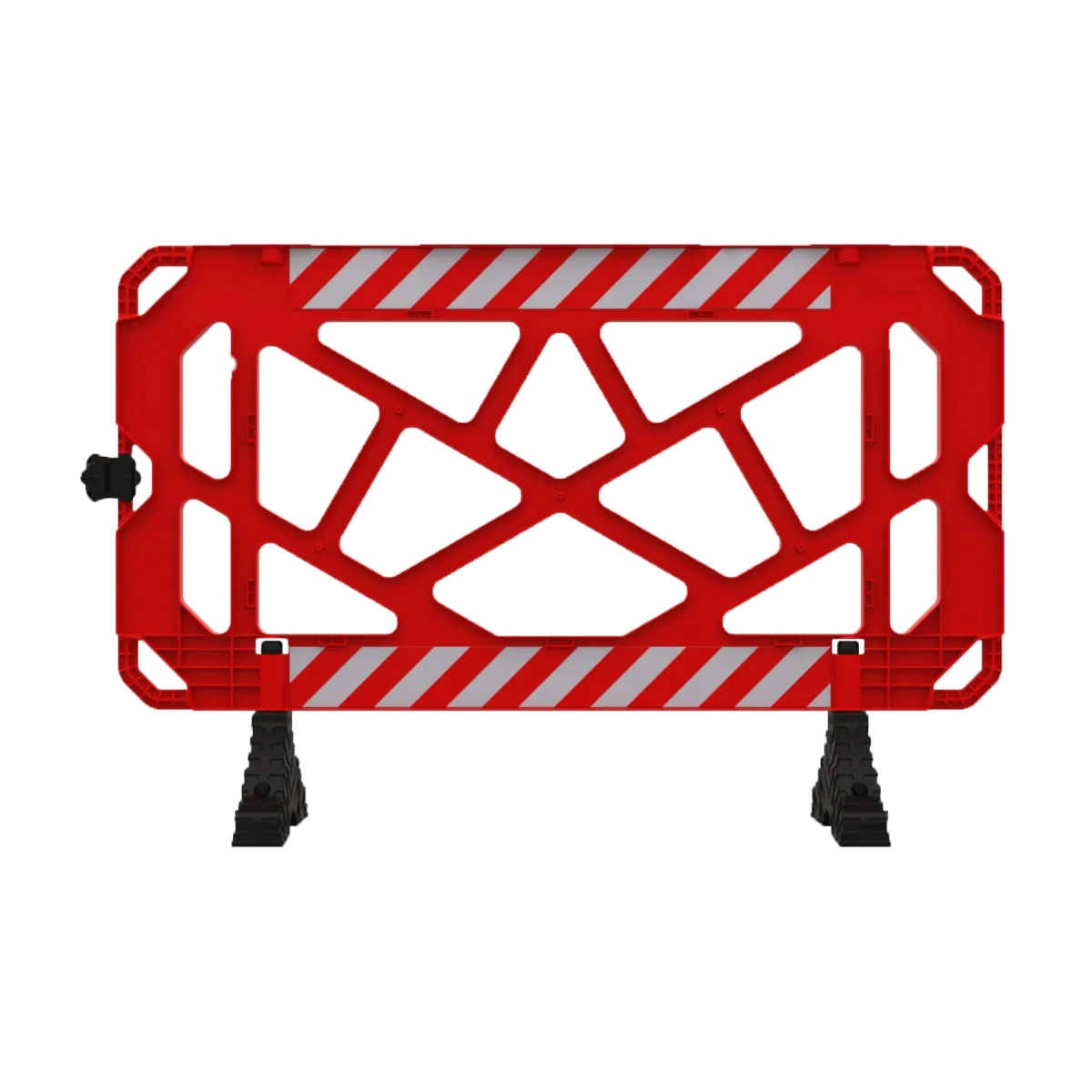
The modular fence is the building block of any temporary enclosure. It is 150 cm long and 100 cm tall, stands on two black feet and weighs 12.5 kg, so one person carries it and sets it up. The frame is PVC and PPC, 5 cm thick, with reflective strips at the top and bottom, 4 reflective sheets in all, and 2 threaded sockets for warning lamps or small plastic signs. The side clamp joins it to the next fence, so a few panels make a continuous enclosure as long as you need. You choose the colour by the place:
- ATZ 80150-R: red, with red-white strips; the usual choice for roads and building sites, around a hole, an open manhole or an area where people are working;
- ATZ 80150-W: white, also with red-white strips; it stands out against fresh asphalt or dug soil and looks tidier in a yard, at a building entrance or at an event;
- ATZ 80150-Y: yellow, with black-yellow strips; for hazards in warehouses and factories, such as inspection pits, forklift areas or machines under maintenance;
- ATZ 80150-BL: blue RAL 5012; less conspicuous than site red and easy to tell apart from the red fences of other crews, for example around a water or gas network repair.
All are under modular barriers.
Fences with a sign panel
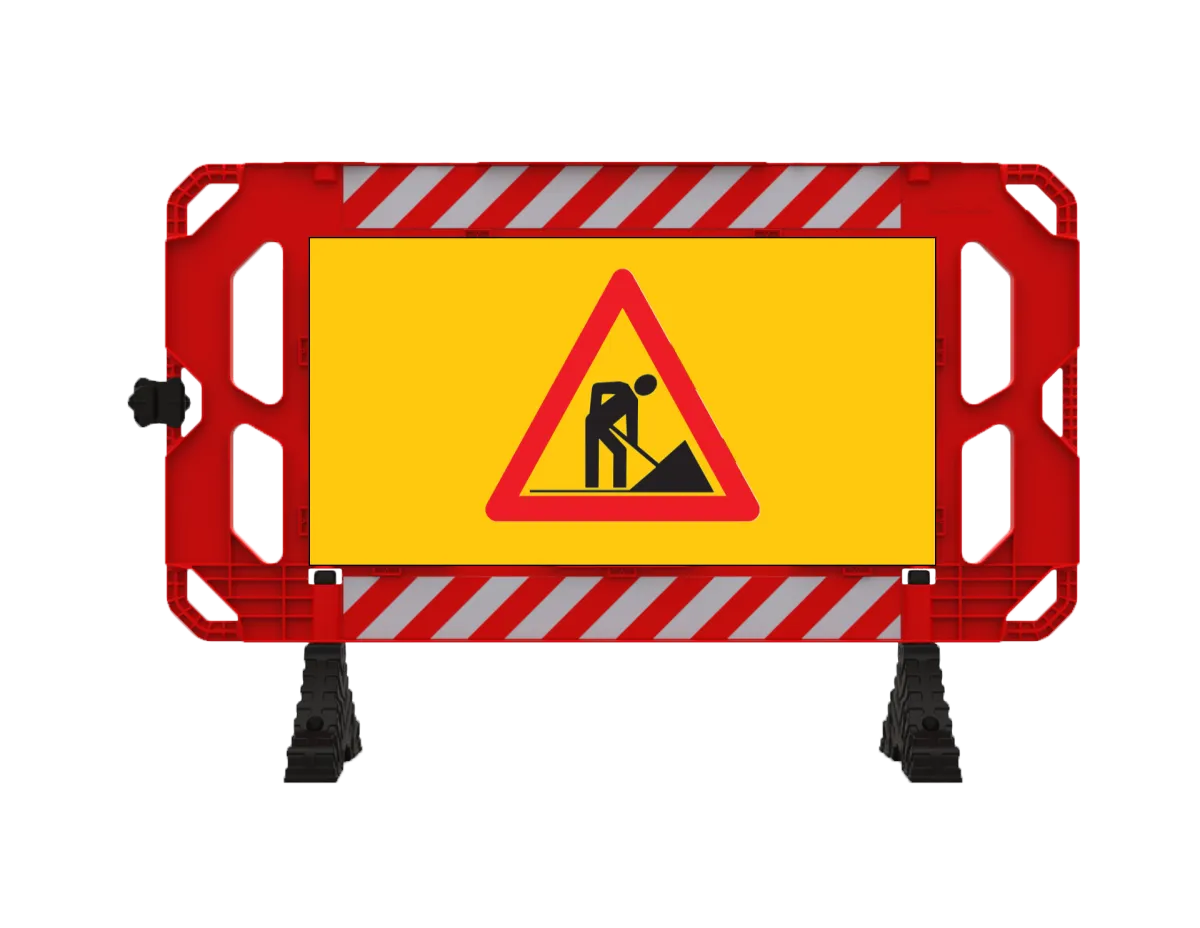
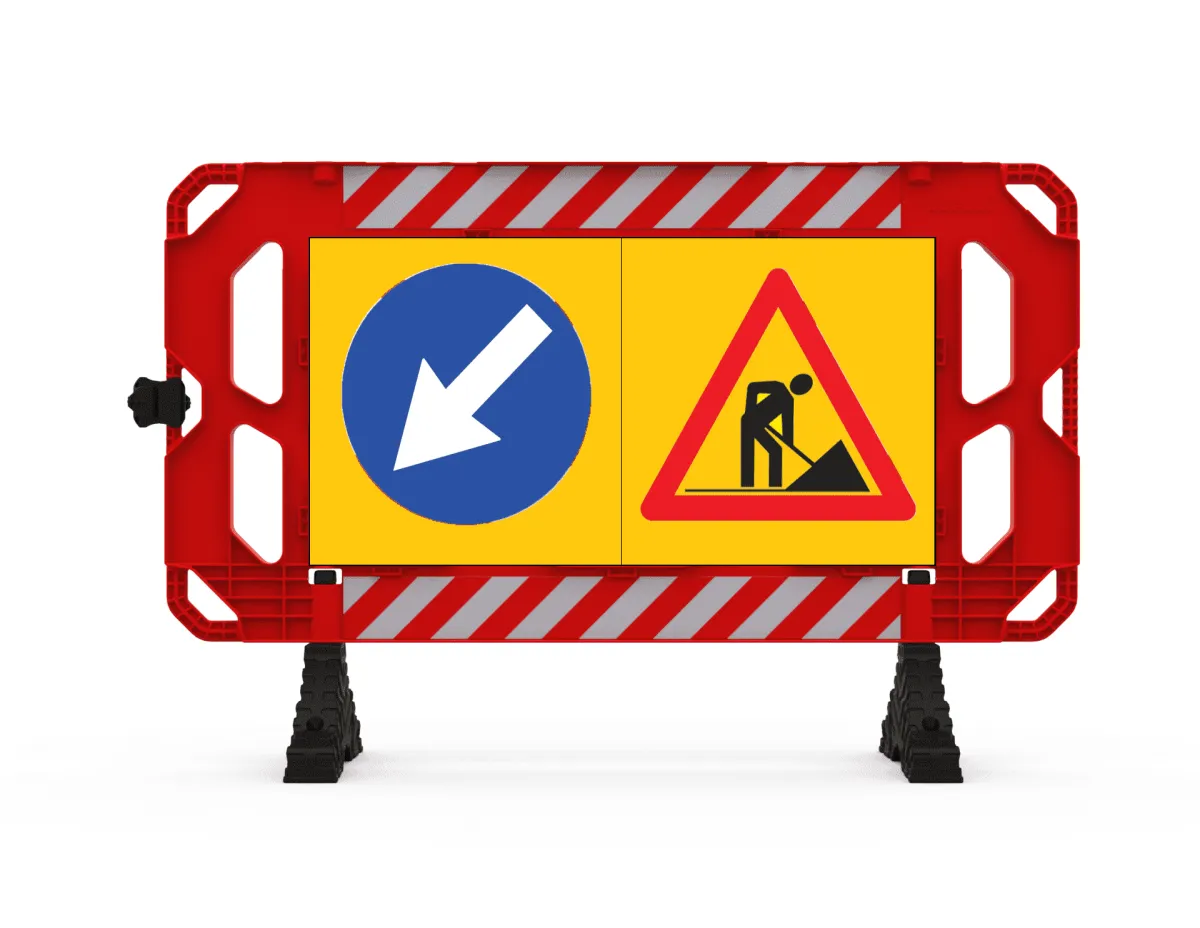
Road works need something that closes the area and something that tells drivers what to do. Fences with a sign panel do both: a yellow 100 x 50 cm panel with one or two signs is fitted in the middle of the red 150 x 100 cm fence, so you no longer need a separate post and stand for the sign. The combinations:
- ATZ 80150-RL: “Road works” only, the triangle with the man digging; for an excavation on the pavement or the entrance to a small site;
- ATZ 80150-ROL: keep left and “Road works”;
- ATZ 80150-RLO: “Road works” and keep right;
- ATZ 80150-ROS: keep left and STOP;
- ATZ 80150-RSO: STOP and keep right;
- ATZ 80150-ROA: keep left and “No entry”;
- ATZ 80150-RAO: “No entry” and keep right.
The fence under the panel is the red modular fence, with the same frame, strips, clamp and lamp sockets. It usually stands at the end of a row of plain fences, facing the oncoming traffic. All are under signalling barriers.
Expandable barriers
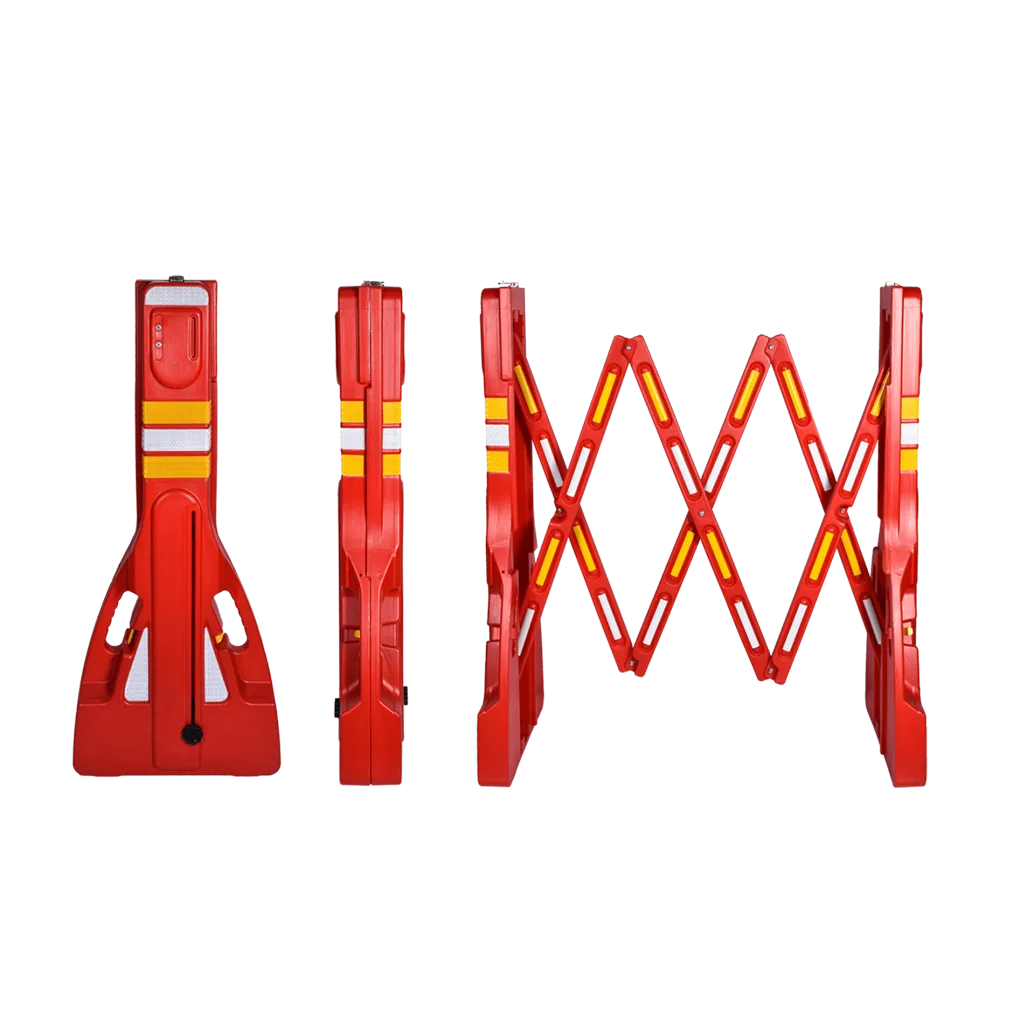
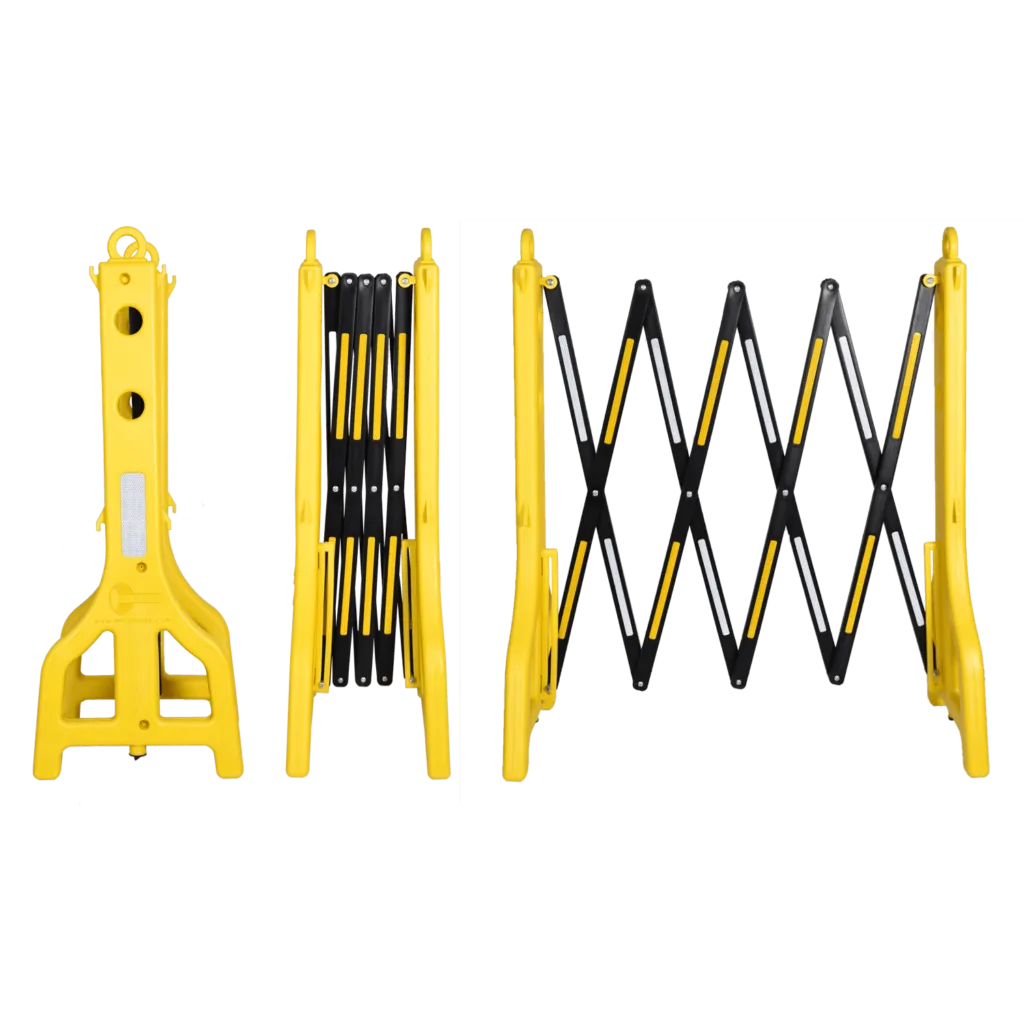
An expandable barrier has two posts with hinged bars between them that open like an accordion. You put one post by the wall or at the edge of the area and pull the other until the opening is covered; when you are done, you push the posts together and the barrier folds up. It is the fastest way to stop people getting into a place for a few hours: the door of a room under repair, a corridor, an open manhole, a lane in a car park.
- ATZ PB02: red, HDPE, opens to 230 cm, 110 cm tall and 7.5 kg, 15 cm folded; 12 reflective sheets and 48 reflective strips, yellow and white;
- ATZ PB03: yellow HDPE posts and black bars, opens to 250 cm, 95 cm tall, 2 kg empty and 9 kg filled, 25 cm folded; 32 reflective strips, yellow and white.
The ATZ PB02 is taller and heavier, so it stands better outdoors. The ATZ PB03 is held in one hand and can live in the service van; it suits the hall of a building being cleaned, a lift under inspection or the edge of an inspection pit. You will find them under extendable mobile barriers.
Ballastable New Jersey barriers
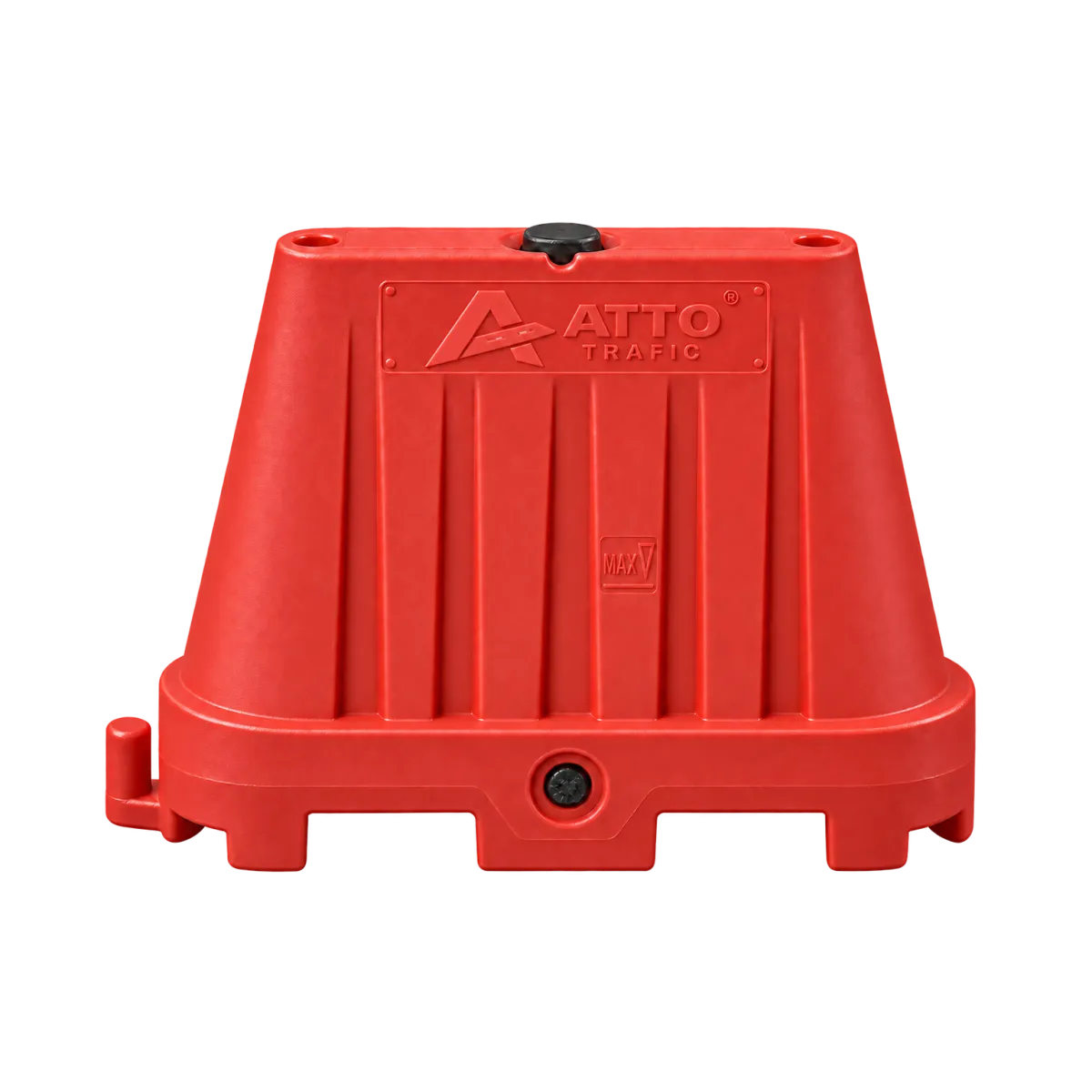
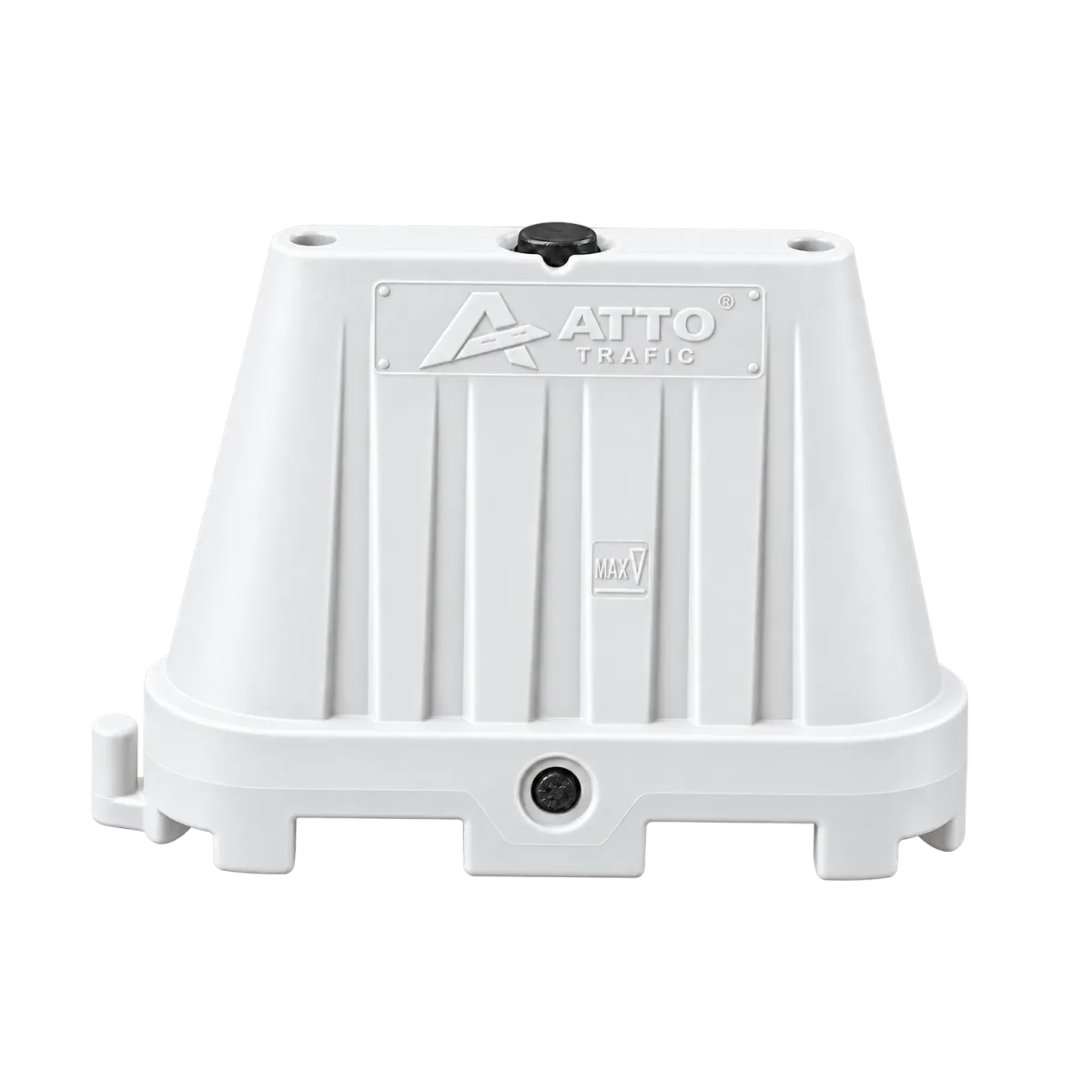
The New Jersey barrier has the shape of the concrete barriers along motorways, wide at the bottom and narrow at the top, but ours is PVC and weighs 7 kg empty. You carry it on your own, then fill it on the spot with water or sand: the inside holds 35 litres. That is how you close a lane, mark out a work zone along its length or separate the directions of traffic on roads with at least two lanes each way, with no crane and no heavy lorries. At the ends it has a linking system that joins it to the next barrier, whatever its colour, into a line with no gaps.
The V15 model is 100 x 40 x 70 cm and comes in four colours, so you can alternate them along the line:
- V15-R red and V15-W white: alternated, each piece shows up on its own at night, while an all-red row blurs into one patch in the dark;
- V15-Y yellow and V15-BK black: alternated, they give the yellow-black warning line, for factory yards, warehouses and loading bays;
- V15-BK on its own is the discreet option, for a private car park or an office building yard; it is hard to see at night, so on a road you alternate it with yellow or white and add lamps.
All four are under ballastable New Jersey barriers.
Fencing net
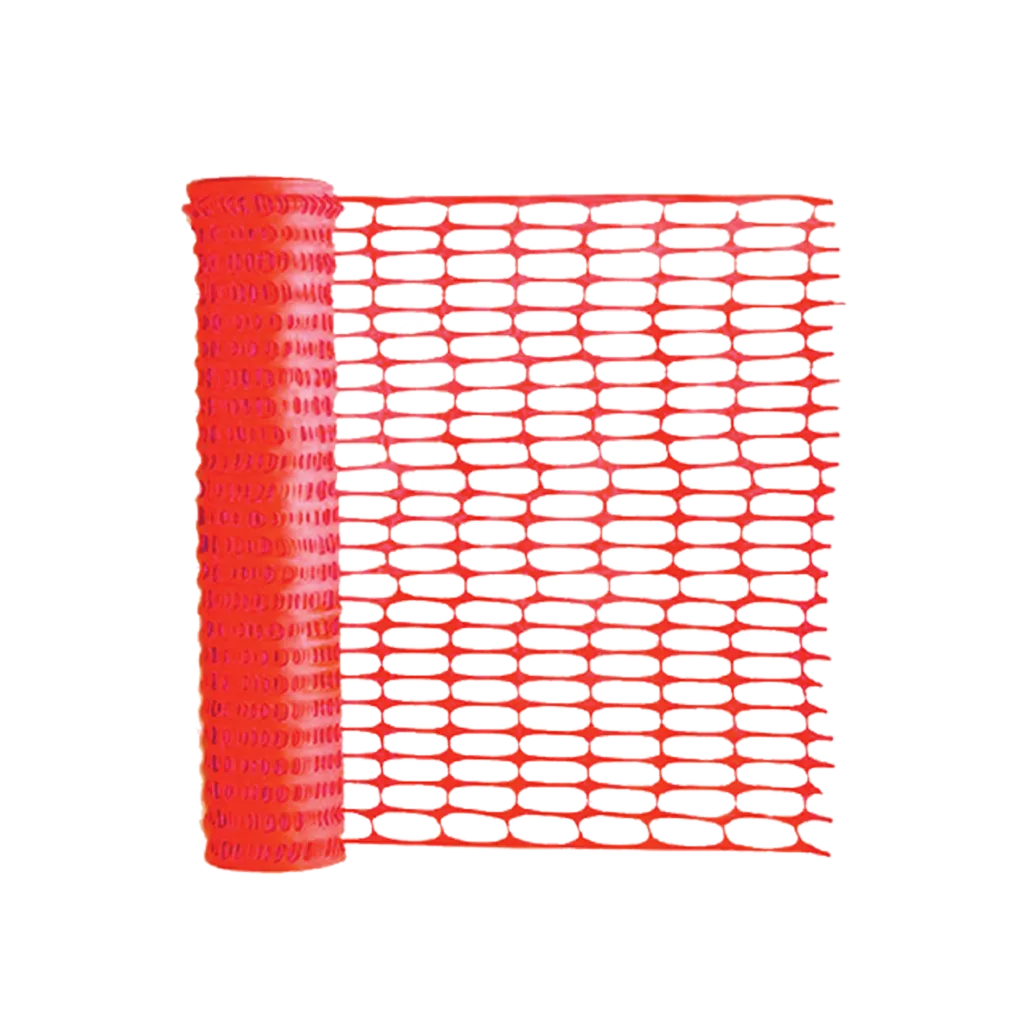
For an area tens of metres long you would have to carry too many fences. The orange ATZ D802 net comes in 1 x 50 m rolls and weighs 4 kg. You stretch it on stakes driven into soft ground, or on posts in heavy bases where nothing can be driven in; these you choose separately. Orange can be seen from far away on soil, grass or snow. It suits enclosing a building site or land under works and marking works along roads. Keep the difference in mind: the net marks and visually closes an area, but it does not actually stop anyone getting through and it carries no signs. That is what fences are for.
How to choose: three questions
How long will the area stay closed?
For a few hours, the expandable barrier is the fastest. For days or weeks, modular fences and New Jersey barriers stay in place and show up at night in the headlights. For a large site where length matters, the net covers 50 metres from a single roll.
Who has to be stopped: people or vehicles?
The expandable barrier stops people who have no business there, and the net marks the area. Where vehicles pass the works, use fences or New Jersey barriers. A filled New Jersey line is continuous, so it is the choice for works along a road and for separating the directions of traffic. In warehouses and industrial yards, yellow with black reads straight away as a hazard; where the area should not look like a building site, white, blue or black fit better.
Do you need to show drivers where to go?
Then use a fence with a sign panel. Look at which side the works are on. If they take up the right side of the lane, vehicles pass on the left, so you choose keep left: ATZ 80150-ROL, ATZ 80150-ROS or ATZ 80150-ROA. If they take up the left side, you choose keep right: ATZ 80150-RLO, ATZ 80150-RSO or ATZ 80150-RAO. STOP and “No entry” go where one direction has to be closed completely. One fence with a panel for each direction traffic comes from is usually enough; the rest of the enclosure is plain fences joined to it with the clamp.
How many pieces you need
One modular fence covers 1.5 m: measure the length to close, divide it by 1.5 and round up.
- a 3 x 3 m hole closed on all sides: 12 m, so 8 fences;
- a 6 m excavation on a pavement, closed along the long side and at both 1.5 m ends: 9 m, so 6 fences, and the one facing traffic can be the ATZ 80150-RL;
- a 20 m line of V15 barriers: one barrier is 100 cm long, so around 20 pieces and, at 35 l each, about 700 l of water or the same volume of sand.
Over several tens of metres, also work out the option with a roll of ATZ D802, and put fences only where people or vehicles really have to be stopped or where you need signs.
How to set them up on site
Fences
- Stand the fences on their feet along the line of the area and join them with the side clamp.
- Put the fence with the panel at the end of the row, facing the oncoming traffic.
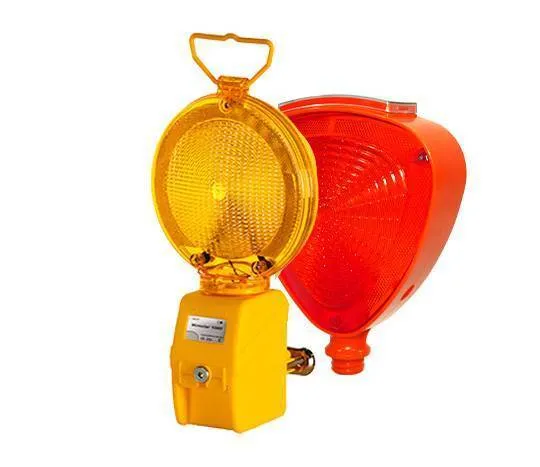
- If the works stay open overnight, fit lamps on the threaded sockets. Sheeting only helps when headlights reach it; a flashing yellow lamp makes the fence visible where headlights do not shine directly.
- Fences usually stand free on their feet. Where they must stay put, the ATZ 80150 fence sheet specifies fixing to the ground with 4 dowels and 4 screws.
New Jersey barriers
- Set the empty barriers out in line; a V15 weighs only 7 kg.
- Join them with the linking system at the ends.
- Only then fill them. Once full, a barrier is hard to move, so check the line first.
On a road, barriers go together with the rest of the signing. Which temporary signs a work site needs is covered in our guide to signing road works with U signs, and the beacons that show the lane diversion in our guide to road beacons.
Transport and storage
Fences, plain or with a panel, stack flat on a pallet, in a trailer or in a van. The expandable barriers fold to 15 and 25 cm respectively and fit in the boot. Empty the V15 barriers of water before transport; empty, they stack and take up little space in the lorry and in the store.
Frequently asked questions
Is the plastic New Jersey barrier the same as the concrete one?
It has the same shape, wide at the bottom and narrow at the top, but it is PVC and weighs 7 kg empty, so you set it down without a crane. It only becomes heavy in position, once you fill it with water or sand. We only stock plastic barriers.
Can I use the barriers as a traffic separator?
Yes. The V15 New Jersey barriers, joined together and filled, are also used to separate the directions of traffic on roads with at least two lanes each way.
What do you fill a ballastable barrier with, and how much goes in?
Water or sand. A V15, such as the V15-R, has an interior volume of 35 l. Fill it only once the line is set out and joined, and empty it of water before you move it.
Can the sign fences be joined to plain fences?
Yes. The fences with a panel join the plain modular fences, such as the ATZ 80150-R, with the clamp on their side, so the sign stands at the end of a continuous enclosure.
Can the expandable barrier be filled?
The yellow one, the ATZ PB03, can: it weighs 2 kg empty and reaches 9 kg filled, which makes it harder for the wind to move. For outdoors, the ATZ PB02, at 7.5 kg and 110 cm, is the sturdier of the two.
Do you sell metal barriers?
Not in this range. The fences are PVC and PPC, the expandable barriers HDPE and the New Jersey barriers PVC. Plastic keeps them light, so one person carries and sets up most of them.
How we can help
All our barriers are under barriers. If you are planning works and are not sure how many fences, which sign combination or how many New Jersey barriers you need, tell us what you want to close off, how long the area is and how long it will stay closed, and we will put the list together for you. We deliver in 24-48 hours.