

Cars that mount the pavement in front of a shop, cut the corner across a lawn or park right against a building entrance are hard to stop with a sign. A row of metal bollards stops them without argument: the bollard is rigid, it is easy to see and it shows clearly where people walk and where cars drive. This guide explains the ornamental bollards we have, how they differ in height, diameter, colour and fixing, where each one fits and how many you need for a path.
What metal bollards are
They are short posts, between 45 and 75 cm tall, fitted along the edge of an area to keep cars out of it: pedestrian zones, pavements, park paths, access lanes, parking bays. They are also called ornamental bollards, because besides acting as a barrier they have to look right next to a building, in a park or in a town centre. All of them have reflective bands at the top that show up in the headlights at night.
We are not talking here about street lighting columns or gate and fence posts, which are different products. If you need posts for road signs, their diameters, lengths and clamps are explained in our guide to sign posts.
Metal or flexible
The bollards in this family are rigid: they do not bend when touched by a car trying to mount the pavement or turn into a path. That is why you put them where you want the car to stop, not just be warned: in front of a shop window, at the corner of a building, along the edge of a lawn. Flexible plastic delineator posts work the other way round: they bend on impact. They are the choice for a line you only want to mark, where cars touch it often. How to choose a flexible post is covered in our guide to flexible delineator posts.
Fixed, removable or fold-down
All seven bollards here are fixed. Six have a flange or a plate at the base and are fixed with dowels and screws, included in the pack, to a surface you can drill. The seventh, the ATD 700-01, is embedded in concrete or asphalt and stays permanently in place, with no visible screws.
This range has no fold-down bollards and no bollards that lift out of a socket with a key. A flanged bollard can be unscrewed if you relay the paving or move the row, but it is not made to be taken out and put back every day. For posts that are moved often, look at mobile delineator posts.
The models, one by one
The ATZ M7592 series: Ø9 x 75 cm, with a rounded cap
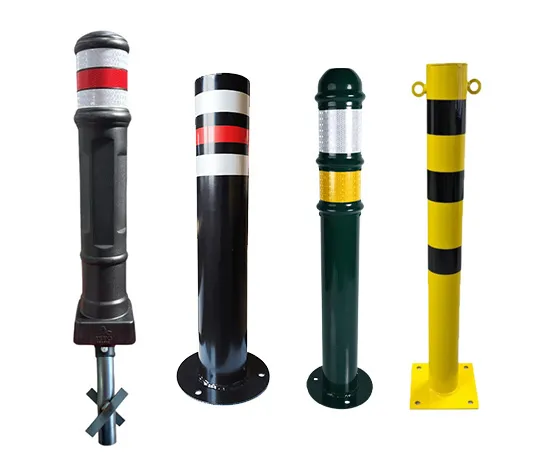
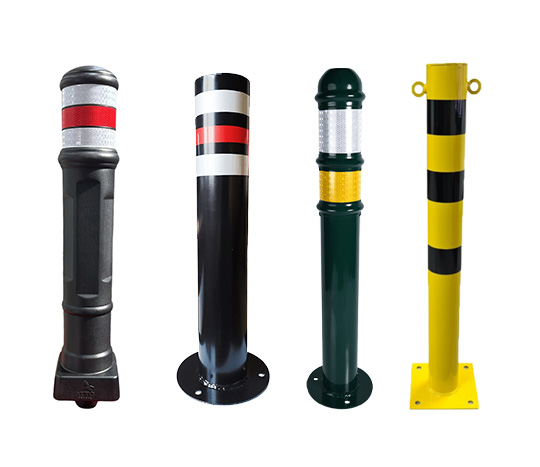
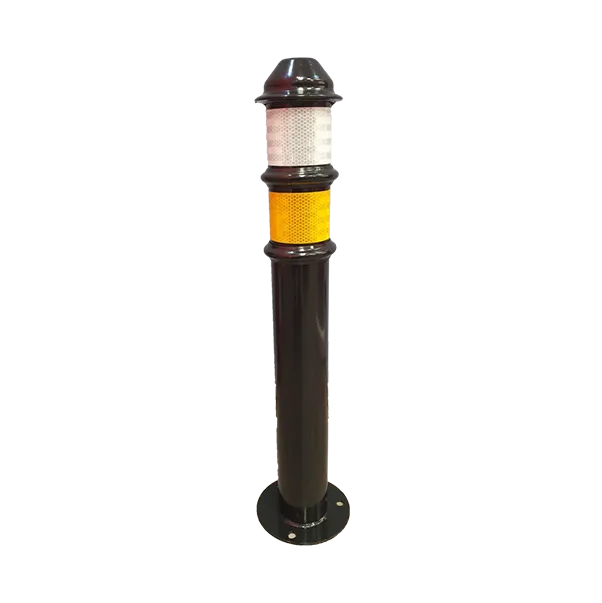
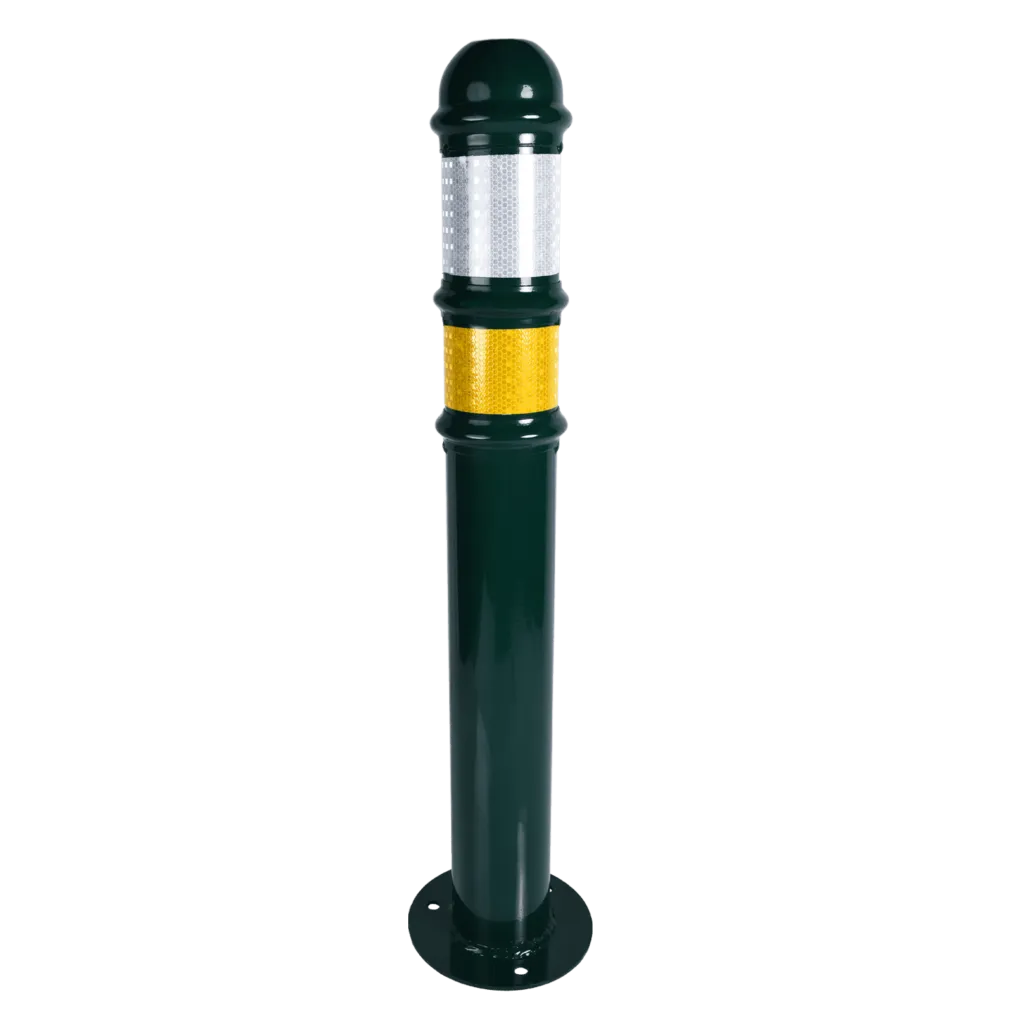
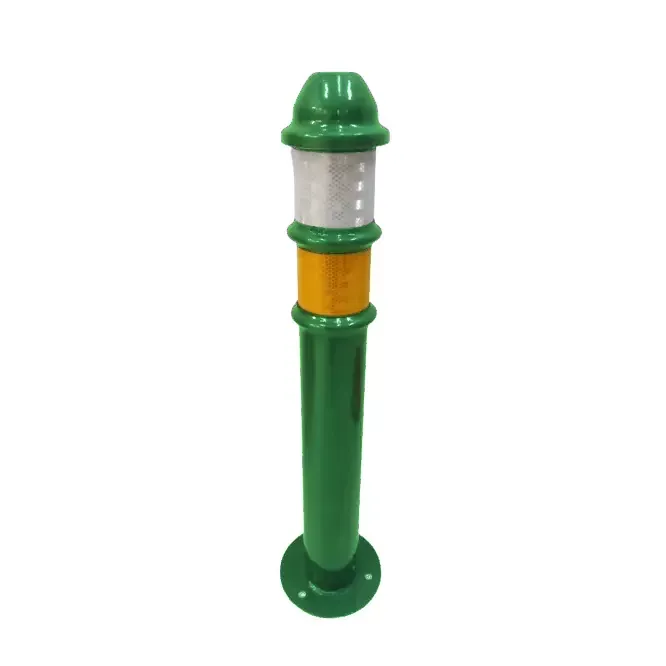
These are the classic ornamental bollards: a Ø9 cm tube of electrostatically painted steel with a 3 mm wall, 75 cm tall, with a rounded cap and 2 honeycomb reflective bands under the cap. At the base they have a round Ø17 cm flange with 3 holes. The shape is the same; the colour differs:
- ATZ M7592-BK: black RAL 9017, 3.5 kg, with one white and one yellow band; for shop fronts and office buildings, car parks and pedestrian zones in town centres, where looks matter too;
- ATZ M7592-GR: green, 3.5 kg; for parks, public gardens, courtyards with green space and tree-lined paths, where a black or yellow bollard would stand out too much; it keeps cars off the grass;
- ATZ M7592-GRd: a lighter green than the ATZ M7592-GR; you choose it when the bollards have to match the benches, fences or other street furniture in a park or a housing estate.
Short bollards: ATZ M5093 and ATO 6320
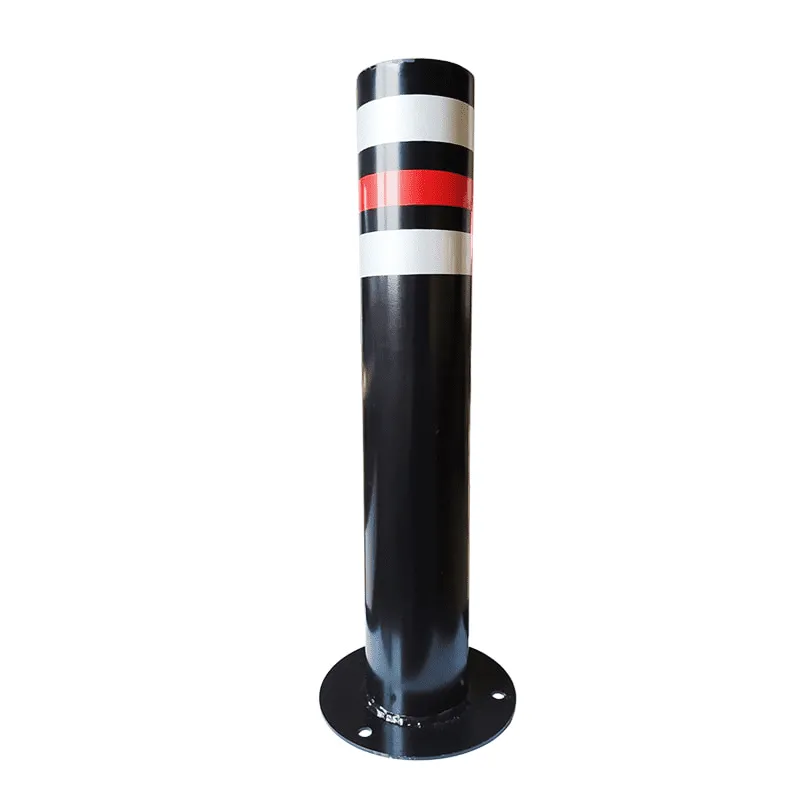
These are for places where a 75 cm bollard would be too much: the edge of a car park, the corner of a building, a garage entrance or a pedestrian zone where the bollard must not spoil the view. Both have a Ø9 cm tube, a straight body with no rounded cap and a round Ø17 cm flange with 3 holes:
- ATZ M5093: 45 cm, black RAL 9017, electrostatically painted steel with a 3 mm wall, with 3 reflective bands at the top, white, red and white;
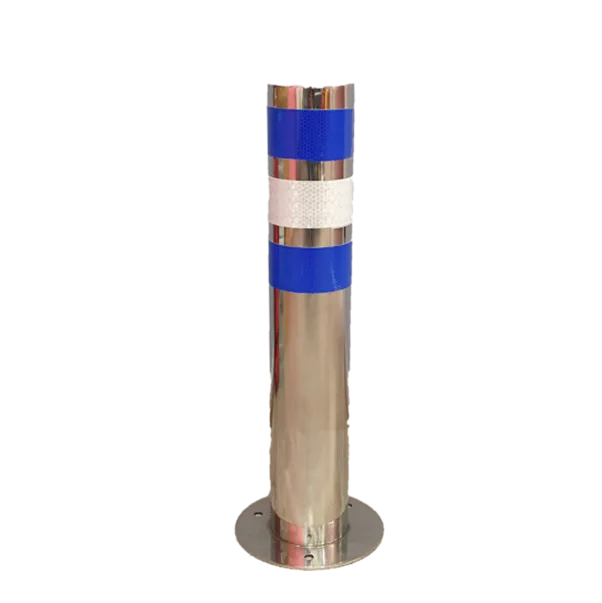
- ATO 6320: 50 cm, polished stainless steel with a 2 mm wall, 2.5 kg, with 3 bands, blue, white and blue; it needs no paint, and the metal surface stays visible.
The ATO 6320 is the bollard for the entrances of hotels, showrooms, office buildings and shops, where the bollards are part of the facade. It stops cars mounting the pavement in front of the entrance and protects shop windows and building corners.
The yellow bollard with chain rings: ATD 7580
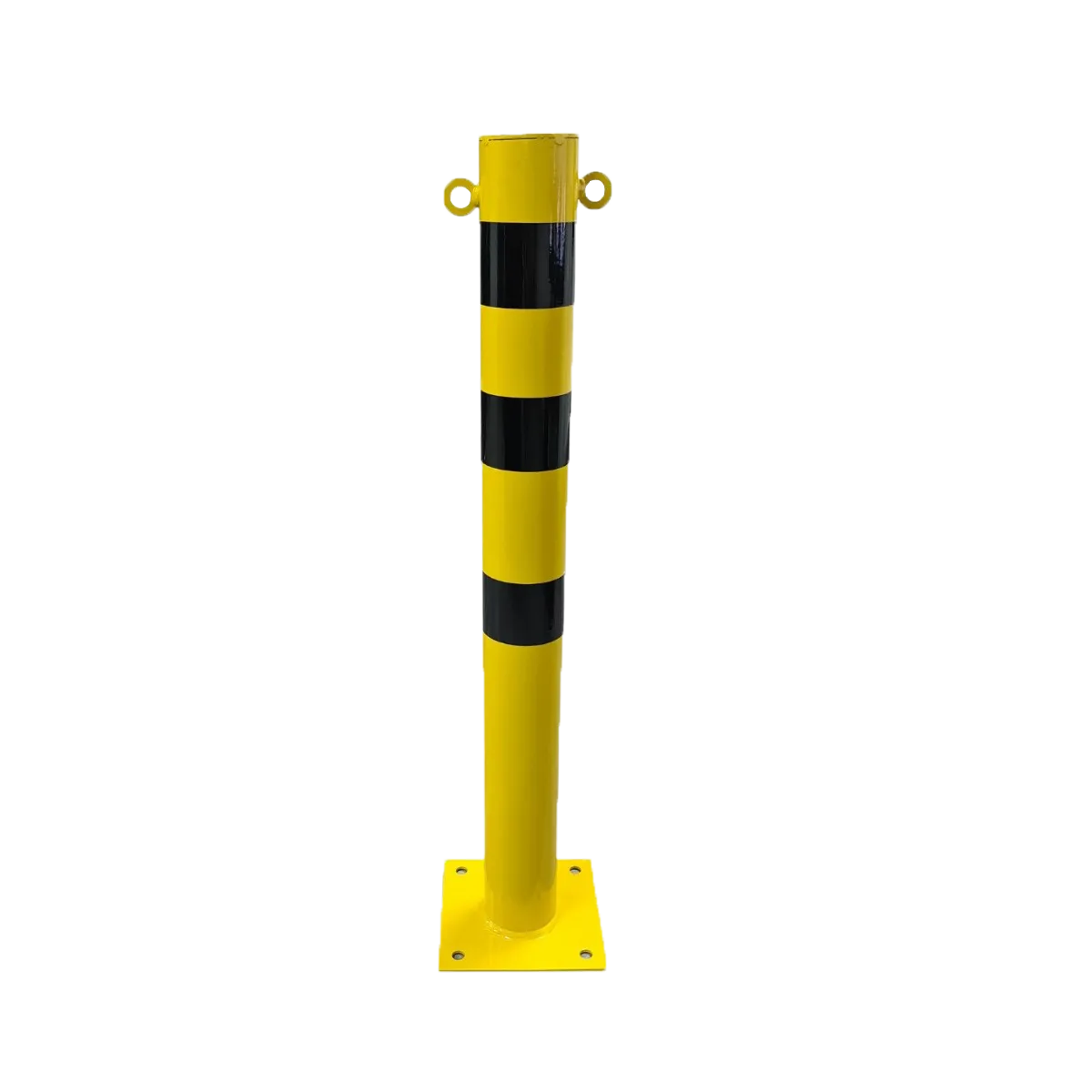
The ATD 7580 is yellow RAL 1023 with 3 black bands, and it is easy to see in car parks, company yards, halls and warehouses, where yellow and black match the floor markings. It has a Ø8 cm tube of electrostatically painted steel with a 3 mm wall, is 75 cm tall and weighs 4 kg. A square 15 x 15 cm plate with 4 holes is welded to the base, so it is fixed at 4 points.
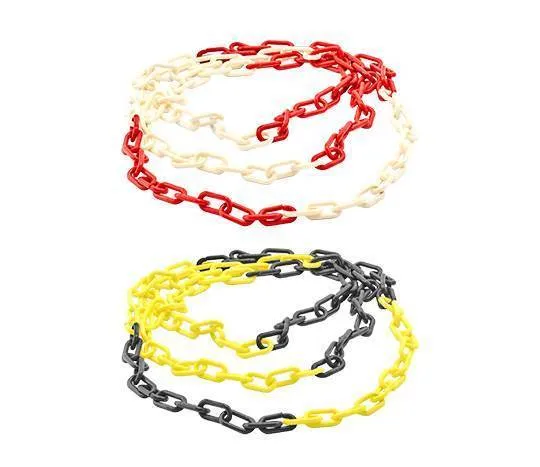
What sets it apart are the 2 rings at the top, one on each side. You pass a yellow-and-black plastic chain, 8 mm, sold by the metre, through them and turn a row of bollards into a continuous barrier, for example around a loading area or along the edge of parking bays.
The embedded hexagonal bollard: ATD 700-01
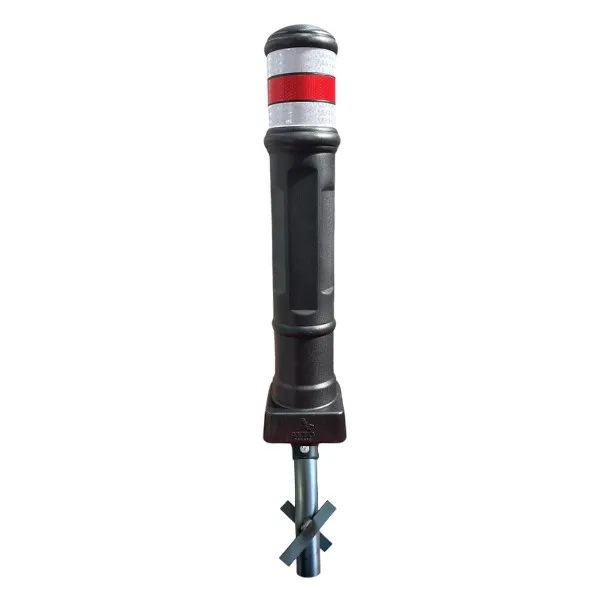
The ATD 700-01 looks different from the others: a glossy black hexagonal body made of UV-protected plastic, with 3 reflective bands at the top. Inside, along its whole length, a Ø48.3 mm steel tube gives it rigidity. The colourant contains a pigment with high UV protection, so the bollard keeps its colour for a long time. It is 100 cm long in total, of which 70 cm stay above the ground, with a 15 x 15 cm footprint and a weight of 3 kg. It is embedded in concrete or asphalt, and at the base it has a locking fixing system for installation in the ground. It is used in pedestrian zones, parks and car parks, wherever you want a decorative bollard with no visible screws.
How to choose: four questions
What height do you need?
The 75 cm bollards, the ATZ M7592-BK and the rest of its series plus the ATD 7580, are easy to see from a car and mark a path or a pavement clearly. The ATD 700-01 stands 70 cm above the ground. Where you want something discreet, at the corner of a building or at a garage entrance, take a short bollard: the 45 cm ATZ M5093 or the 50 cm ATO 6320.
Which colour suits the place?
Black and stainless steel suit buildings and town centres, green suits parks and housing estates, and yellow with black suits car parks, company yards and warehouses. If the park already has green benches or fences, compare their shade with the two greens, the ATZ M7592-GR and the ATZ M7592-GRd.
How can it be fixed where you are?
If you can drill holes for dowels, any flanged bollard will do: the round Ø17 cm flange is fixed at 3 points, the square plate of the ATD 7580 at 4. If you are laying out the area from scratch and want a bollard with no visible screws, the ATD 700-01 is embedded. If you cannot make the holes needed for embedding, stay with a flanged bollard, such as the ATZ M7592-BK.
Do you want to link the bollards?
Then you need the ATD 7580, the only one with chain rings. The other bollards stand on their own, spaced apart, and let pedestrians walk between them.
Where they are used
- Pedestrian zones and town centres: the ATZ M7592-BK, the ATD 700-01 or, where the bollard must be discreet, the ATZ M5093.
- Pavements and shop fronts: bollards stop cars mounting the pavement and parking next to the windows; the ATO 6320 fits best at the entrance of a hotel, showroom or shop.
- Parks, green spaces and housing estates: the ATZ M7592-GR and ATZ M7592-GRd, along paths and lawns.
- Car parks: the ATZ M5093 along the edges, the ATD 7580 to mark out bays and access lanes.
- Company yards, halls and warehouses: the ATD 7580, with or without a chain between the bollards.
Fixing
For the flanged bollards, the dowels and screws come in the pack: 3 of each for the round flange, 4 for the square plate of the ATD 7580. The bollards are light and one person can fit them.
- Mark the line of the row and the spot for each bollard, at equal distances.
- Stand the bollard in place and mark the holes through the flange.
- Drill the holes and insert the dowels.
- Put the bollard back and tighten the screws.
The ATD 700-01 has no flange: it is embedded in concrete or asphalt, using the fixing system at its base. If you want to put it into an existing surface, ask us first how the embedding is done on your site.
How many bollards you need
Choose the spacing, divide the length of the path by it and add one bollard for the end of the row. For a 12 m path with a bollard every 1.5 m, you need 9 bollards. For 6 m at the same spacing, you need 5. If you link ATD 7580 bollards with a chain, also count the metres of chain between them.
Frequently asked questions
Does a metal bollard bend if a car hits it?
Not from a knock. The bollards are rigid and do not bend when a car tries to mount the pavement or turn into a path. The Ø9 cm steel tube with a 3 mm wall does not bend from a light impact.
Do they stand up to rain and sun?
Yes. The steel bollards are electrostatically painted, which makes them weather-resistant. The ATO 6320 is stainless steel and needs no paint, and the ATD 700-01 has a UV-protective pigment in its plastic body.
What comes in the pack for fixing?
For the flanged bollards, the dowels and screws: 3 and 3 for the round flange, 4 and 4 for the ATD 7580. All you need is a drill.
Can the bollards be seen at night?
Yes. All have reflective bands at the top that show up in the headlights: 2 honeycomb bands on the ATZ M7592-BK series and 3 bands on the others.
Do you have fold-down or removable bollards?
Not in this range. All seven bollards are fixed: six are screwed down, and the ATD 700-01 is embedded.
Can I link the bollards with a chain?
Yes, with the ATD 7580, which has 2 rings at the top. A yellow-and-black 8 mm plastic chain matches the bollard in looks.
How we can help
All the bollards are under ornamental bollards and we deliver in 24-48 hours. If you are not sure which model and how many you need, send us the length of the area, what they will be fixed to, concrete, asphalt or paving, and what the place looks like, and we will put the list together for you.