










SR 1848-1:2024 has two signs with the same name, “Turn right”: D2 and D3. Both are blue discs with a white arrow and both make the driver turn. The difference is not colour or size but where the sign stands in relation to the junction, and therefore when the turn is made. Put one in place of the other and the sign tells drivers something you did not mean.
In short: D2 stands beyond the junction, D3 before it
- D2 has a horizontal arrow. It goes on the far side of the junction, facing the driver, and the turn is made without passing the sign.
- D3 has an arrow that starts upwards and then bends. It goes before the junction, on the right of the road, and the turn is made after passing the sign.
The arrow draws the manoeuvre itself: with D2 you turn straight away, with D3 you carry on to the junction and turn there.
What SR 1848-1:2024 says
The standard lists the two signs one under the other in the table of mandatory signs, with the same name. Only the placement rule tells them apart:
- D2 goes on the side opposite the entry to the junction with the road or street where the direction of the arrow is compulsory, and the turn is made without passing the sign;
- D3 goes before the entry to the junction where turning in the direction of the arrow is compulsory, and the turn is made after passing the sign.
For both, the standard adds that the arrow may point left where needed. One general rule covers the whole D group: the meaning of the sign applies in the immediate vicinity of where it is installed, before or after it, as the case may be. For D2 the obligation comes before the sign, for D3 after it.
The usual rule in the standard is that signs stand on the right-hand side of the direction of travel. D2 has its own placement rule, which takes it across the road, in front of the driver. That is why a D2 fitted on the right, before the junction, is simply in the wrong place.
D2 on site: at the end of a street
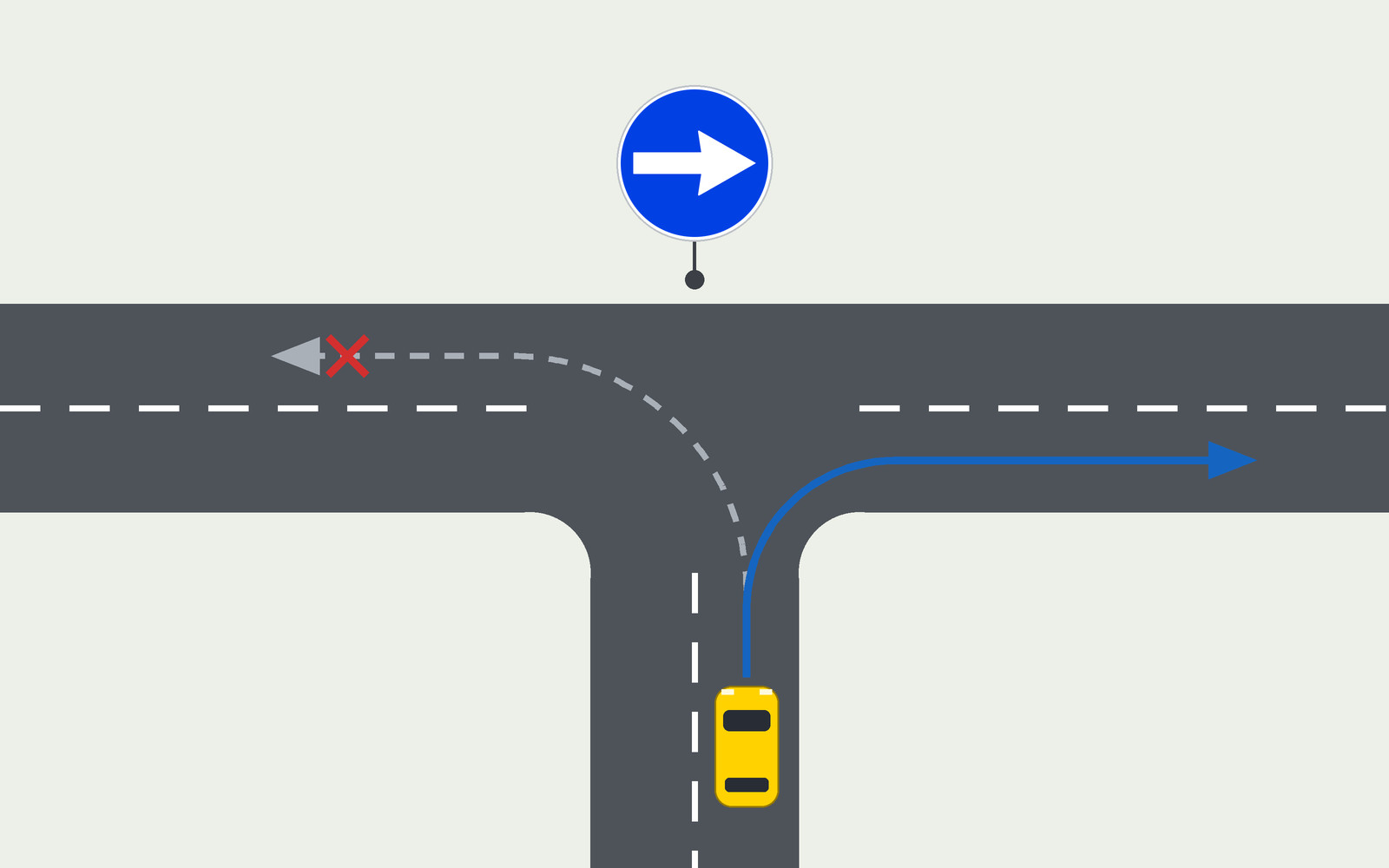
The clearest example is a T-junction. The driver reaches the end of the street and sees, on the pavement or verge across the road, the disc with the arrow to the right. There is no way to pass it, because the street ends there, so the turn is made before the sign, exactly as the standard requires.
D2 is used where a road can only be left in one direction: for example, when the road you join is one-way, or when the road authority has banned the left turn at that point. The face of the sign is turned towards the road the drivers come from, so they see it from the end of the street, not from the road they are about to join.
Worth checking before you order: D2 needs a spot for the post on the other side of the road. If there is a fence, a private yard or a narrow pavement across the road, check beforehand where the foundation will go.
D3 on site: before the junction
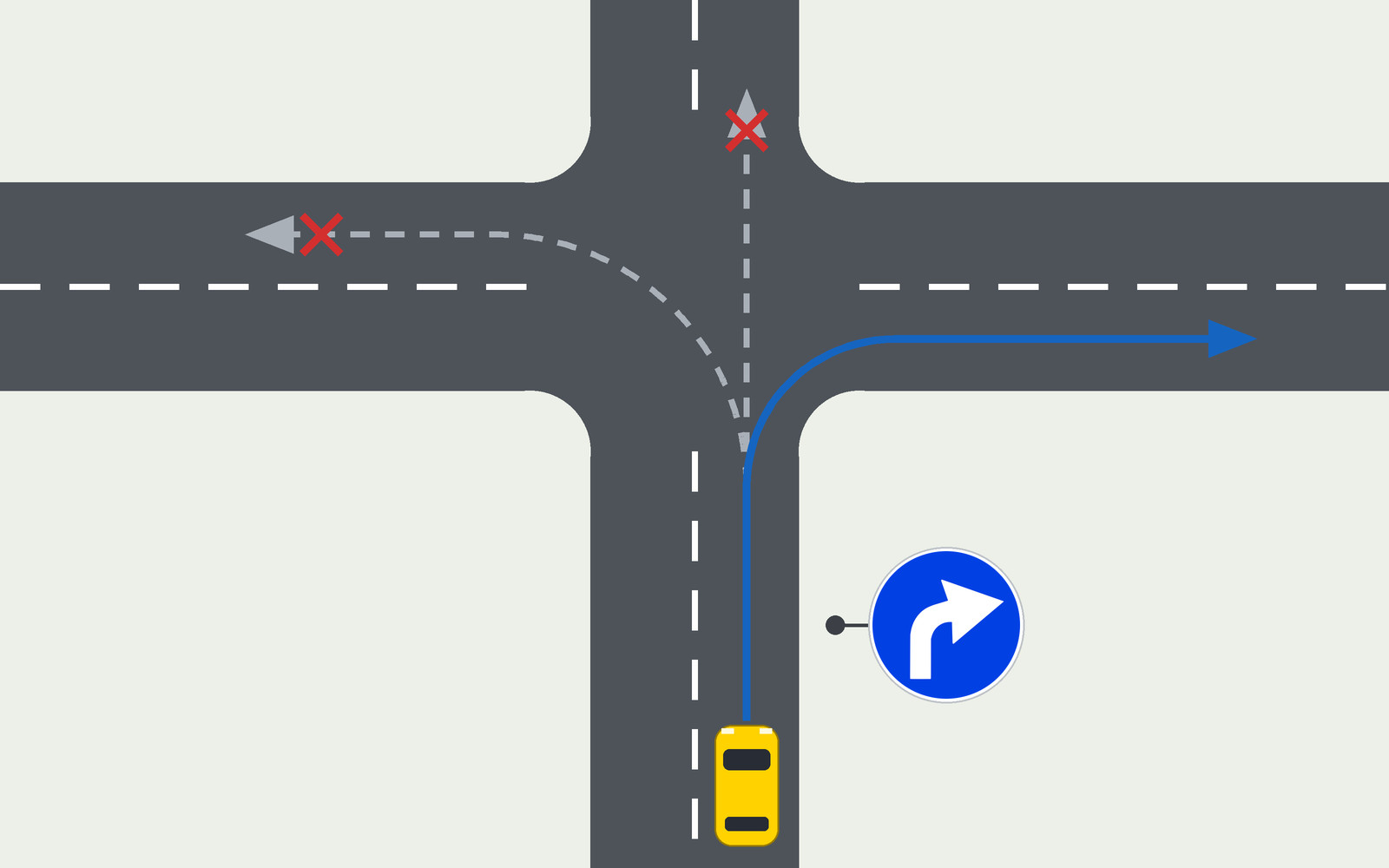
You see D3 on the right-hand side of the road, before the junction. Its arrow starts upwards, meaning “keep going”, and only then bends to the right: you drive on to the junction and turn there. At a four-way junction this means that going straight on and turning left are banned for traffic coming from that direction.
The standard sets no distance for D3, unlike D1 “Straight ahead”, which goes at most 15 m before the junction. D3 is fitted before the entry to the junction, where drivers see it in time to move into the right-hand lane. On roads with two or more lanes in each direction, SR 1848-1:2024 recommends repeating regulatory signs on the left-hand side as well, for safety; mandatory signs belong to that group.
The advantage of D3 when fitting it: the post stands on your side of the road, on the pavement or verge you already have access to.
Why D2 is one product and D3 is two
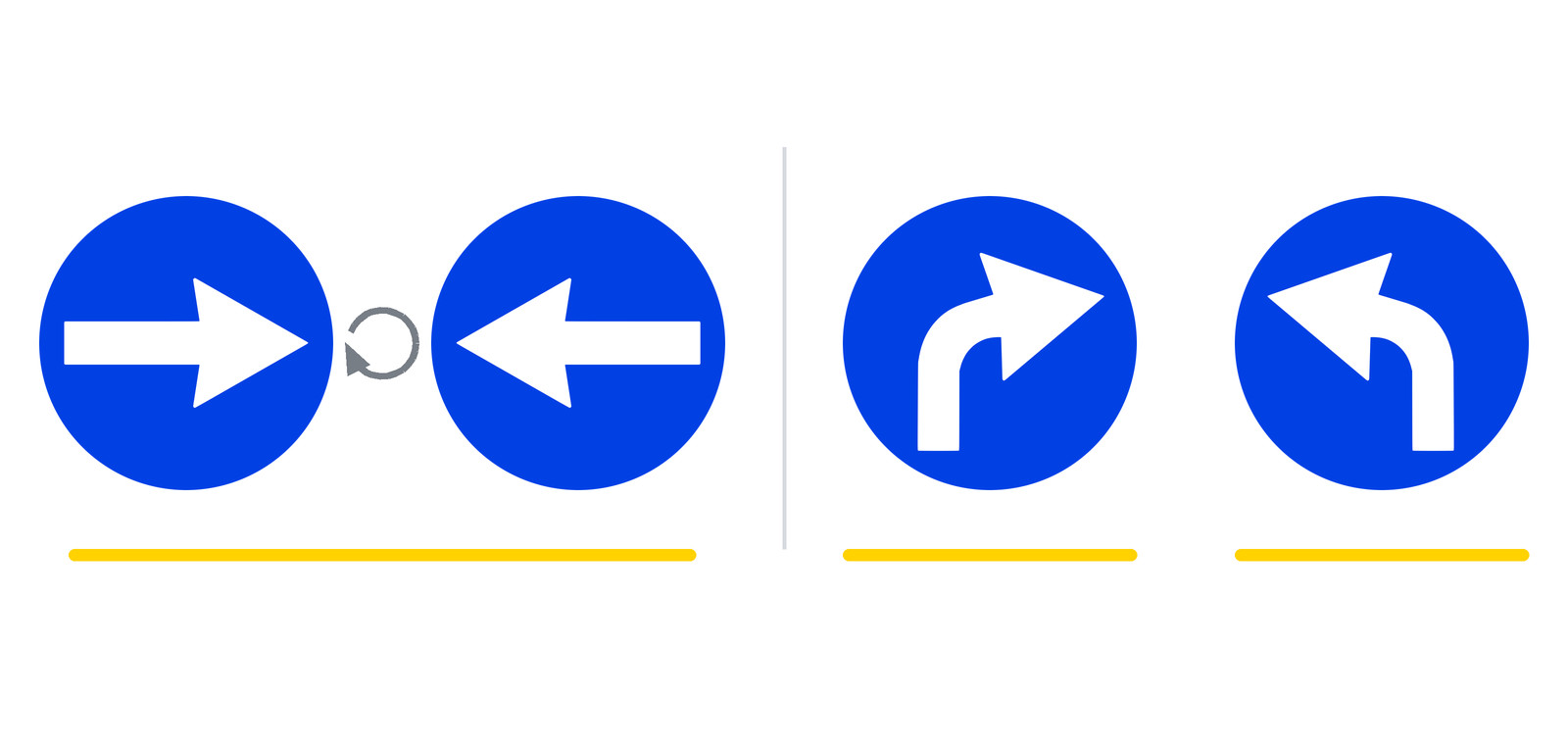
The D2 arrow is symmetrical. Turn the disc 180° on the post and the arrow points left while the sign stays correct. The fixing channels on the back stay horizontal in both positions and the clamps and bolts are the same, which is why D2 is sold as one product for both directions.
With D3 turning does not work. Turned 180°, the upward arrow would point down and the sign would no longer match any figure in the standard. The left-hand version has the arrow drawn as a mirror image, so it is a different face and a different product: D3a for right and D3b for left. When you order for several junctions, count separately how many D3 signs must point right and how many left.







Which size and which sheeting
D2 and D3 come in the same formats. SR 1848-2 ties the format to the category of road and forbids a smaller format than the road requires:
- Ø40 cm, small format: low-traffic local roads and short-term police signing at the scene of an accident;
- Ø60 cm, normal format: county and commune roads, streets, private roads open to public traffic and some busier local roads;
- Ø80 cm, large format: national roads, apart from those that require the very large format;
- Ø100 cm, very large format: motorways and some E-road routes set by the road authority.
In the shop you will find D2 in Ø60 cm with Class I sheeting. D3 comes in three versions for each direction: Ø40 cm Class I (D3a_40_I, D3b_40_I), Ø60 cm Class I (D3a, D3b) and Ø80 cm with Class II prismatic sheeting (D3a_II, D3b_II). On each sign page you can also choose other size and class combinations; the ones not in the range are marked “on request”.
Class I sheeting (RA1) suits roads where headlights are the only light and has a 7-year service life. In areas with street lighting, shop windows and advertising, SR 1848-2 requires Class 2 or 3 prismatic sheeting, because a Class I sign gets lost against the lit background there. Class II sheeting has a guaranteed 10-year service life. The difference is explained in detail in our article on Class I and Class II.
Fitting: fixings, post, height
Every sign comes with its post fixings: 2 clamps for a Ø48 mm post, with bolts and nuts. Clamps for a Ø60 mm post are available on request. The Ø60 cm disc weighs 3 kg and the Ø40 cm disc 2 kg. The post is ordered separately, depending on where the sign goes:
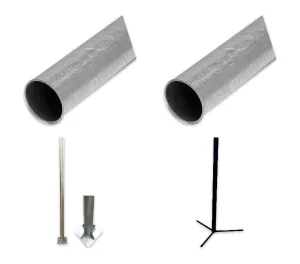
- ATT 48x2_3, galvanised post Ø48 mm, 300 cm, for fixed installation in a concrete foundation;
- ATZ M348, flanged post Ø48 mm, 300 cm, bolted onto concrete or paving where you cannot dig;
- ATZ M12048, tripod stand Ø48 mm, 120 cm, for temporary signing.
The bottom edge of the sign goes 1.50–2.50 m above the road or the kerb. The edge nearest the road stands at least 0.50 m from the edge of the road platform or the pavement, and the standard recommends keeping that distance under 2.0 m. No more than 3 signs go on one support, and if D2 or D3 shares a post with a priority sign, the priority sign goes on top.
What a driver risks by ignoring D2 or D3
D2 and D3 are mandatory signs. The Romanian traffic code fines failure to obey mandatory signs and markings with a class II fine, that is 4 or 5 fine points. One fine point is worth 10% of the gross national minimum wage, so the amount changes with the minimum wage.
Common mistakes
- D2 on the right, before the junction. That is where D3 belongs. A D2 placed before the junction tells drivers to turn without passing the sign, in a spot where there is usually nowhere to turn.
- D3 across the road, facing the driver. Its arrow tells drivers to keep going and only then turn, but at the end of a street there is nowhere left to go.
- A right-hand D3 turned round for left. Turned 180°, its arrow ends up pointing down. For left, order the D3 left version.
- Mixing it up with D5 “Pass on this side”. D5 has a diagonal arrow pointing down and goes at the ends of traffic islands, refuges or before an obstacle, to show which side to pass it on. It does not require a turn.
- Mixing it up with D4. D4 “Straight ahead or right” allows two directions, not one.
- Ø40 cm on a street. The small format is for low-traffic local roads. Streets and county or commune roads require at least the normal format, Ø60 cm.
Frequently asked questions
What is the difference between the D2 and D3 signs?
D2 stands on the side opposite the entry to the junction and the turn is made before it. D3 stands before the junction and the turn is made after passing it. Both make the turn in the direction of the arrow compulsory.
Can I use D2 for a left turn?
Yes. The same disc turned 180° on the post points left, and the fixings stay the same.
Can I turn a right-hand D3 round so it points left?
No. The arrow would end up pointing down. There is a separate D3 left version for that.
Which size do I need for a town street?
At least the normal format, Ø60 cm. On a street with street lighting, shop windows or advertising choose Class II prismatic sheeting; for D3 it is ready made in the Ø80 cm version.
Is the post included?
No. The 2 clamps for a Ø48 mm post and the bolts are included; the post is ordered separately.
Who decides which sign goes at a junction?
On public roads, the type of signs and where they go are decided by the road authority together with the traffic police, as SR 1848-1:2024 provides.
How we can help
All versions are in mandatory signs, with delivery in 24-48 hours. If you are signing a whole junction, send us a sketch of the roads and directions of travel and we will put together the list of signs, posts and fixings you need. For the other groups of signs, see our guide to metal road signs, and for priority junctions, our article on the STOP sign.