

At night, on a car park lane or on a warehouse ramp, the line painted on the asphalt all but disappears. Road studs solve exactly that: small pieces fixed straight onto the road surface that return the headlight beam or light up on their own, and show the driver where the centre of the lane is, where the ramp edge is or where they have no business going. Below you will find the types of studs we have, how reflective studs differ from the solar one, what the colours mean and how each one is fitted, with screws or with adhesive.
What road studs are
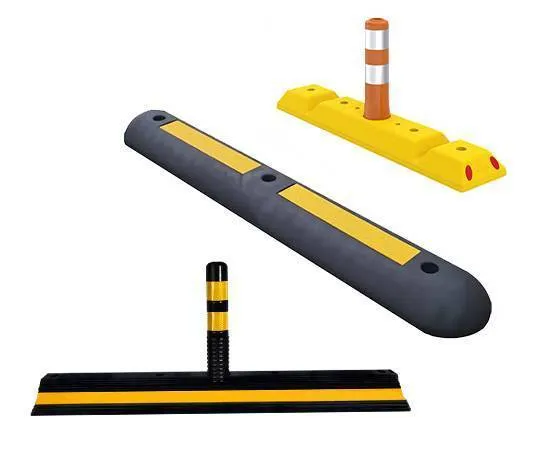
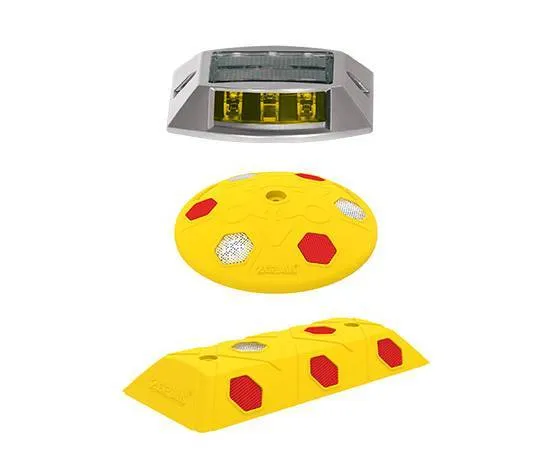
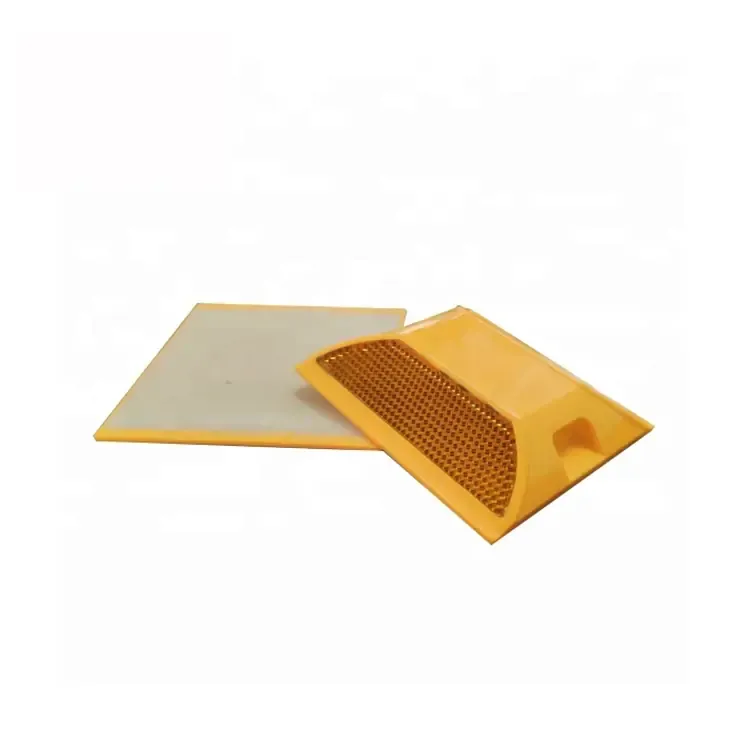
Road studs, often searched for as reflective studs or cat’s eyes, are small, low markers fixed straight onto the road surface. By day they show through the colour of the body, yellow or grey, and at night through the reflectors that return the headlight beam to the driver. They are between 2 and 3 cm tall, so a wheel rolls over them, but the driver feels that they have left their path.
The reflectors come in two kinds. Cat’s eyes are the coloured reflectors on the sides of the stud. Glass lenses are made of many small glass beads that return the headlight beam to the driver, and glass does not scratch as easily as plastic.
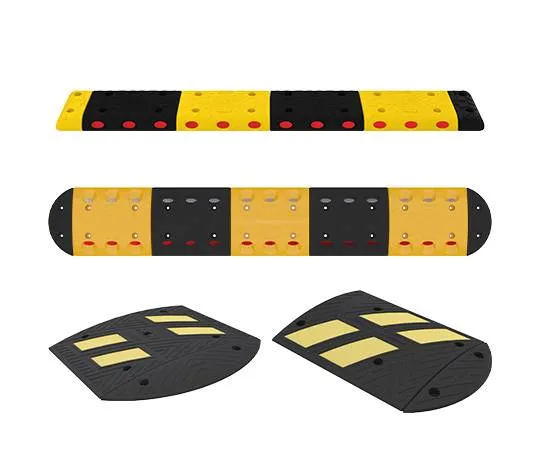
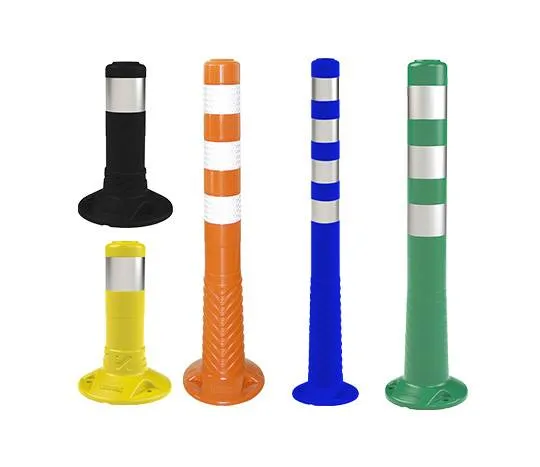
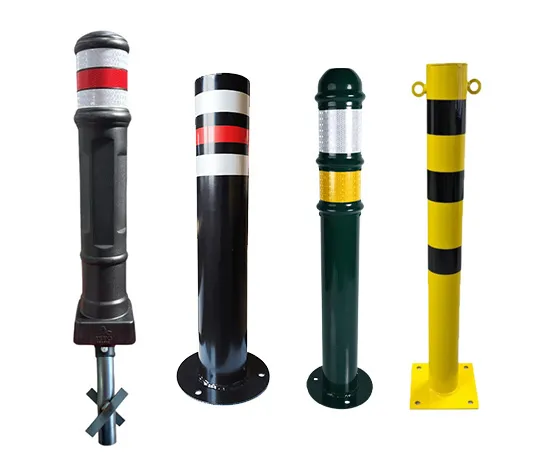
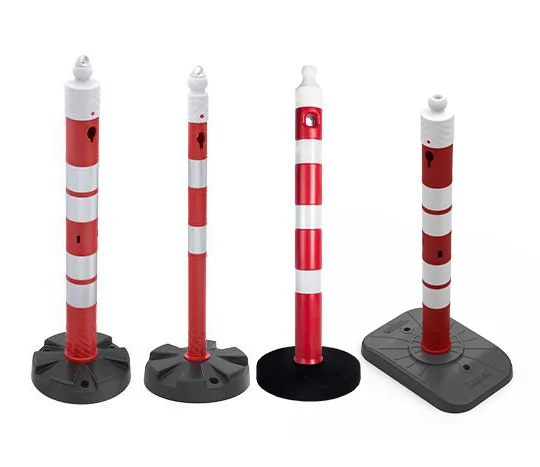
One thing studs do not do: they do not slow vehicles down. That is what speed bumps are for, explained in our guide to speed bumps. And if a line must not be crossed at all, a stud will not stop a car rolling over it; there you need a visible obstacle, such as flexible delineator posts.
The types of road studs
Plastic studs, fixed with screws
For car parks and yards, plastic studs are enough. The body is yellow and shows up well by day on dark asphalt, and the shape depends on what you are marking:
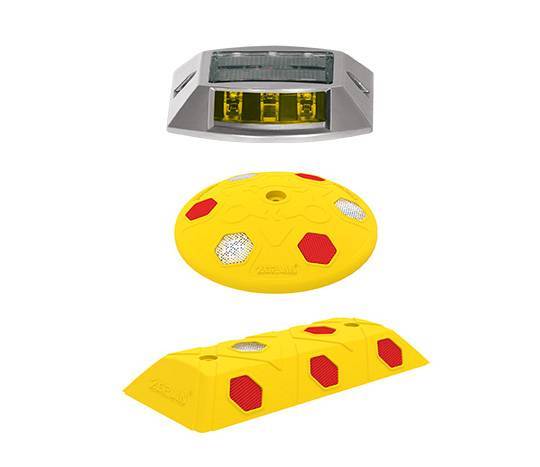
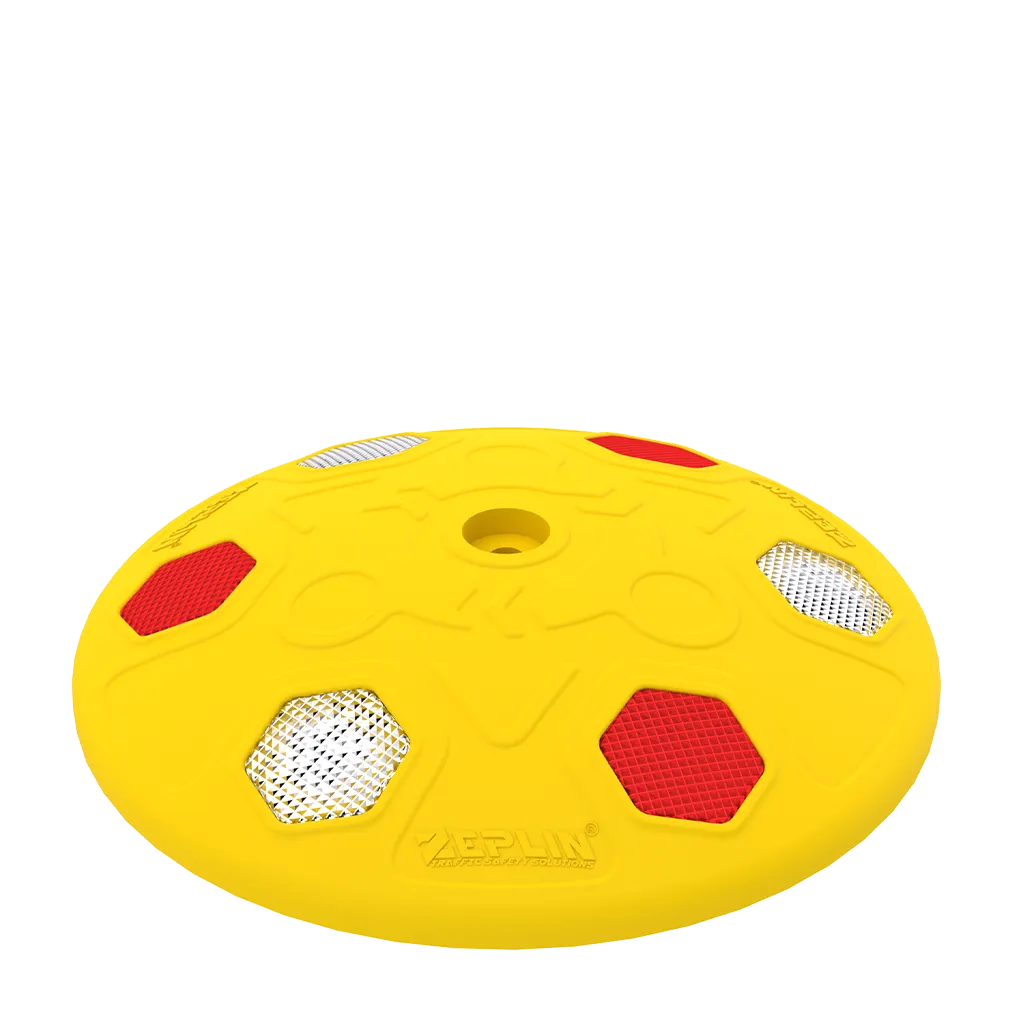
- ATZ 8001: round, Ø14 cm, 2.5 cm tall, 110 g, PPC, with 6 cat’s eyes all the way round, three red and three white, alternating; because it can be seen from whichever side a vehicle comes, it is the stud for roundabouts, the corners of traffic islands and junctions inside car parks;
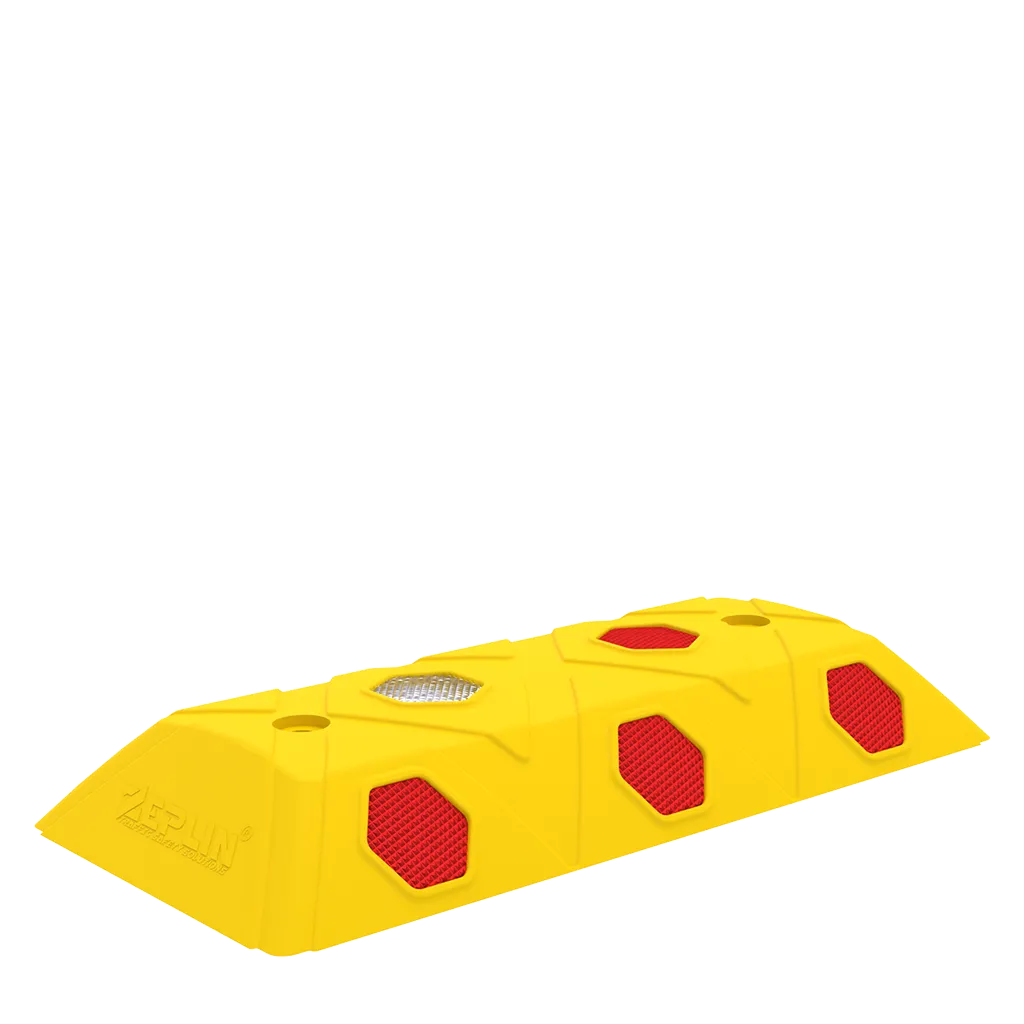
- ATZ 8002: elongated, 21 x 9.7 cm, 2.8 cm tall, 170 g, PPC, with 8 red cat’s eyes on the sides; set one after another, the studs form a line, for example between the lanes of a car park ramp, between the parking bays and the traffic lane or along the edge of a cycle lane;
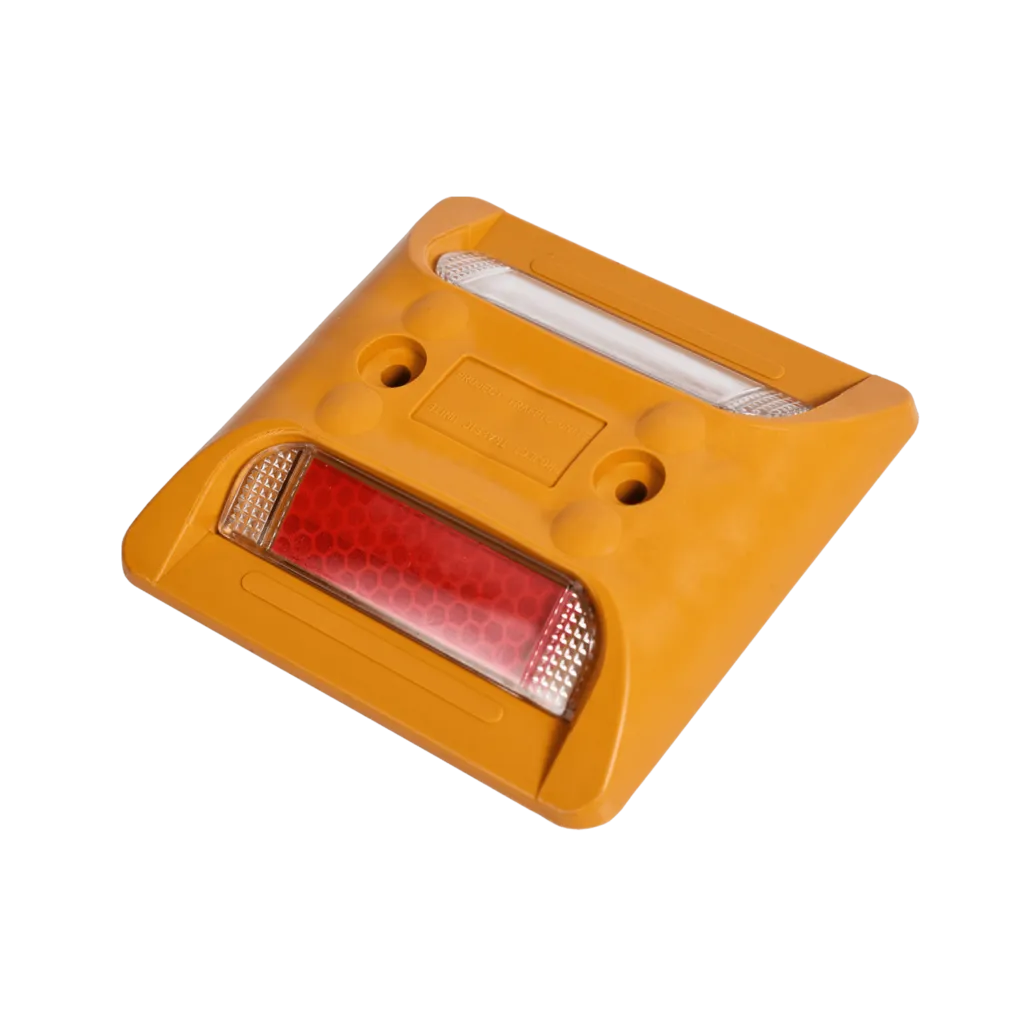
- ATE 12005: square, 10.5 x 10.5 cm, ABS, with a red reflector on one side and a white one on the opposite side; at 2 cm tall it is the lowest screw-fixed stud in the range and goes on the centre line of two-way lanes, along ramp edges or at the entrance to a car park or a company yard.
The range also includes a yellow PPC series with four fixing points, all 3 cm tall: the ATO 5100 (13 x 9 cm, 4 red glass lenses), the ATO 5120 (15 x 13 cm, 4 cat’s eyes) and the oval ATO 5140 (22 x 12 cm, 6 red glass lenses).
The aluminium stud with glass lenses
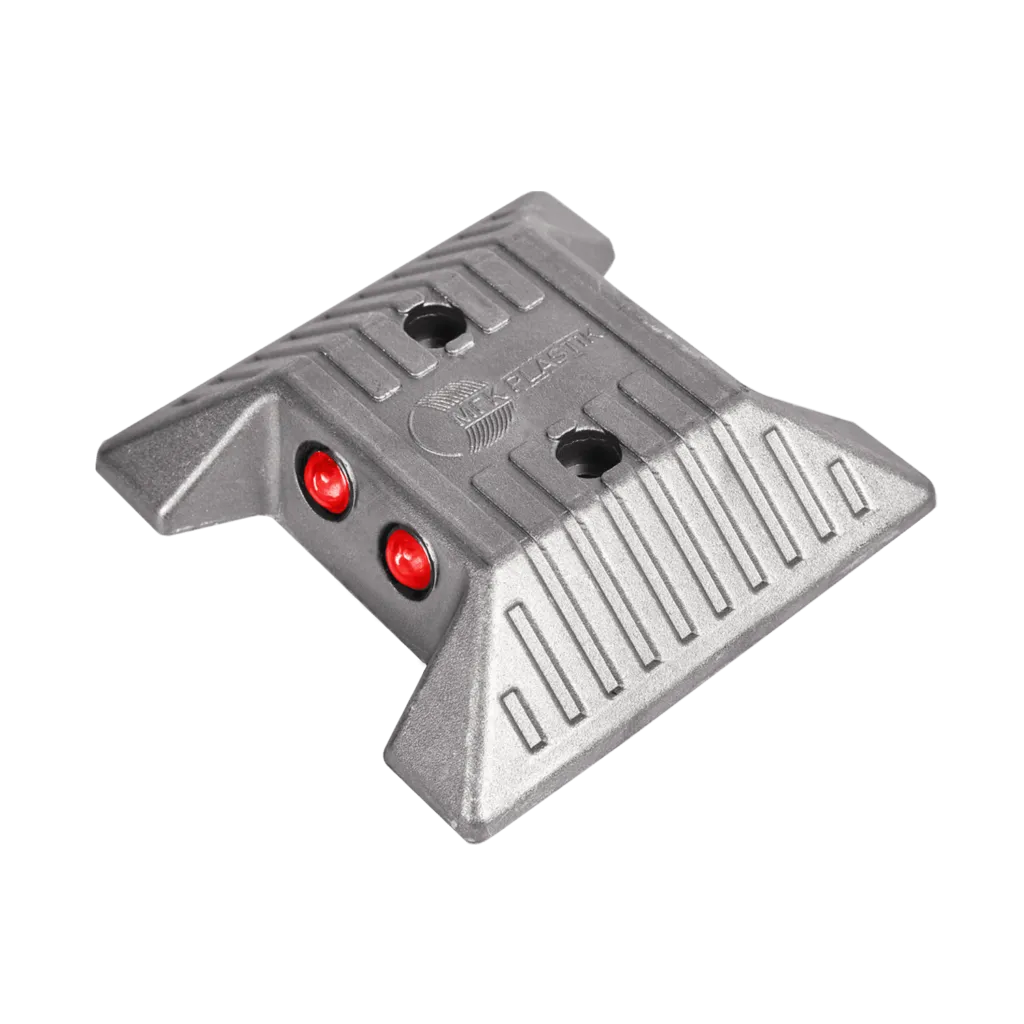
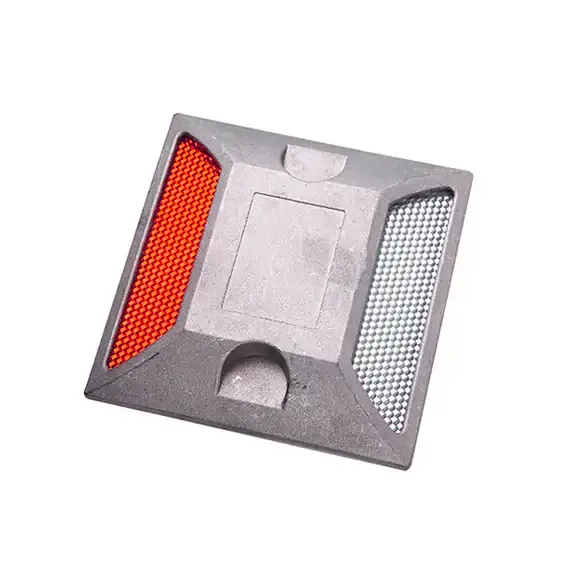
The ATO 5160 has a grey cast aluminium body with ribs on its sloping sides and 4 round red glass lenses, two on each side. It measures 12 x 12 cm, is 2.8 cm tall and weighs 330 g, which makes it heavier and steadier than the PPC models. It goes where the stud is driven over often: car park entrances and exits, access lanes at filling stations, warehouse yards and ramp edges.
Bonded studs, for heavy traffic
The ATT 9007 and ATT 9008 are not screwed down but bonded with epoxy adhesive. You drill no holes in the road surface and there are no screw heads left to work loose over time. Both are 10 x 10 cm and 2 cm tall, and the base has a layer of sand so that the adhesive grips well. They are the only studs in the range with a declared load rating:
- ATT 9007: yellow ABS, 190 g, one yellow reflector on each of two opposite sides, rated 10-20 t; for access roads, car parks and company yards that vans also use;
- ATT 9008: grey aluminium, 340 g, a red reflector and a white one on opposite sides, rated 30 t, the highest in the range; for roads used by lorries, logistics yards, warehouse entrances and car parks with heavy traffic.
The solar stud with LEDs
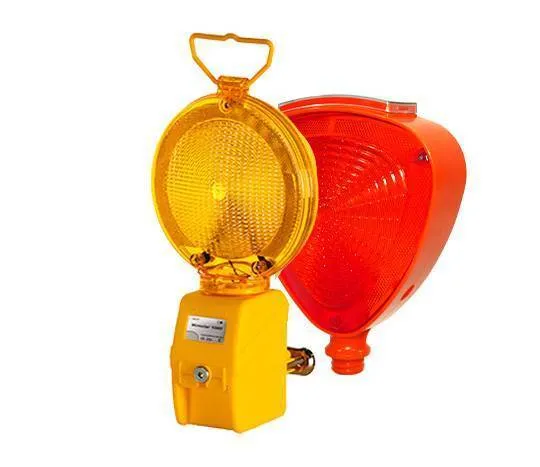
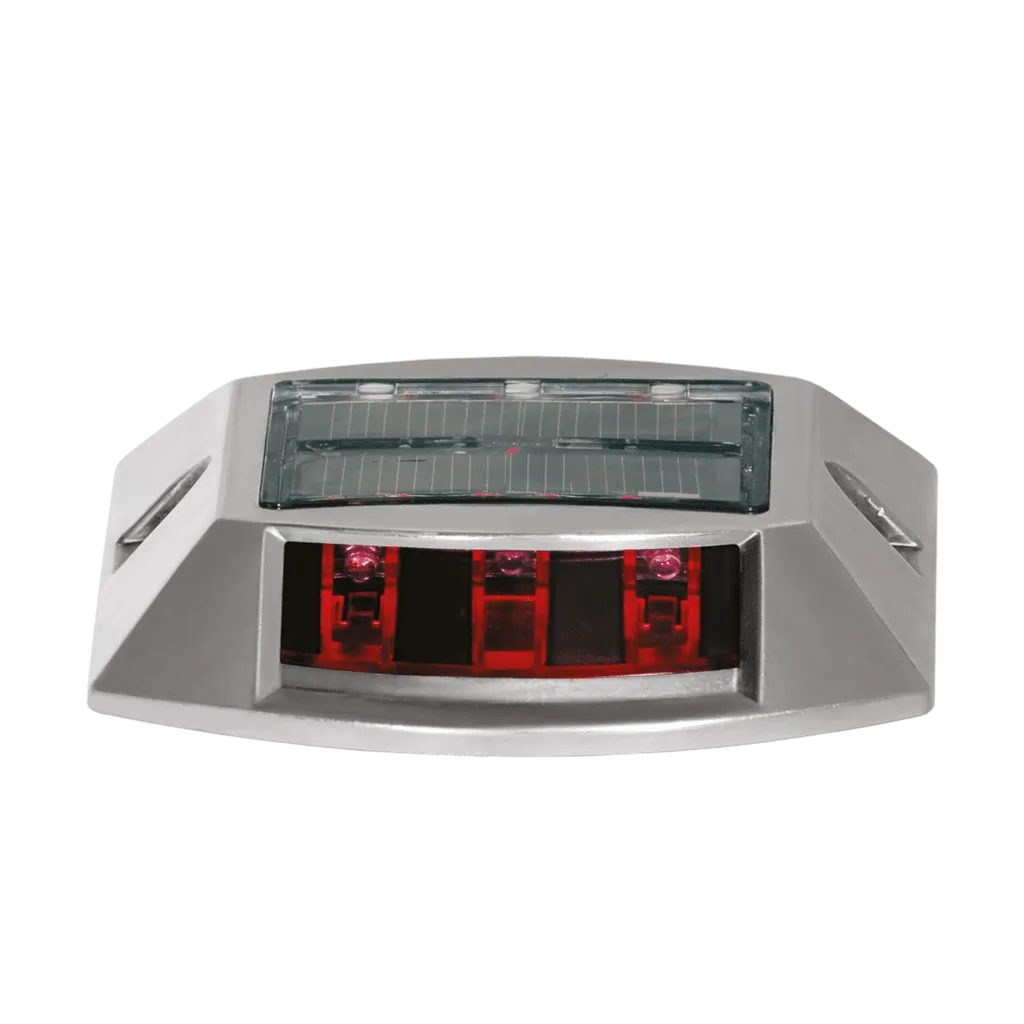
A reflective stud only shows when headlights hit it. The ATE 11920 lights up on its own: during the day the solar panel on top charges the battery, and at night its 6 red LEDs flash, 3 towards each direction of travel, 120 times a minute. After a day of charging, it stays lit all night.
- 12 x 15 cm, 3 cm tall, 420 g;
- aluminium body with a polycarbonate cover;
- 5.4 x 6 cm monocrystalline solar panel, 3 V / 0.4 W, and a 1.2 V, 2000 mAh NiMH battery;
- IP65 protection, works between -20 and +60 °C.
It has no cables, so it can be fitted where there is no power supply: along an unlit lane, at a car park exit, on traffic islands or along a ramp edge. All models are under road studs.
Reflective or solar
Reflective studs need nothing after fitting: no power, no batteries. But they only work while headlights reach them. The solar stud can be seen even where headlights do not reach yet, because the light comes from the stud itself. It is worth fitting where the lane or ramp is unlit and you want a particular spot to be seen in good time: an exit, a traffic island, a ramp edge.
The solar stud has one condition, daylight: choose a spot that is not in shade all day, so that the panel can charge the battery. On a long line you can combine the two types: reflective studs along the whole length and solar studs at the points where you want extra attention.
What the colours mean
The body works by day: the yellow of the PPC and ABS studs shows up well on dark asphalt, and the aluminium studs are grey. The reflectors work at night, and their colour matters according to how they are arranged:
- red on one side and white on the opposite side, on the ATE 12005 and ATT 9008: the stud shows one colour to drivers coming from one direction and another to those coming from the opposite direction;
- red and white alternating all the way round, on the ATZ 8001: the stud can be seen from any direction, which is why it suits roundabouts and corners;
- the same colour on both sides: yellow on the ATT 9007, red on the ATZ 8002 and on the glass lenses of the ATO 5160;
- the red LEDs of the ATE 11920 solar stud: red suits marking places where traffic must not pass.
Many people search for blue road studs. There are no blue studs in our range: the bodies are yellow or grey.
How to choose: three questions
What traffic will drive over them?
For car parks and yards with cars, plastic studs are enough. Where the stud is driven over often, take the aluminium ATO 5160. For heavy traffic, the only studs with a declared load rating are the bonded ones: the ATT 9007, rated 10-20 t, where vans also pass, and the ATT 9008, rated 30 t, where lorries run.
Are you marking a line or a point?
For a line, along a ramp, a cycle lane or between parking bays and the traffic lane, the elongated ATZ 8002, set in a row. For a point that vehicles approach from several directions, such as a small roundabout or the corner of a traffic island, the round ATZ 8001. For the centre line of a two-way lane, a stud with reflectors on two opposite sides, such as the ATE 12005.
Is the spot lit at night?
If it is, reflective studs are enough. If not, and the marking must be seen without headlights, fit the ATE 11920 solar stud, at least at the key points.
How to fit them
Screw-fixed studs
The screws, and the plugs where they are needed, come in the pack. How many depends on the model:
- 1 concrete screw of 7.5 x 80 mm, in the centre hole: ATZ 8001;
- 2 concrete screws of 7.5 x 80 mm: ATZ 8002;
- 2 screws and plugs of 7.5 x 80 mm: ATE 12005;
- 2 plugs and 2 screws: ATO 5160, into asphalt or concrete, and the ATE 11920 solar stud;
- 4 plugs and 4 screws: ATO 5100, ATO 5120 and ATO 5140.
Before drilling, place the stud and check the orientation: on the ATO 5160, the lenses face the direction vehicles come from; on the ATZ 8002, the long side runs along the line you are marking. The round ATZ 8001 has no particular direction. Its profile is low and rounded, so wheels roll over it without catching.
Bonded studs
- Prepare the spot: the surface must be clean and dry.
- Apply the epoxy adhesive to the sanded base of the stud. The adhesive is not included, so get it separately.
- Press the stud into position, with the reflectors facing the directions of travel.
- Do not let traffic over it until the adhesive has hardened.
How far apart
For a line of ATZ 8002 studs, leave an equal distance between them, for example 1 m. At 1 m, a 20 m line needs 21 studs: one for every metre, plus the one at the end. If the line also needs painting, the right paint is in our guide to road marking paint.
Frequently asked questions
What are cat’s eyes?
They are the reflectors on the sides of the stud. They return the headlight beam to the driver. Our reflective studs have between 2 and 8 cat’s eyes or glass lenses.
What load can a road stud take?
Only the bonded studs have a declared load rating: the ABS ATT 9007 is rated 10-20 t and the aluminium ATT 9008 30 t. The other models have no declared value.
Do I need to drill the asphalt?
For the ATT 9007 and ATT 9008, no: they are bonded with epoxy adhesive. All the other models are screwed into holes drilled in the road surface.
How long does the solar stud stay lit?
After a day of charging, the ATE 11920 stays lit all night, with 6 red LEDs flashing 120 times a minute.
Why do some studs have two colours?
On the ATE 12005 and ATT 9008, the red and the white reflectors are on opposite sides, so drivers see one colour from one direction and another from the opposite direction. On the ATZ 8001, red and white alternate all the way round.
How we can help
All models are under road studs. If you are not sure which stud and how many you need, tell us what you are marking, how long the line is, what traffic passes there and whether the spot is lit at night, and we will put the list together for you.