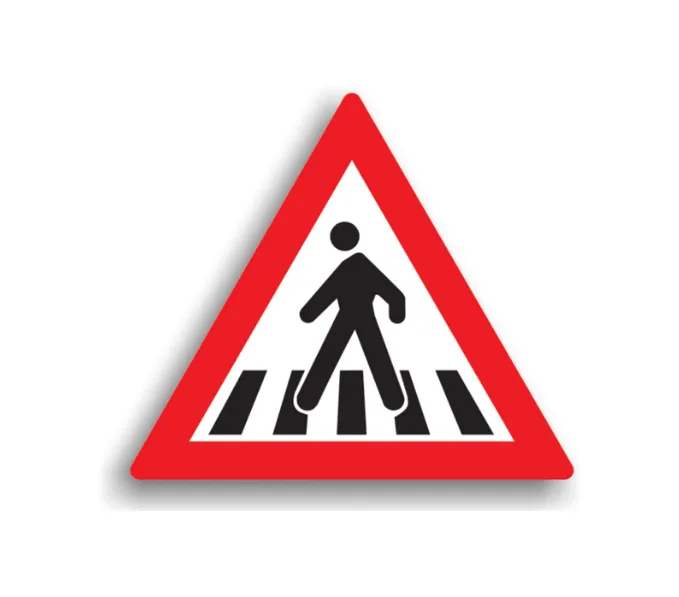
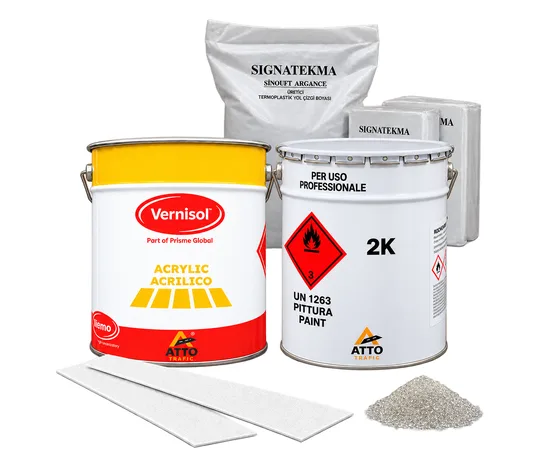
A road marking has to be seen by day, seen at night in the headlights and stand up to wheels for as long as possible. The questions come quickly: which paint for a car park, which material for a crossing where cars brake all day, how many pails you need, how long the area stays closed, whether you need primer or glass beads. This guide compares the four marking materials we carry, using the figures from their data sheets.
Four materials, four ways of working
The main difference is the thickness of the layer. Acrylic paint goes on at a few hundred microns, two-component cold plastic is spread with a roller in a much thicker layer, and thermoplastic and preformed markings are 2-3 mm thick. The thicker the layer, the longer the marking stands up to wheels, but it calls for other equipment and other consumption.
One-component road marking paint
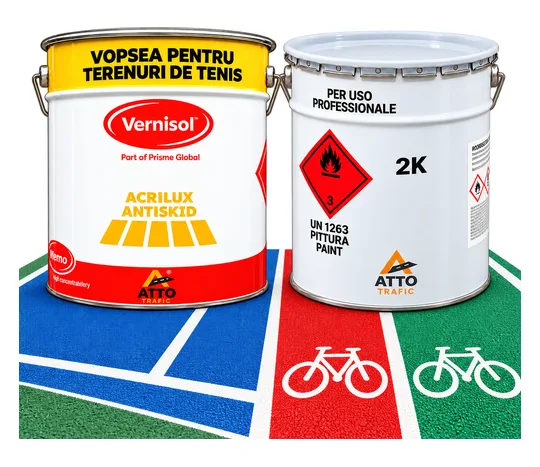
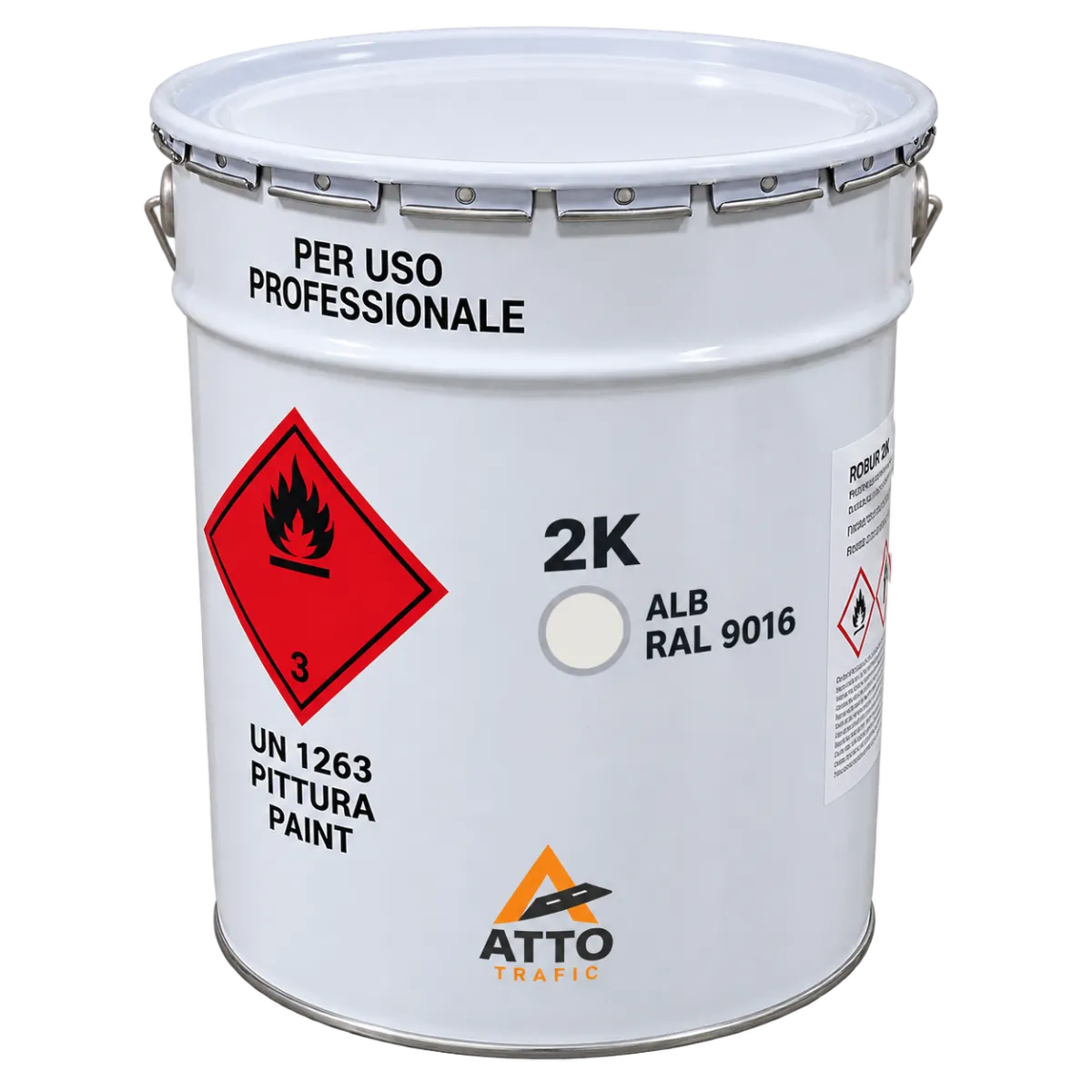
This is the most widely used paint for markings. It has no catalyst: you mix it with a mechanical stirrer and apply it with an airless machine or, on small areas, with a handgun, brush or roller. It dries as the solvent evaporates. The ATP 1K range is based on pure acrylic resin, matt, compliant with BS EN 1871, in 25 kg pails:
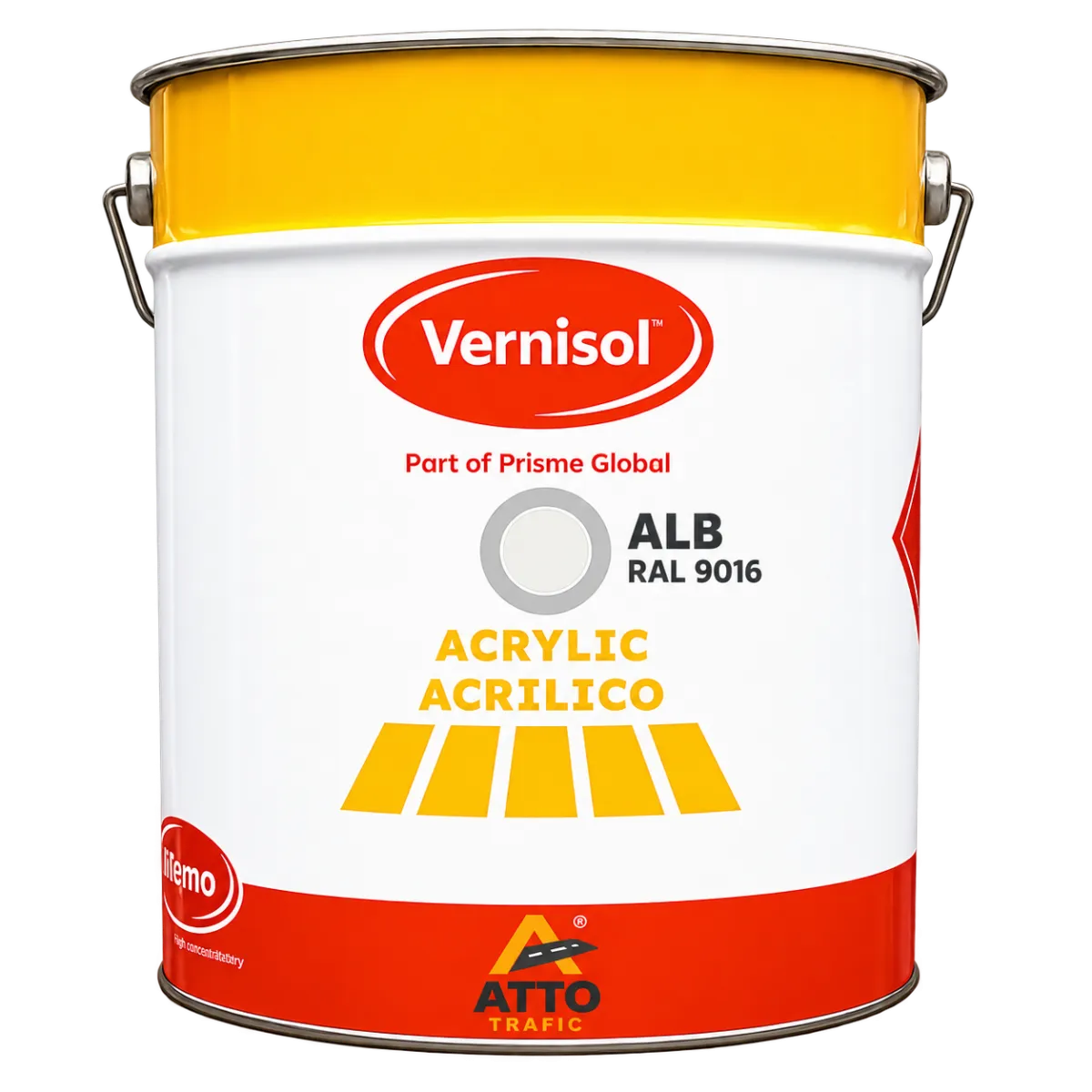
- ATP 1K-9016, white RAL 9016: lane lines, pedestrian crossings, parking bays, arrows;
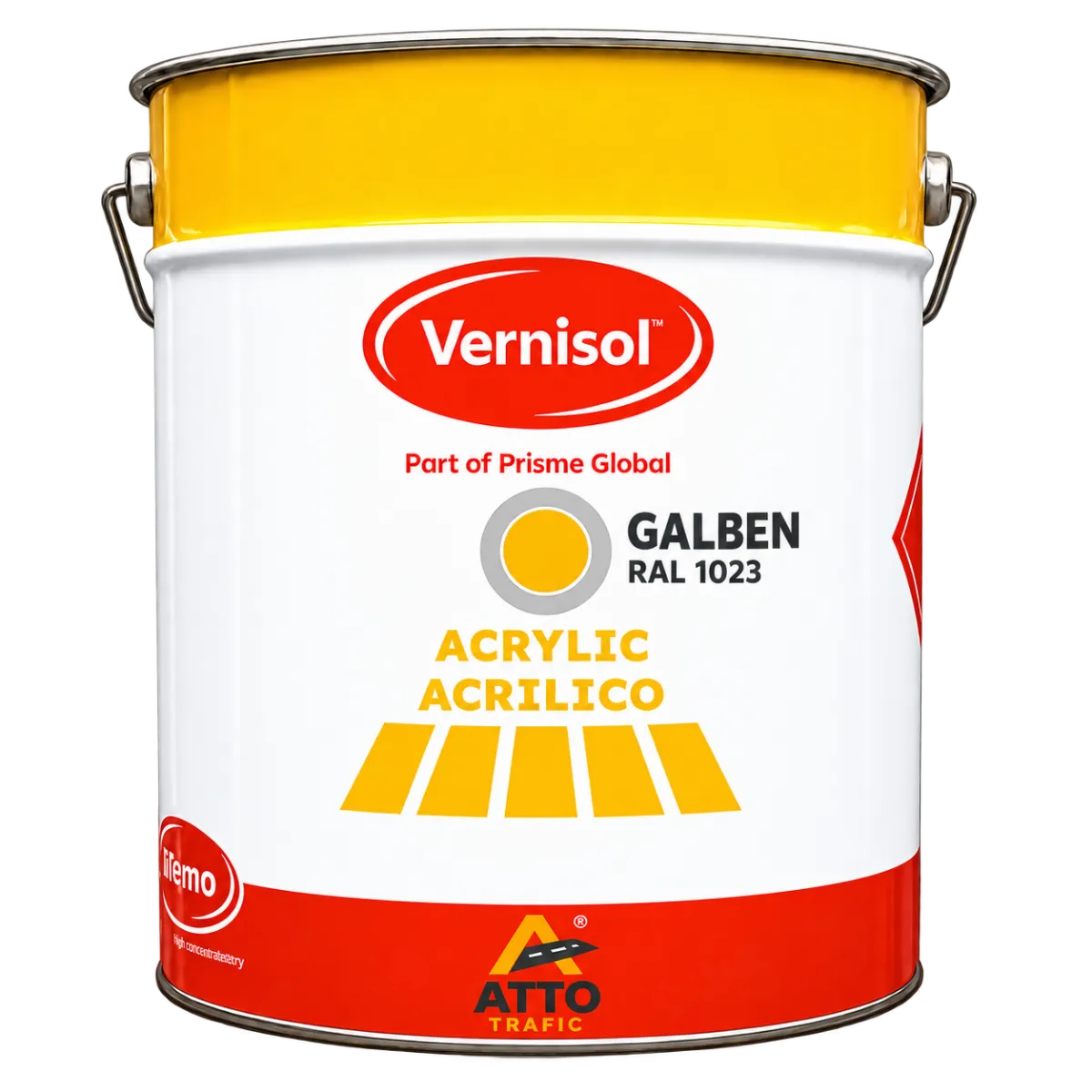
- ATP 1K-1023, yellow RAL 1023: temporary markings at road works, bus stops, no-stopping zones;
- ATP 1K-5017, blue RAL 5017: the background of disabled parking bays;
- ATP 1K-6024, traffic green RAL 6024: cycle lanes and electric vehicle charging bays;
- ATP 1K-6001, emerald green RAL 6001, darker: park paths, school yards, play areas;
- ATP 1K-9017, black RAL 9017: outlines along white lines on light-coloured concrete.
It dries in 30 minutes at 10 °C, 25 minutes at 25 °C and 5 minutes at 45 °C. White uses 641 g/m² at a 400 µm wet film, so one pail covers about 39 m², roughly 390 m of 10 cm line. The colours use 599 g/m², about 41 m² per pail.
For red and for RAL 5015 blue there is a second one-component, solvent-based range, in 25 and 5 kg pails: the ATA 1225 and ATA 1205 in red RAL 3020, for warning zones and coloured bands, and the ATA 1425 and ATA 1405 in blue, for reserved bays in car parks. At 500-900 g/m², depending on layer thickness, the 25 kg pail covers 28-50 m² and the 5 kg pail 5.5-10 m². They dry in about 20 minutes at 25 °C and are not applied over old alkyd-based marking paint. All are under one-component road marking paint.
Two-component cold plastic
Where cars brake, pull away and turn every day, a thin paint wears off within a few months. Two-component cold plastic, based on methacrylic resin (MMA), solvent-free and with 99% solid content, is poured onto an area marked out with tape and spread with a rubber roller once the catalyst has been added. It lasts on crossings, stop lines and coloured areas with heavy traffic. Consumption is 1.5-2 kg/m²:
- ATP 2K-9016, white, 15 kg, for 7.5-10 m², the only one with premixed glass beads;
- ATP 2K-3020, red RAL 3020, 15 kg, for 7.5-10 m²;
- ATP 2K-6024, traffic green RAL 6024, 20 kg, for 10-13 m²;
- ATP 2K-6024/10, the same green, 10 kg, for 5-6.5 m² and repairs.
Once the catalyst is in, you have 20 minutes of working time at +5 °C, 12 at +10 °C, 8 at +20 °C and 6 at +30 °C, and the marking cures in 55, 40, 30 and 20 minutes respectively. The colours keep for 24 months in the sealed container, the white for only 6 months, so order it close to the job. The green and the red are used mostly on cycle lanes, where cars cross the lane. The range is under two-component road marking paint.
Hot-applied thermoplastic
On motorways, main roads and the big city arteries, markings are made of thermoplastic. The material comes solid, is melted in a melter at 180-210 °C and is applied with a machine that has one gun for the material and one for the beads, in a 2-3 mm layer. It hardens by cooling in 2-4 minutes at 10 °C, so the lane reopens almost at once, and it contains no volatile compounds. The softening point is at least 95 °C, so it does not soften on hot asphalt in summer. The packs are 20 kg:
- ATA 4020, white RAL 9016, luminance factor LF6 (β ≥ 0.80), for ordinary lines;
- ATA 4120, yellow RAL 1023, for temporary markings, no-standing zones and bus stops;
- ATA 4520, black RAL 9017, for contrast borders on concrete or light-coloured asphalt.
Consumption is 4 kg/m² at 2 mm and 6 kg/m² at 3 mm, so 20 kg covers about 5 m² or 3.3 m² respectively, at no more than 80% humidity. Without hot-application equipment, paint or preformed markings remain. Details under thermoplastic road marking paint.
Preformed markings
A symbol painted on asphalt needs a stencil, time and a steady hand. Preformed markings come ready-made, in 2-3 mm thermoplastic: you lay them on clean, dry asphalt, heat them with a gas burner until they melt onto the surface and, once cooled, traffic can run over them. No drying time and no marking machine. There are three families:
- 100 cm lines in 3 mm thermoplastic: the ATP L10015-9016, white, 15 cm, the ATP L10015-1003, yellow RAL 1003, 15 cm, and the ATP L10040-9016, white, 40 cm, for stop lines and crossings in yards and car parks; they are laid end to end or cut to length before heating;
- road surface signs, 3 mm: the ATP P300160-B2 (STOP, 160 x 300 cm), then, at 100 x 300 cm, the ATP P300100-B1 (give way), the ATP P300100-A22 (pedestrian crossing ahead), the ATP P300100-C27-30 and ATP P300100-C27-50 (speed limits);
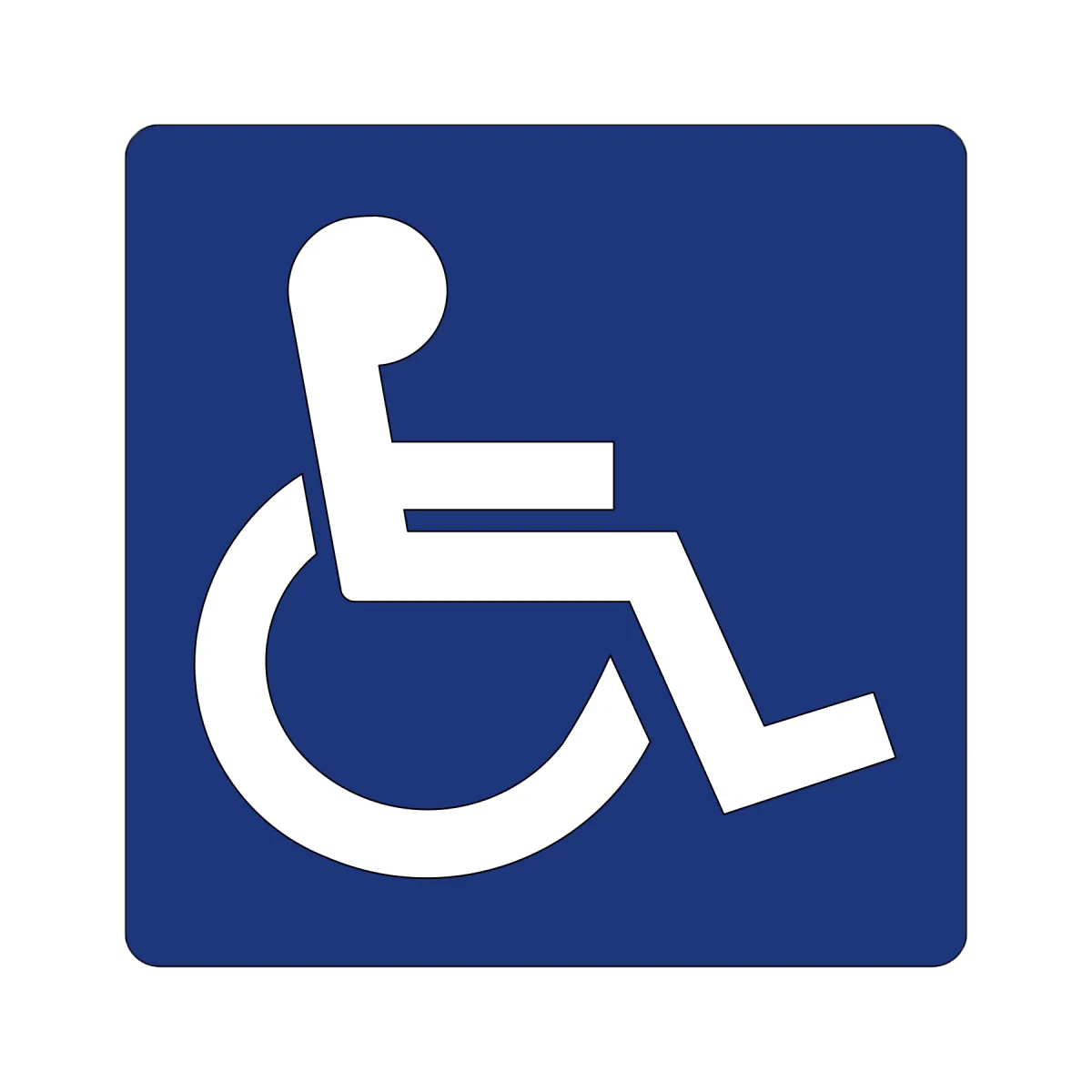
- parking symbols: the ATP P100-D (100 x 100 cm, 2 mm) and ATP P150-D (150 x 150 cm, 3 mm) for disabled parking, white on blue; the ATP P100-VE (100 x 100 cm, 2 mm) and ATP P150-VE_G (150 x 150 cm, 3 mm) for electric vehicles, on green, plus the ATP P150-VE, on blue.
The road surface signs are three times longer than they are wide: seen from a car, a sign on the asphalt looks shortened, and the elongated shape makes it look like the sign on the post. Preformed markings suit a few symbols or a few metres of line, in car parks, yards and housing estates. All are under preformed road markings.
Glass beads: the marking that shows at night
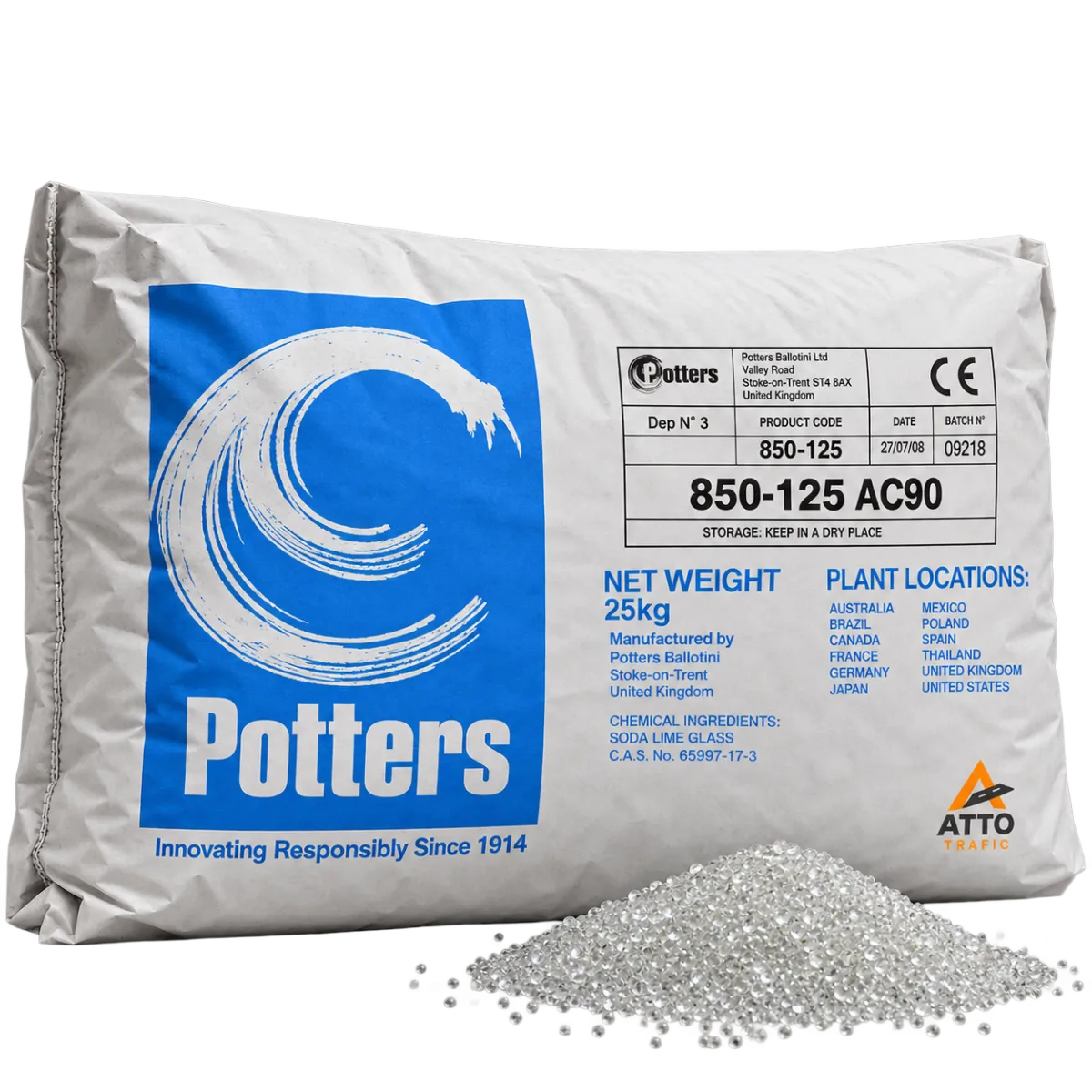
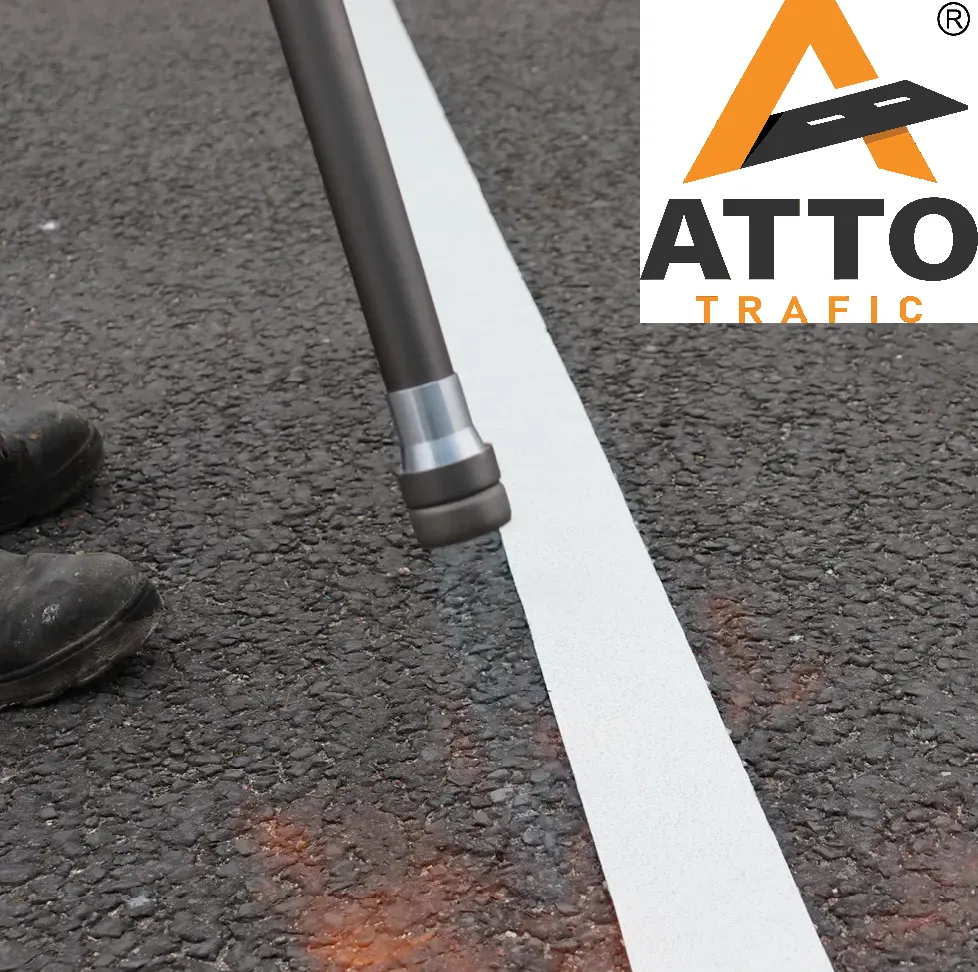
At night, a white line without glass beads is just a lighter patch in the headlights. Beads dropped onto the still-wet paint send the light back to the driver, so the marking seems to glow. The ATP AC90 are soda-lime glass beads of 125-850 µm, with roundness above 80% and a Class A refractive index, compliant with EN 1423, in a 25 kg bag.
They are dropped straight after application, by hand or with the machine’s bead gun, and they sink partly into the layer and stay held once it dries. The data sheets give about 350 g/m² on the ATA paints and 400 g/m² on thermoplastic; at 400 g/m², one bag is enough for roughly 62 m². In EN 1436 tests, the white ATP 1K-9016, with 600 g/m² of paint and 400 g/m² of beads, reached retroreflection class R5 at the start and R2 after 2 million wheel passes. On cold plastic, where vehicles brake, the beads are dropped mixed with anti-skid material, for visibility and grip.
Primer: when you need it
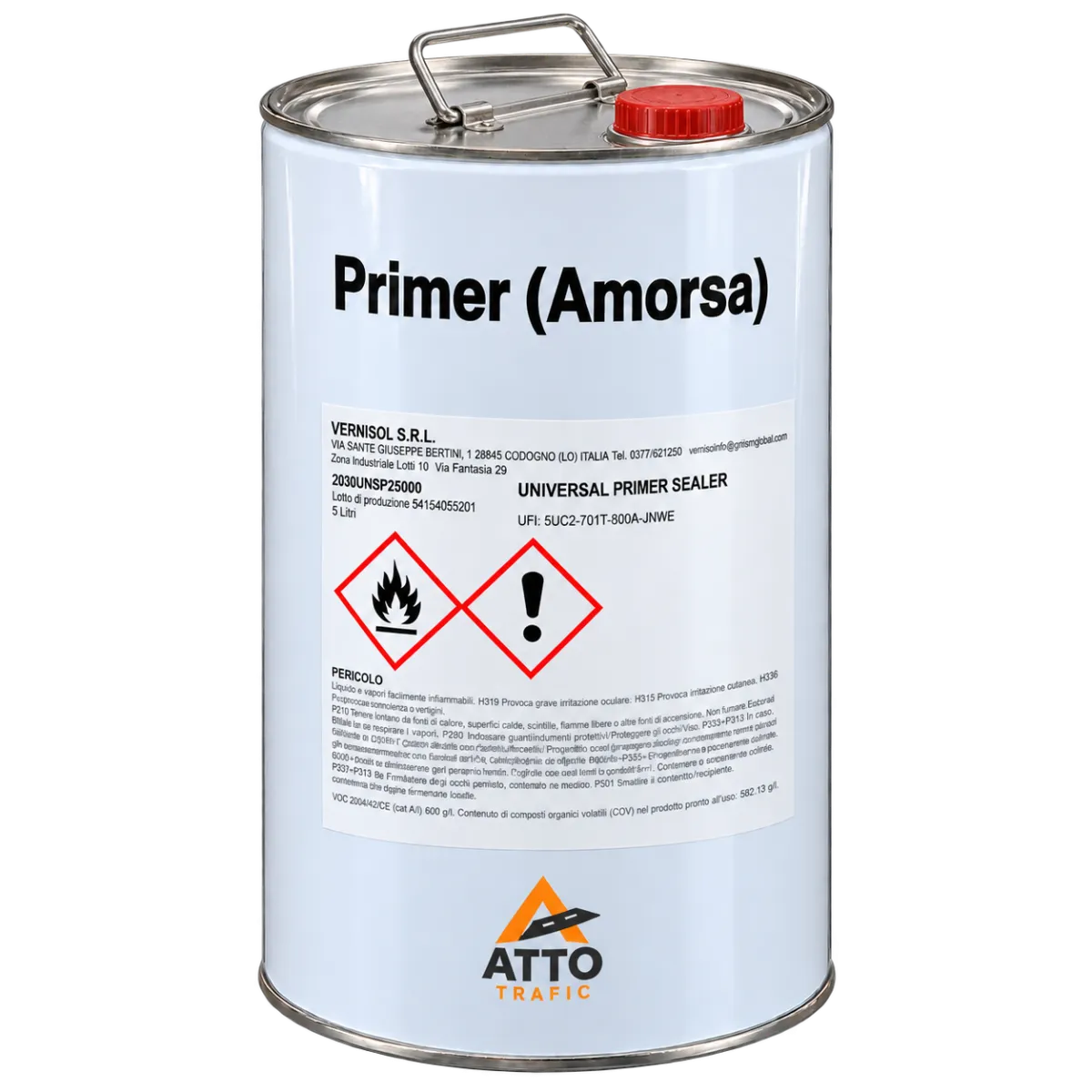
On ordinary asphalt in good condition, paint bonds well and usually needs no primer. On concrete and on very old asphalt or asphalt polished by traffic, it can flake off in the first winter without primer. There, the ATP 1K data sheets call for ATP PRIMER first, a clear solvent-based acrylic primer in a 5 l can. The paint goes on once the primer has dried, and a test on a small area beforehand is a good idea. The primer is highly flammable and irritates the eyes: work outdoors, with gloves and glasses, away from flames.
How to choose: four questions
How much do you have to mark?
For long lines, one-component paint is the fastest and most economical. For a symbol or a few metres of line, preformed markings spare you the machine and the stencils.
How heavy is the traffic?
On ordinary streets and in car parks, paint is enough. Where vehicles brake and turn every day, cold plastic lasts longer. On motorways and main roads, the work is done with thermoplastic.
How long can the area stay closed?
Thermoplastic is ready in 2-4 minutes, preformed markings once cooled, paint in 25 minutes at 25 °C, and cold plastic in about 30 minutes at +20 °C and 55 minutes at +5 °C.
What equipment do you work with?
Paint goes on with an airless machine or a roller. Cold plastic is spread by hand with a rubber roller. Thermoplastic needs a melter and a hot-application machine, and preformed markings only a gas burner.
How much paint you need
- a 10 cm yellow line in ATP 1K-1023 uses 59.9 g per metre, so one pail is enough for roughly 417 m;
- a coloured area of 1.5 x 25 m is almost 38 m², so one pail of ATP 1K-6024 is enough;
- a 5 cm black outline in ATP 1K-9017 takes about 30 g per metre, so one pail is enough for several hundred metres;
- a stop line across a 3 m lane takes 3 pieces of ATP L10040-9016.
The data sheet figures are theoretical and rise with the layer thickness: at a 600 µm wet film, the ATP 1K colours reach 901 g/m².
How to apply it
- Check the conditions: surface between 5 and 45 °C, humidity no more than 80% and a temperature at least 5 °C above the dew point, so that no condensation forms.
- Clean off dust, oil and loose old paint. On new asphalt, the data sheets of the ATP 1K-9016 and ATP 1K-6024 call for a 4-6 week wait. On concrete, apply the primer first.
- Mark the edges out with tape and mix the paint with the stirrer; thin it by no more than 3%, with solvent-based thinner.
- Apply with an airless machine or a roller and drop the beads at once.
- Keep the area closed until it dries.
With cold plastic, you first mix the product, add the catalyst, 2% at +5 °C and 1% between +10 and +30 °C, and mix for at least one more minute. Too little catalyst leaves a marking that gets dirty easily and wears quickly. Prepare only what you can spread within the working time and remove the tape before full cure. It is not thinned and not applied over other paints, thermoplastic or tapes, and on new asphalt the wait is again 4-6 weeks.
Preformed markings are laid the right way round before heating: speed limits and STOP with the lettering facing oncoming traffic, give way with its point towards the junction, the disabled symbol facing the entrance to the bay. On a two-way street, the speed limit goes on each lane.
Frequently asked questions
What is the difference between one-component and two-component paint?
One-component paint is applied straight from the pail, with no catalyst, at a few hundred microns. Two-component paint is mixed with a catalyst, spread thick at 1.5-2 kg/m², and lasts longer where vehicles brake every day.
How many square metres does a 25 kg pail cover?
The white ATP 1K-9016 about 39 m², the ATP 1K colours about 41 m². The ATA paints, such as the ATA 1225, cover 28-50 m², depending on layer thickness.
Can I paint over an old marking?
Loose old paint is removed first. The ATA paints are not applied over alkyd marking paint, and cold plastic is not applied over other paints, thermoplastic or tapes.
How does thermoplastic differ from preformed markings?
Both are 2-3 mm thermoplastic. Bulk thermoplastic, such as the ATA 4020, is melted in a melter and applied by machine, on long roads. Preformed markings come ready-cut and are melted onto the asphalt with a burner.
Which colours are used for road markings?
White for lines, crossings and parking, yellow for temporary markings and no-stopping zones, blue for reserved bays, green for cycle lanes and charging bays, red for warning, black for contrast.
Is road marking paint solvent-based?
The one-component paints in the range are solvent-based. Two-component cold plastic is solvent-free, and thermoplastic hardens by cooling and contains no volatile compounds.
How we can help
All 32 products are under road marking paint. Tell us what area you need to mark, on asphalt or concrete, how much traffic passes there and what equipment you work with, and we will work out how many pails and beads you need and whether you need primer. If the yellow marking is for road works, add the signs from our guide to signing road works with U signs. We deliver in 24-48 hours.