A basketball court in a school yard, a hard tennis court or a cycle lane on a pavement all end up the same way after a few years: the colour has faded, the lines can barely be seen and the bare asphalt is slippery in places. The right paint depends on who walks or rides on the surface. Only people cross a sports court, so an acrylic paint with good grip is enough. A cycle lane is also crossed by cars, at junctions and at driveways, and there it needs a thick, hard layer. This guide explains which paint suits each case, how much a pail covers and how to apply it. We mean paint for asphalt surfaces, not paint for a bicycle frame.
Two surfaces, two kinds of paint
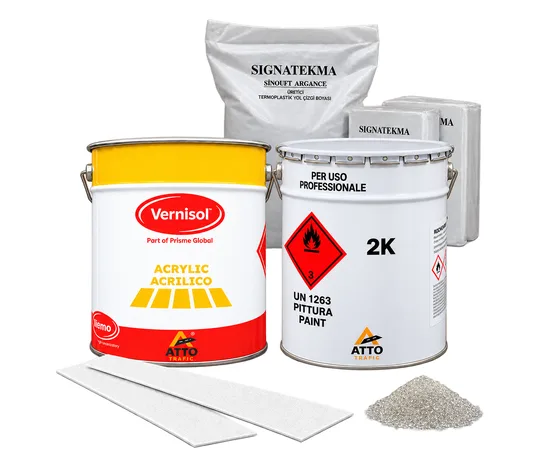
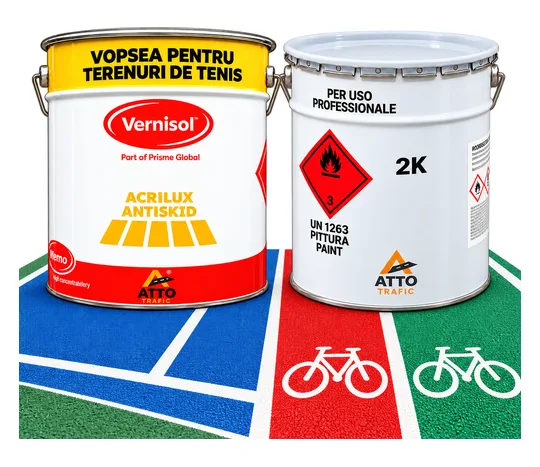
For sports courts we carry one-component acrylic paints: you open the pail, stir and apply, with no catalyst. For cycle lanes we carry two-component cold plastic based on methacrylic resin (MMA): a catalyst is added, it is spread with a roller in a layer of 1.5-2 kg/m² and it cures in about 30 minutes at +20 °C. The difference in thickness shows in the coverage: a 25 kg pail of blue or green court paint covers about 42 m², while a 20 kg pail of cold plastic covers 10-13 m². Acrylic paint is made for feet, cold plastic for wheels.
Sports court paint
Anti-slip paint with quartz
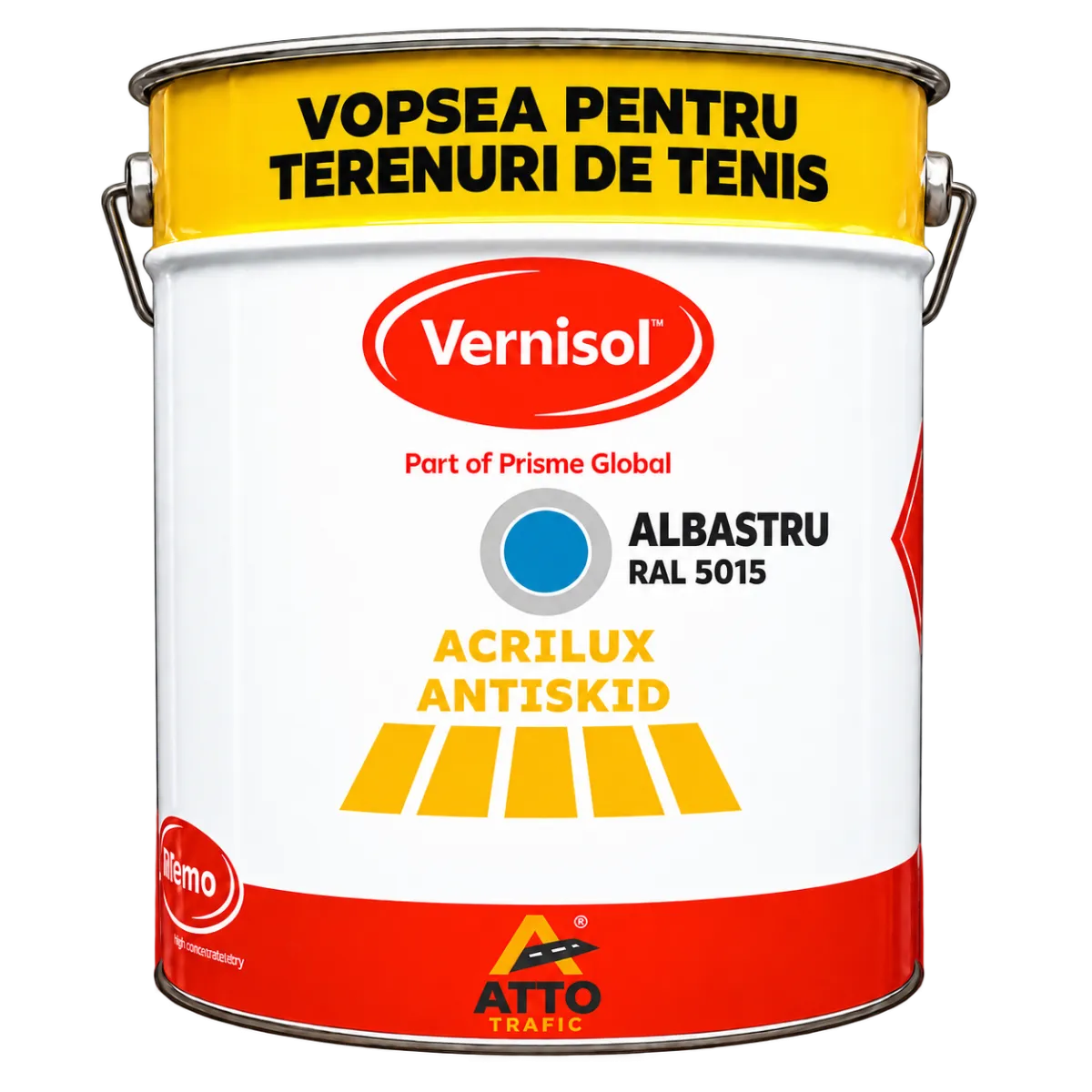
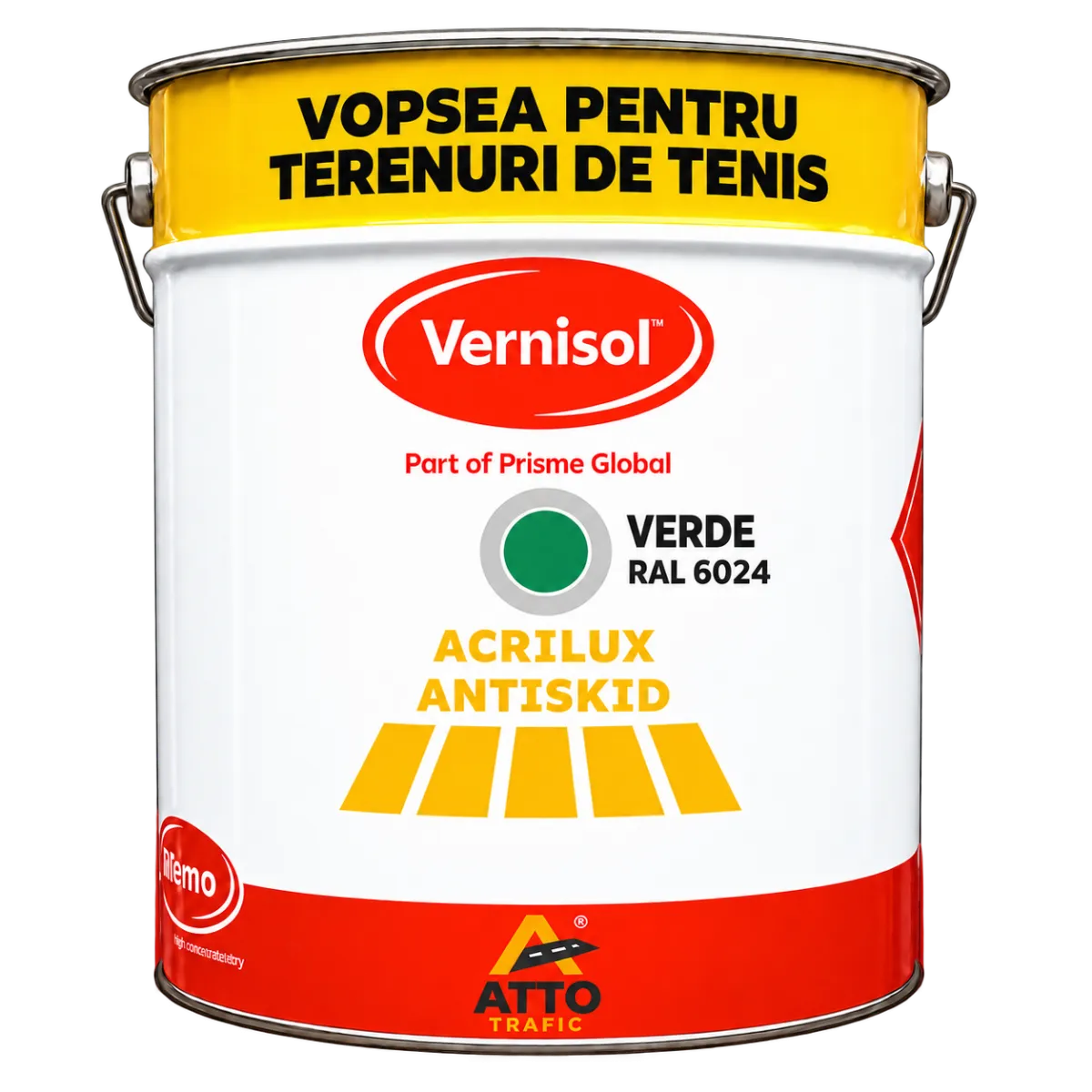
The ATP T range is a solvent-based acrylic paint with 0.06-0.25 mm quartz sand already mixed into the pail. The quartz makes the surface slip-resistant, so there is nothing to broadcast separately, and the finish stays matt. There are three colours, all in 25 kg pails:
- ATP T-5015, blue RAL 5015, for the playing surface; on a blue background, white lines stand out very well;
- ATP T-6024, green RAL 6024, one of the classic colours of tennis courts and asphalt playgrounds, also good for the areas outside the lines;
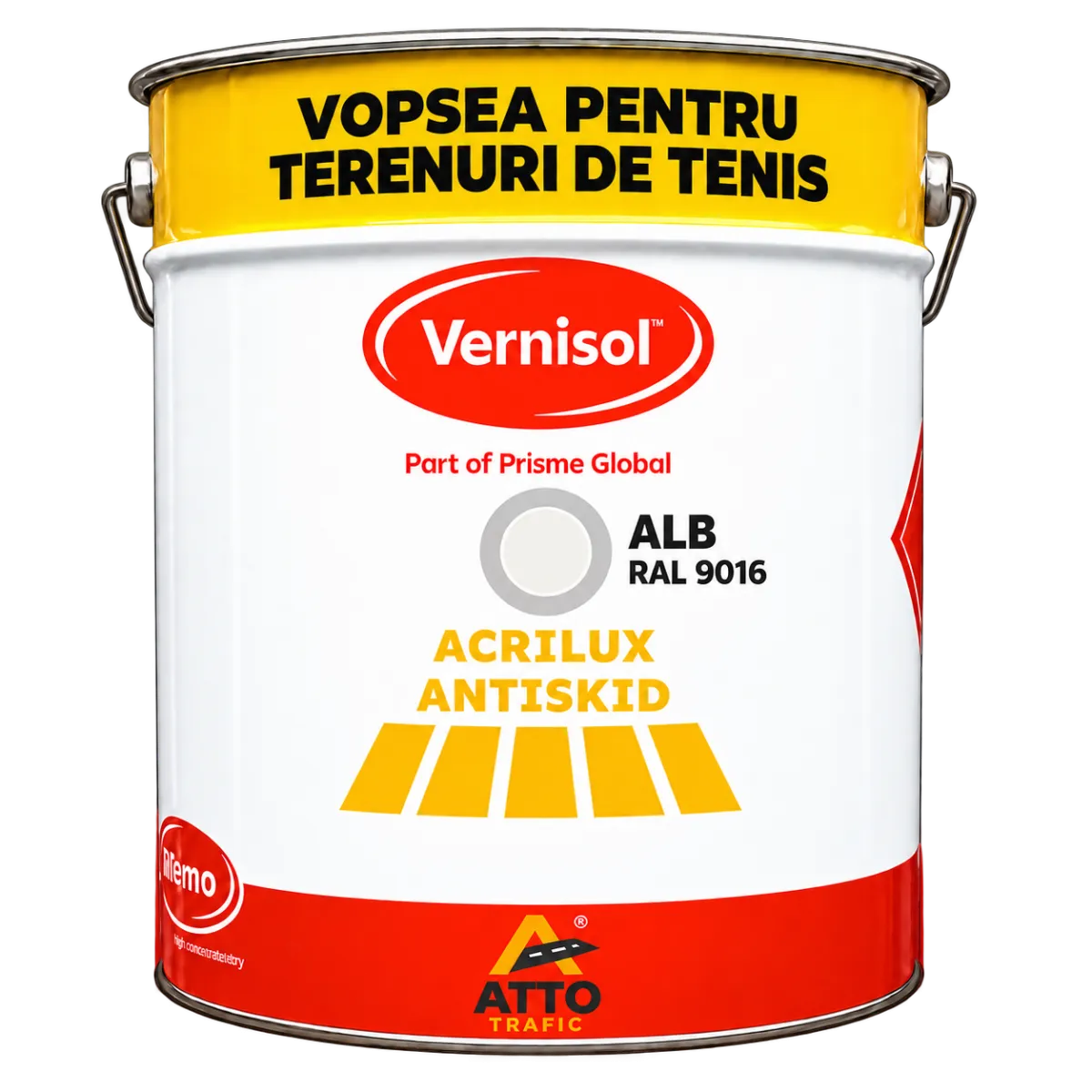
- ATP T-9016, white RAL 9016, for the playing lines.
The pigments are UV-resistant, class UV1, and the hiding power is HP4, meaning over 95% at a 300 µm coat. The paints comply with BS EN 1871. The blue and the green have a spread rate of 1.67 m²/kg at a 400 µm wet film, so about 42 m² per pail. At a 600 µm film the spread rate drops to 1.11 m²/kg, about 28 m². You will find them under sports court paint.
Red and brown paint for tennis
A red or brown tennis court looks like clay, but a hard surface is much easier to maintain. For this look we carry two one-component acrylic paints, in 25 kg pails, used both for coating the surface and for lines:
The two can be used together for a two-colour court. Consumption is 500-800 g/m², so one pail covers 31-50 m²; on porous asphalt or with a thicker coat, consumption moves towards the upper limit. The paint dries in about 15 minutes at 19 °C, 37% humidity and a 5 km/h wind; in colder or damper weather it takes longer. The data sheets of these two paints do not give the application tools, the number of coats or the surface preparation, so tell us what surface you are working on before you order.
Playing lines: tennis, basketball, football on asphalt
Lines are stepped on, jumped on and braked on every day, so you paint them with an anti-slip paint as well: ATP T-9016. The white is denser than the other colours, 1.60-1.70 g/cm³, and uses 0.64-0.68 kg/m² at a 400 µm wet film. A 25 kg pail covers about 37-39 m², or roughly 370-390 m of 10 cm wide line. At a 600 µm film it is enough for 24-26 m², so 240-260 m of line of the same width.
For a grass football pitch we have no data: the data sheet of the white, like those of all the paints here, only covers asphalt.
Cycle lane paint: cold plastic
A cycle lane does not carry only bicycles. Cars cross it at junctions, at driveways and at car park entrances, and there a thin paint wears off within a few months. That is why for cycle lanes we carry two-component MMA cold plastic, solvent-free, with 99% solid content: almost everything you apply stays on the asphalt. The colours are:
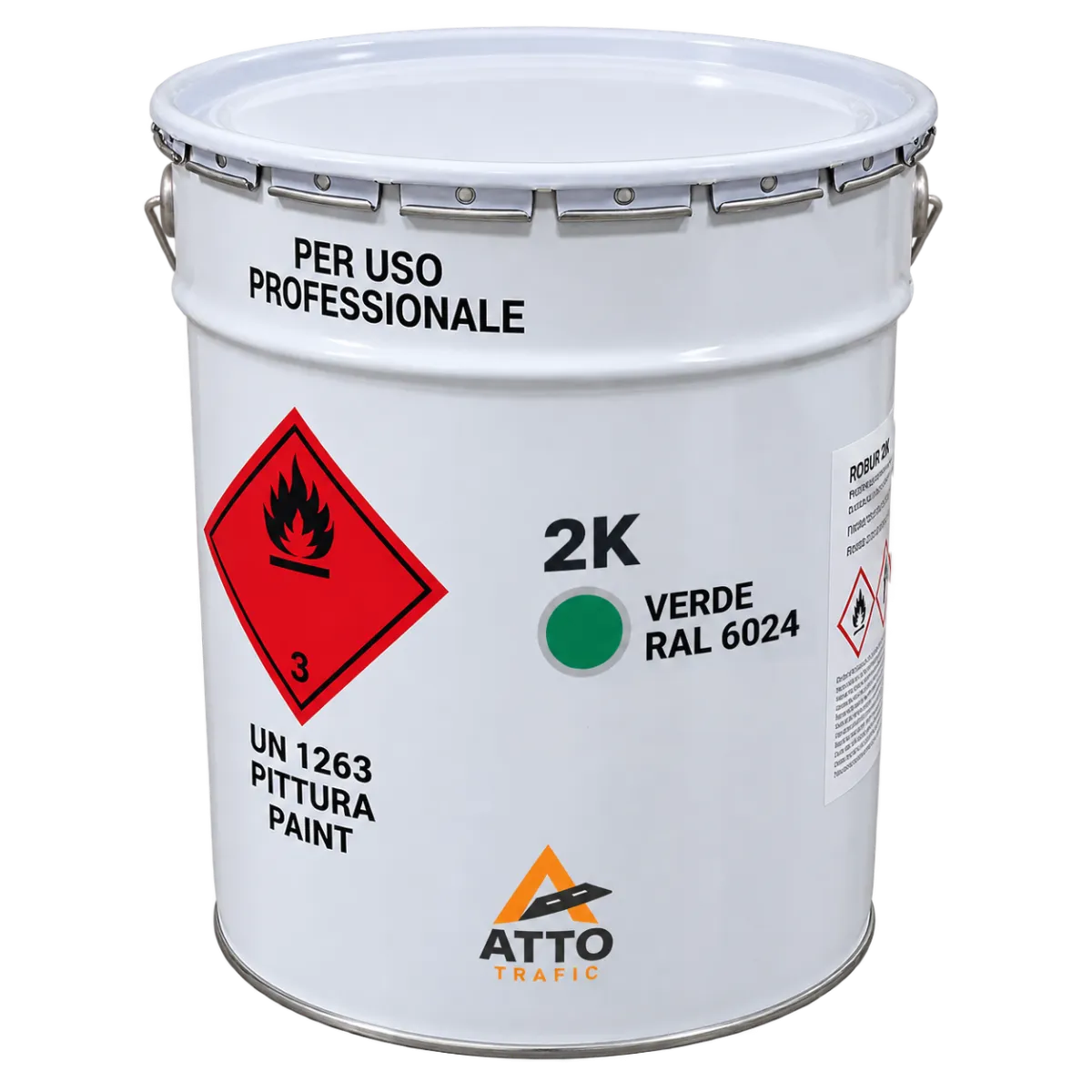
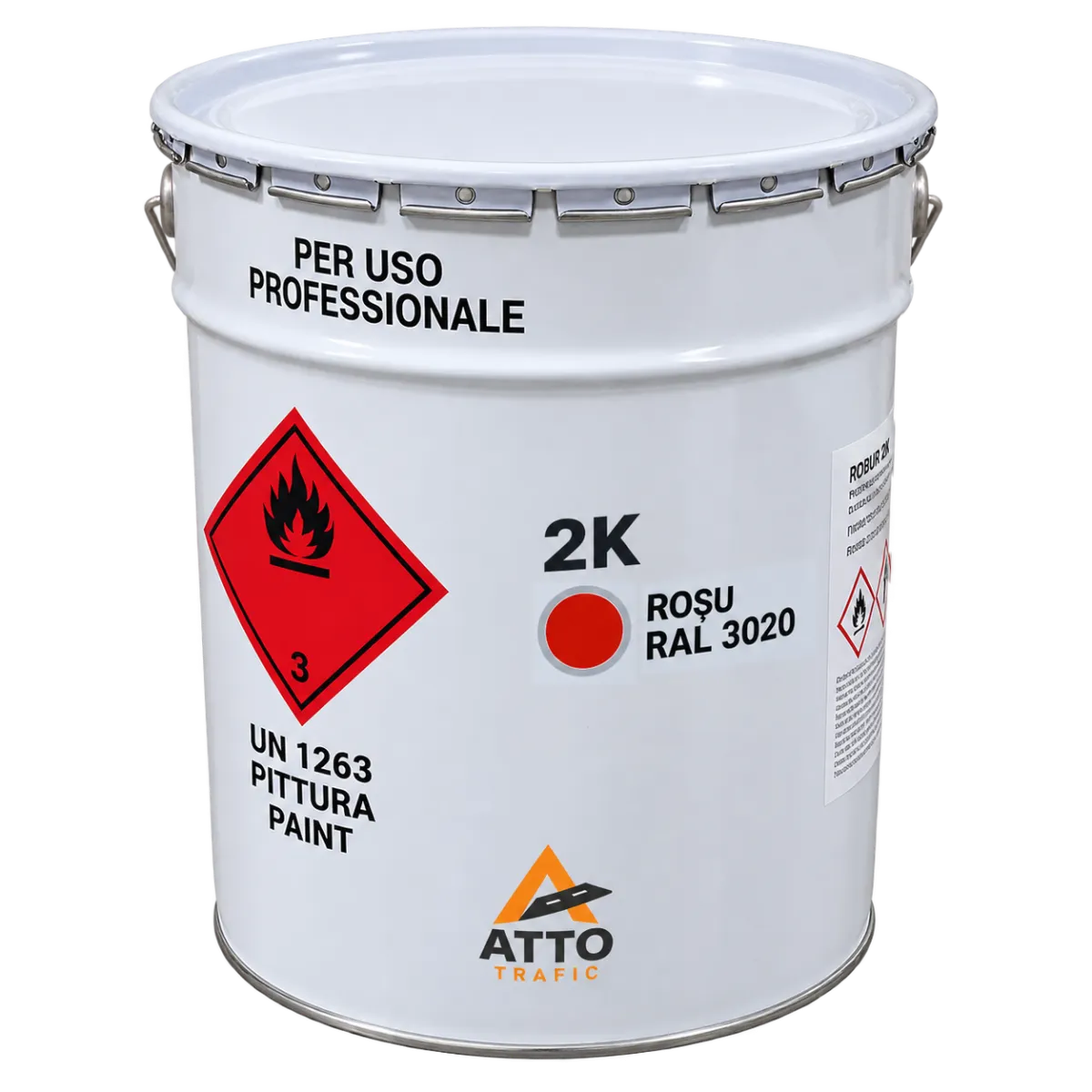
- ATP 2K-6024, traffic green RAL 6024, 20 kg, for 10-13 m²; this is the colour used for cycle lanes;
- ATP 2K-6024/10, the same green in a 10 kg pail, for 5-6.5 m²; for repairs at junctions and for short lanes;
- ATP 2K-3020, red RAL 3020, 15 kg, for 7.5-10 m²; for crossings where cyclists and cars meet, warning areas and entrances to pedestrian zones;
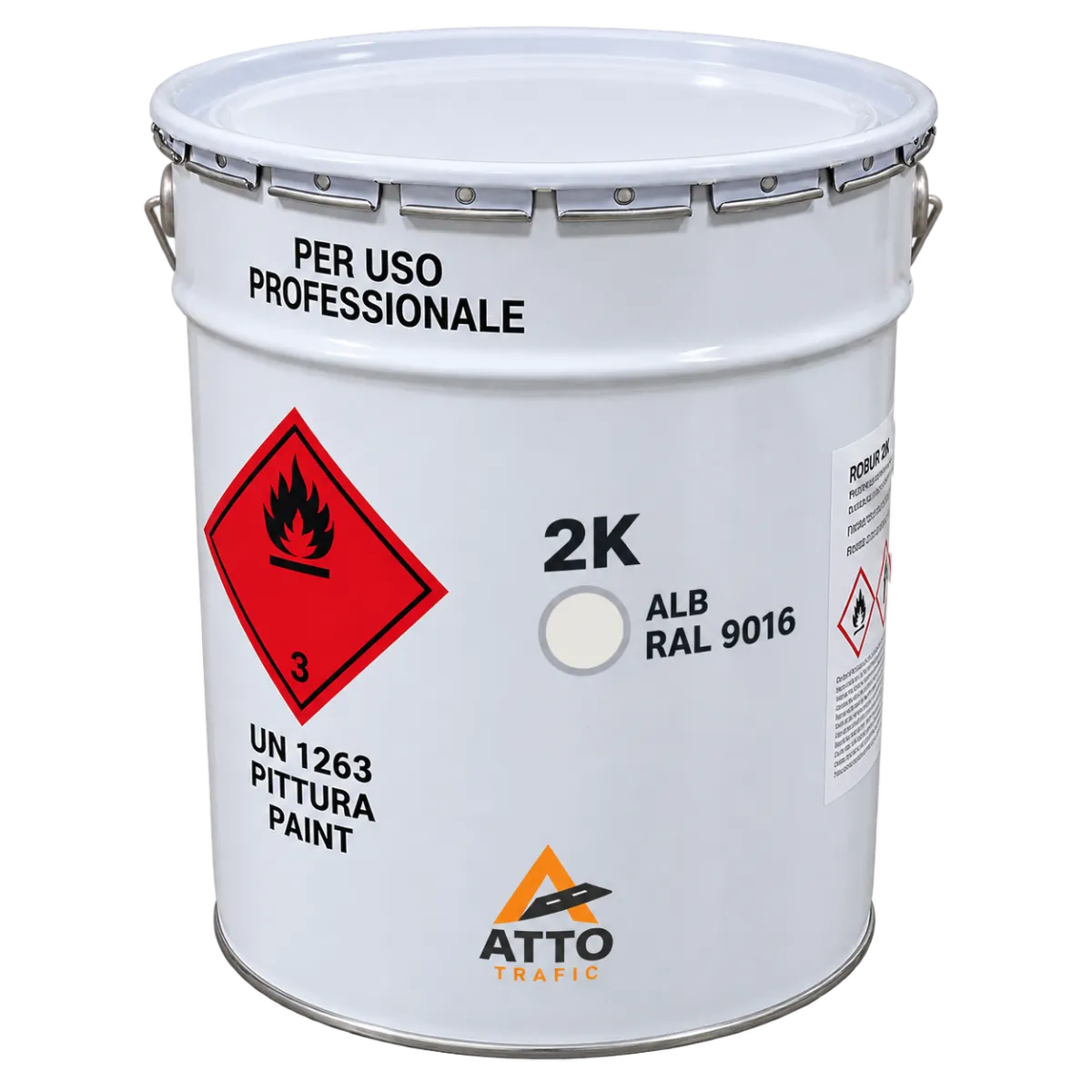
- ATP 2K-9016, white, 15 kg, for 7.5-10 m²; for the bicycle symbol, arrows and edge lines. It is the only one with premixed glass beads, so the marking can be seen by day and by night, even in the rain.
The pigments are UV-resistant, class UV1. The colours keep for 24 months in the sealed container, at +5 to +30 °C, and the white for only 6 months, so order it close to the date of the job. All of them are under cycle lane paint.
Catalyst and working time
Cold plastic cures once you add the catalyst. The amount and the times depend on the surface temperature:
- +5 °C: 2% catalyst, 20 minutes of working time, cured in 55 minutes;
- +10 °C: 1% catalyst, 12 minutes of working time, cured in 40 minutes;
- +20 °C: 1% catalyst, 8 minutes of working time, cured in 30 minutes;
- +30 °C: 1% catalyst, 6 minutes of working time, cured in 20 minutes.
In summer you only have a few minutes to spread the material, so mix only as much as you can cover in that time and prepare the area beforehand. The data sheet for the white also warns that with too little catalyst or poor mixing, the marking gets dirty easily and stands up less well to wear.
How to apply it on a cycle lane
- Clean dust, oil, fuel, de-icing salt and loose old marking off the asphalt. Cold plastic is not applied over other paints, thermoplastic or marking tapes.
- Mark out the area or the outline of the symbol with adhesive tape.
- Stir the product with a mechanical stirrer, add the catalyst and stir for at least one more minute. Do not thin it.
- Pour the material and spread it evenly with a rubber roller, preferably a disposable one.
- On the fresh coat, broadcast anti-skid material for grip under braking, or a mix of anti-skid material and ATP AC90 glass beads, so the lane has both grip and retroreflection.
- Remove the tape before the material has fully cured. At +20 °C, the lane can reopen after about 30 minutes.
The surface must be dry, between +5 and +30 °C, and at least 5 °C above the dew point. On new asphalt, wait 4-6 weeks. Tools are cleaned with road marking thinner.
How to choose: two questions
Who uses the surface?
If only people use it, as on an asphalt tennis, basketball or football court, acrylic paint is simpler: it needs no catalyst, it is applied by hand or with a marking machine and it covers several times more per pail. If the court doubles as a car park or a vehicle access, or if it is a cycle lane crossed by cars, choose cold plastic.
How many pails do you need?
Measure the area in square metres, divide it by what one pail covers and round up. A few examples:
- 500 m² in blue or green, at a 400 µm wet film: 500 / 42 = 11.9, so 12 pails of ATP T-5015 or ATP T-6024;
- the same area in red, with ATA 6225: between 10 and 17 pails, depending on how porous the asphalt is and how thick the coat is;
- 300 m of 10 cm wide lines: one pail of ATP T-9016 at 400 µm, but two at 600 µm;
- a cycle lane 1.5 m wide and 30 m long, so 45 m²: 67.5-90 kg of cold plastic, which means 4-5 pails of ATP 2K-6024.
How to paint a sports court
The steps below are those from the ATP T data sheets:
- Check the asphalt: it must be dry and clean. New asphalt is left for up to 28 days before painting.
- Check the weather: surface between 5 and 45 °C, air at least 5 °C, humidity below 80% and the temperature at least 5 °C above the dew point. Early morning, with dew on the court, is not the time.
- Stir the paint well with a mechanical stirrer, not with a stick. Do not thin it: it comes ready to use.
- Apply the playing surface with a roller, brush or handgun, or with an air-assisted marking machine. Once a pail is opened, use it all.
- Paint the white lines once the background has dried.
- Wait for it to dry: the data sheet gives 30 minutes at 10 °C, 25 minutes at 25 °C and 5 minutes at 45 °C. Play starts only once the paint has dried completely, and until then nobody walks on the lines.
- Clean the tools straight away with solvent-based thinner and do not leave paint in the equipment.
Kerb and column paint
In this category we have no paint made specifically for kerbs or columns, and the data sheets of the paints above only cover asphalt. Road marking paints, with their colours and coverage, are explained in our guide to road marking paint. If you want to mark a kerb, tell us what it is made of and which colour you need, and we will tell you what we can offer.
Primer, new asphalt and concrete
On dry, clean asphalt, neither the court paint nor the cold plastic needs a primer. The wait on new asphalt differs, though: up to 28 days for the ATP T paint, 4-6 weeks for cold plastic. The ATP PRIMER, a clear acrylic primer in a 5 l can, is called for by the data sheets of acrylic road paints on concrete and on very old or traffic-polished asphalt, and a test on a small area before the job is recommended. For concrete courts, the data sheets of the paints here give no guidance, so ask us before you order.
Safety and storage
The ATP T paints, the cold plastic and the primer are professional, flammable products, with flash points of 15 °C, 21 °C and -18 °C respectively. Work outdoors, away from flames, with gloves and safety glasses. The ATP T paint keeps for 12 months in the sealed pail, at 5-30 °C, away from sunlight and frost.
Frequently asked questions
Do I need to sprinkle sand on court paint so it is not slippery?
Not with the ATP T range: the ATP T-5015, ATP T-6024 and ATP T-9016 already contain 0.06-0.25 mm quartz sand. On cold plastic, by contrast, the anti-skid material is broadcast onto the fresh coat.
Can I use court paint in a car park?
If cars drive on the surface, the cycle lane cold plastic is the better fit. For markings on roads and in car parks, see the road paints in our road marking guide.
Which colour is used for cycle lanes?
Traffic green RAL 6024: the ATP 2K-6024 in a 20 kg pail or the ATP 2K-6024/10 in a 10 kg pail. Crossings are highlighted with the red ATP 2K-3020.
Can I paint a court in two colours?
Yes. The red ATA 6225 is used together with the brown ATA 6625, and the blue ATP T-5015 goes with the green ATP T-6024 for the areas outside the lines.
Can a concrete court be painted?
The data sheets of the court paints and of the cold plastic only cover asphalt. We have no verified data for concrete, so write to us before you order.
How we can help
All the court and cycle lane paints are under cycle lane and sports court paint. Send us the area in square metres, the length of the lines, the colours you want and who uses the court or the lane, and we will put the list of pails together for you. We deliver in 24-48 hours.